











Not everyone searching "HiBob alternatives" is trying to do the same thing.
Some teams want to replace HiBob completely. Others are happy with their core HRIS but frustrated by one specific gap — payroll that doesn't fit their region, performance reviews that feel disconnected, engagement surveys that never lead to real action, or a price tag that's hard to justify when you're only using half the platform.
That's why this guide is built differently. Instead of giving you a flat list of tools and calling it a comparison, this guide starts with the question that actually matters:
What part of HiBob are you trying to replace? Your answer to that question will change everything about which tool makes sense. Let's work through it.
The Short Answer: Best HiBob Alternatives by Need
If you want the quick version before going deeper, here it is.
The best HiBob alternative depends on what you're trying to fix:
- For employee engagement, performance, recognition, and action planning: ThriveSparrow
- For simple core HR: BambooHR
- For HR, payroll, and IT automation: Rippling
- For European HR teams: Personio
- For global payroll and compliance: Deel
- For US payroll-heavy teams: ADP Workforce Now, Paylocity, or Gusto
- For enterprise HCM: Workday, SAP SuccessFactors, or UKG
- For performance reviews and goals: Lattice or Leapsome
- For budget-friendly HR tools: Zoho People or Factorial
If one of those answers already fits what you're dealing with, the relevant section below has the detail you need. If you're not sure yet, keep reading — the next few sections will help you figure it out.
Watch this quick breakdown of the 5 best HiBob alternatives to find the right fit faster.
Quick Comparison: Best HiBob Alternatives in 2026
How We Picked These HiBob Alternatives
We selected these HiBob alternatives based on practical buyer needs: core HR, payroll, global workforce management, employee engagement, performance, pricing transparency, regional fit, and ease of adoption.
Some tools replace HiBob as a full HRIS. Others are better for fixing one layer — payroll, performance, engagement, or recognition. That is why this guide compares tools by use case, not just by feature count.
The 17 Best Culture Amp Alternatives
1. BambooHR
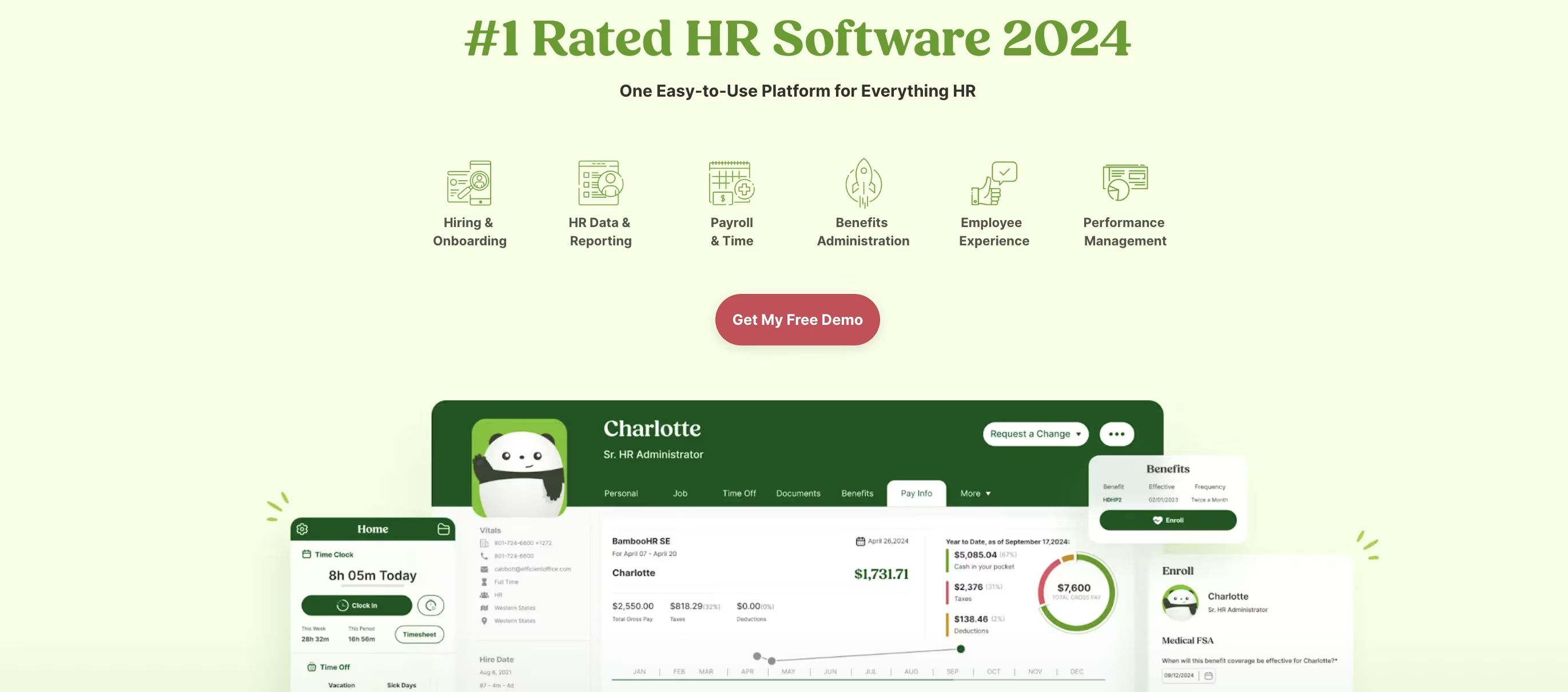
Best for simple core HR for SMBs
If the issue with HiBob is cost and complexity — you don't need half of what it offers and you're paying for it anyway — BambooHR is a natural option. It's clean, intuitive, and built around the workflows small and growing companies actually use every day: employee records, onboarding, time-off, basic performance reviews, and self-service.
BambooHR is generally easier for smaller HR teams to adopt than more complex HRIS platforms. Most teams can get the core setup running without a heavy implementation project, though actual timelines depend on your data and configuration needs.
What it isn't: a deep engagement platform. BambooHR's engagement and performance capabilities exist, but they're lightweight. If you need real survey analytics, action planning, or ongoing performance workflows, you'll want to pair it with a focused tool.
Core strengths
Centralized employee records and document management. Automated onboarding checklists and welcome flows. Employee self-service that reduces HR ticket volume. Clean, intuitive interface that non-technical teams adopt quickly.
Limitations
Engagement analytics are basic. No benchmarking, no action planning, no AI insights. Performance management module is functional but not deeply configurable. Not built for companies that need a serious engagement program.
Feature snapshot
Pricing: BambooHR publishes plan pricing on its website. Check their pricing page for the latest details. Demo available.
Choose BambooHR if you want a solid HRIS foundation without the complexity or price of HiBob, and you're comfortable adding a separate engagement or performance tool when the time comes.
2. Rippling
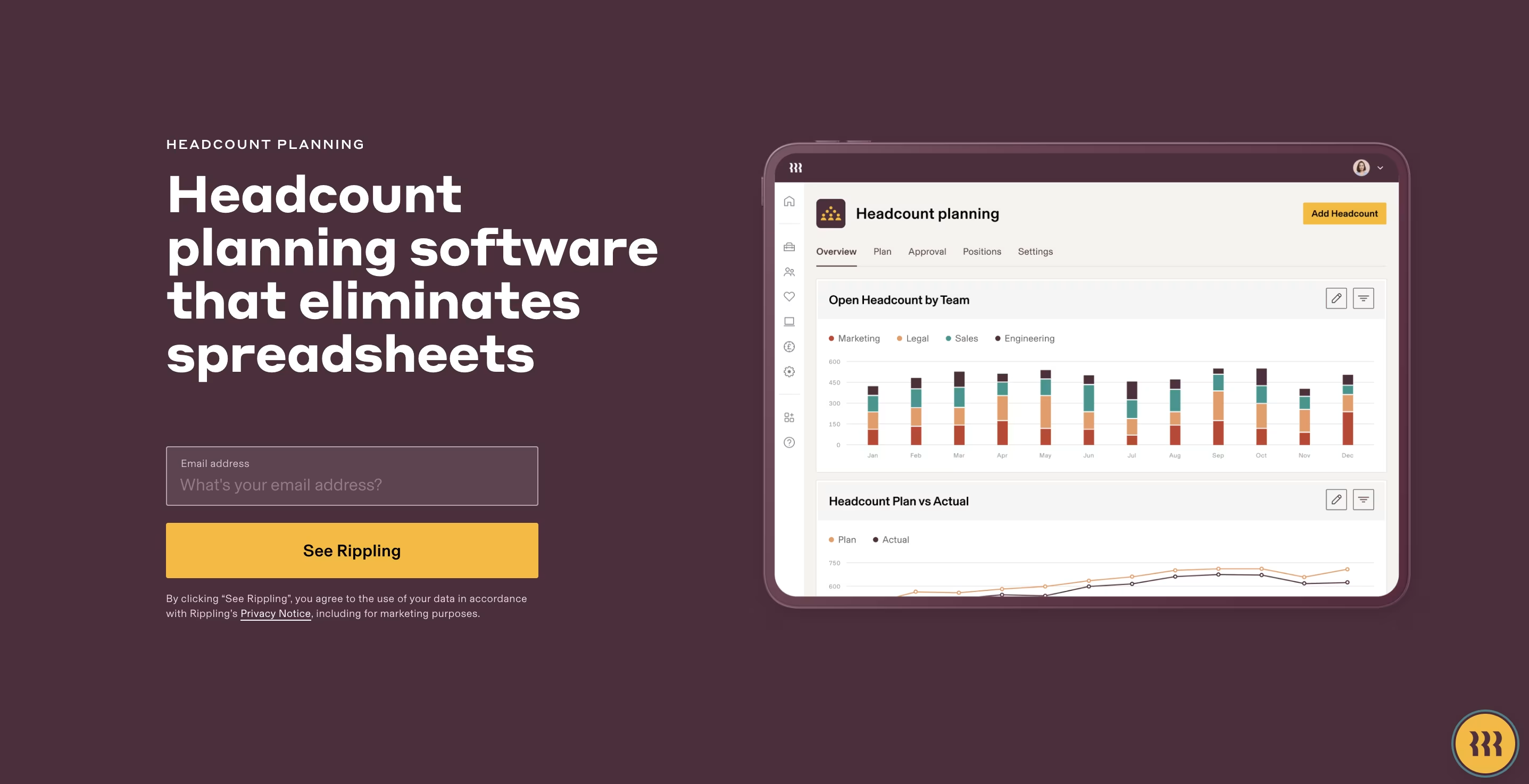
Best for HR, payroll, and IT automation
Rippling is the right call when the problem isn't just HR — it's the fact that HR, payroll, IT access, device management, and app provisioning all live in different systems and create a mess every time someone joins or leaves the company.
It's one of the more automated platforms in this space. When you onboard someone, Rippling can set up their payroll, provision their laptop, give them access to the right apps, and enroll them in benefits — from a single workflow. When someone offboards, the same logic runs in reverse.
That's a completely different value proposition from HiBob. If operational efficiency and automation across HR and IT are your real problem, Rippling is one of the strongest options in this category.
Core strengths
Unified workforce management across HR, IT, and payroll. Multi-country payroll support across a growing number of countries — check Rippling's website for the current list of supported regions. Custom workflow automation using any data point in the system. App and device management built into the same platform.
Limitations
More complex to configure than simpler HRIS tools. If you only need core HR, you may be paying for capabilities you won't use. Engagement and employee experience features aren't a primary focus.
Feature snapshot
Pricing: Rippling uses modular pricing. Check their website or contact sales for the latest plan details.
Choose Rippling if people experience and pure HR workflows aren't your main priority — you need HR, payroll, IT, app access, devices, and workflow automation in one system.
3. ThriveSparrow
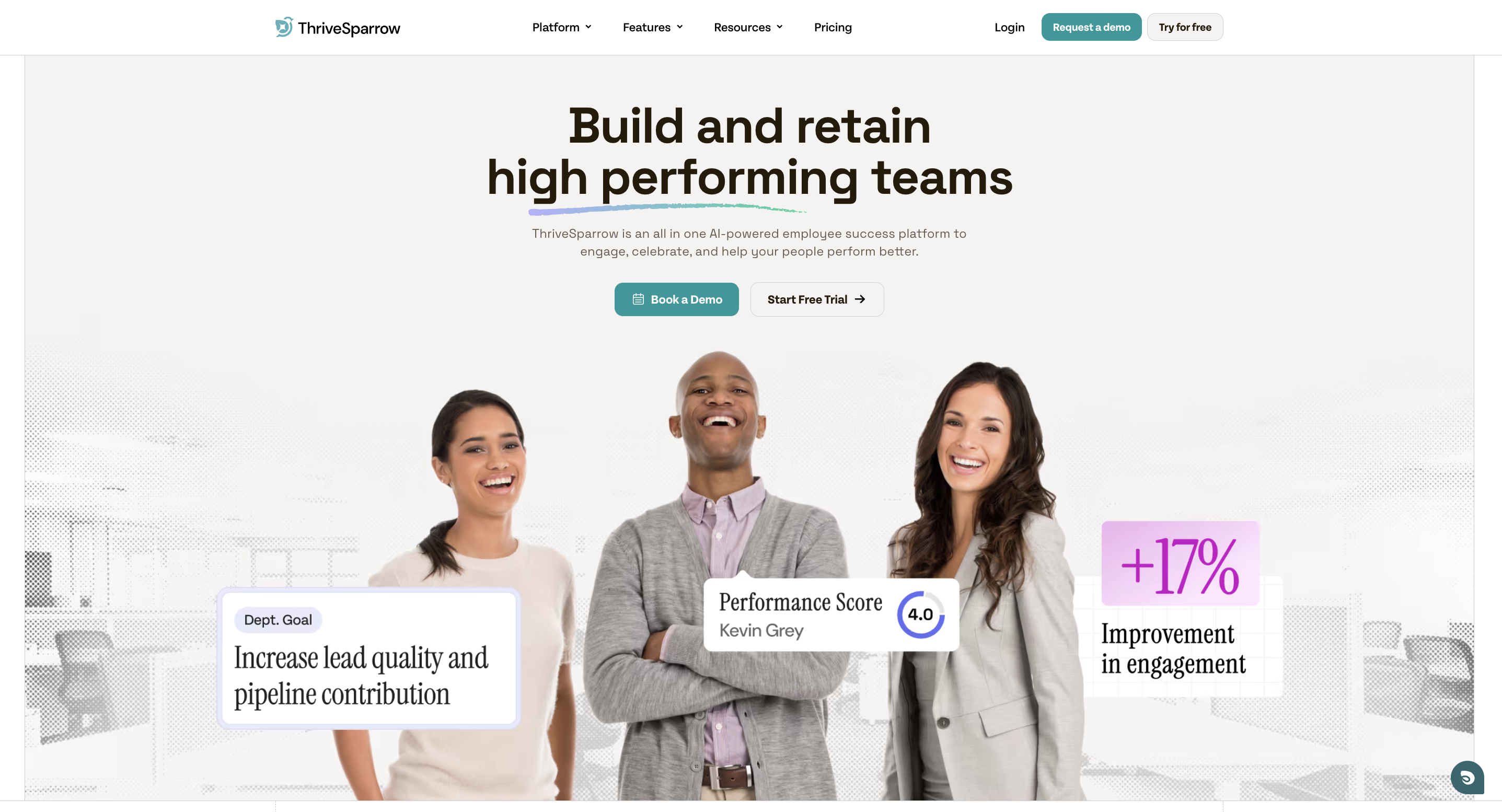
Best for employee engagement, performance, recognition, and action planning
ThriveSparrow is not a full HRIS replacement for HiBob. That distinction is intentional — and it's what makes it genuinely worth considering.
If your core HRIS is working but your employee experience workflows aren't — engagement surveys aren't leading to action, performance reviews feel disconnected, recognition is an afterthought, and managers aren't using the data they're getting — ThriveSparrow is built exactly for that problem.
It covers engagement surveys, performance reviews, recognition, goals and OKRs, and action planning in one place, with AI insights that help HR teams spot patterns in feedback and decide where to act next.
Why teams add ThriveSparrow
The most common scenario is straightforward: teams have an HRIS that handles the operational side fine, but the employee experience layer is missing. Survey results come in and sit in a dashboard. Performance cycles run but feel disconnected from anything meaningful. Recognition may exist, but often sits outside daily workflows.
ThriveSparrow addresses that specific gap. And because it focuses on employee experience workflows rather than full HRIS migration, setup is usually lighter than replacing an HRIS.
Core strengths
ThriveSparrow helps turn engagement survey results into structured action plans — not just charts for HR to interpret, but actual next steps with owners and timelines. You can run pulse surveys, eNPS, and lifecycle surveys from one place. The Kudos module lets people give and receive recognition directly from Slack and MS Teams, which means it fits into how work already happens rather than requiring a separate login. Goals and OKRs connect to performance data, so reviews and development conversations actually have context. And the AI sentiment analysis can help surface early signs of disengagement in open-text feedback.
For teams where recognition is still fragmented across tools, it is also worth comparing dedicated employee recognition software to see what stronger recognition workflows actually look like in practice.
Limitations
Fewer pre-built integrations than full enterprise HRIS platforms. Teams with very large or highly complex HRIS configurations may want to evaluate fit carefully before committing. Check with ThriveSparrow directly about your specific team size and setup.
Feature snapshot
Pricing
- Goals (OKRs): $3/month/employee, billed annually
- Performance: $5/month/employee, billed annually
- Kudos: $2/month/employee, billed annually
- Engage: $3/month/employee, billed annually
- 14-day free trial, no credit card required
Verify current pricing on ThriveSparrow's pricing page before making a final decision.
Choose ThriveSparrow if your core HRIS is working but engagement, performance, recognition, and action planning aren't. It is a strong fit for teams whose real problem is the employee experience layer, not the HRIS itself.
4. Lattice

Best for performance reviews and goal tracking
Lattice is a common answer when a team's specific problem is performance management depth. If your current setup doesn't give managers enough control over how review cycles work, how goals connect to performance outcomes, or how continuous feedback flows between formal reviews, Lattice is worth a serious look.
It's not lightweight. Setup takes time and requires HR ownership to maintain well. But for mid-market teams where performance management is genuinely a priority and the bandwidth is there to run it properly, the depth pays off.
Core strengths
Custom review cycle design — quarterly, biannual, project-based, your call. Visual goal and OKR alignment from individual to company level. Continuous feedback tools alongside formal review cycles. Workforce analytics for identifying high performers and retention risks.
Limitations
Pricing adds up when you add modules. Admin complexity is real — this isn't a tool that runs itself. Recognition features exist but aren't a primary strength.
Feature snapshot
Pricing: Lattice uses quote-based pricing for many plans. Contact Lattice for current pricing.
Choose Lattice if performance management depth and review cycle flexibility are your top priorities, and your HR team has the bandwidth to manage a complex platform.
5. Leapsome
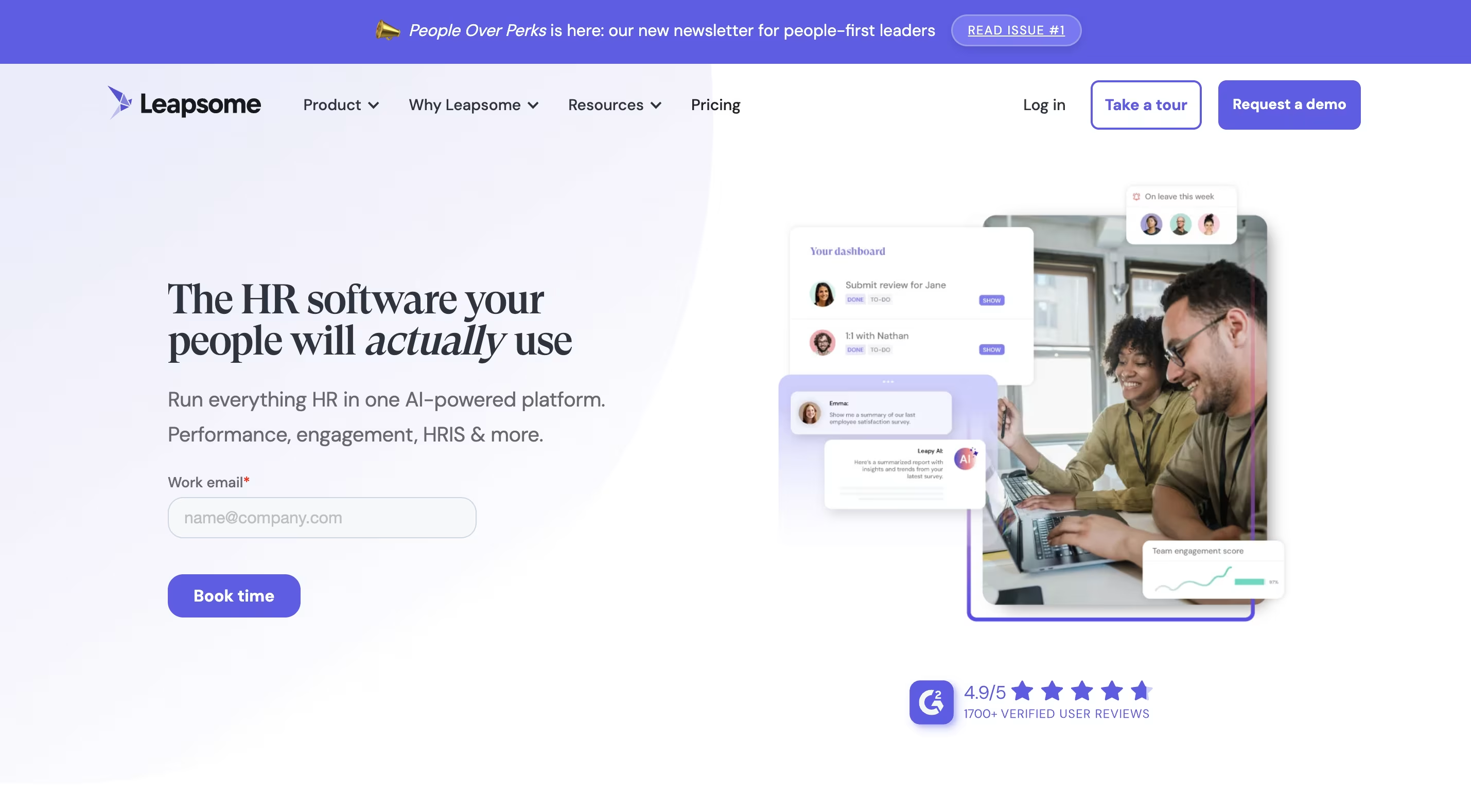
Best for performance, engagement, and learning combined
Leapsome is a strong option for teams that want performance, engagement, goals, and learning in one platform. If you're done managing four separate tools that don't talk to each other, Leapsome is worth the evaluation time.
The key difference from other all-in-one platforms is that the connections between modules are meaningful. OKRs link directly to review cycles. Feedback from reviews feeds into development plans. Pulse surveys close the loop. It rewards investment with workflows that actually make sense together.
Core strengths
OKRs linked to review cycles. Personalized development plans that emerge from review data. Continuous pulse surveys and feedback channels. Recognition built into the same system. AI insights across the suite.
Limitations
A full Leapsome setup can take more planning if you use multiple modules across reviews, goals, engagement, and learning. Pricing isn't public, which slows initial evaluation. Best value when you're actually using all the modules.
Feature snapshot
Pricing: Custom pricing. Demo available.
Choose Leapsome if you want performance, engagement, goals, and learning in one platform and have the HR bandwidth to implement it properly.
6. Personio
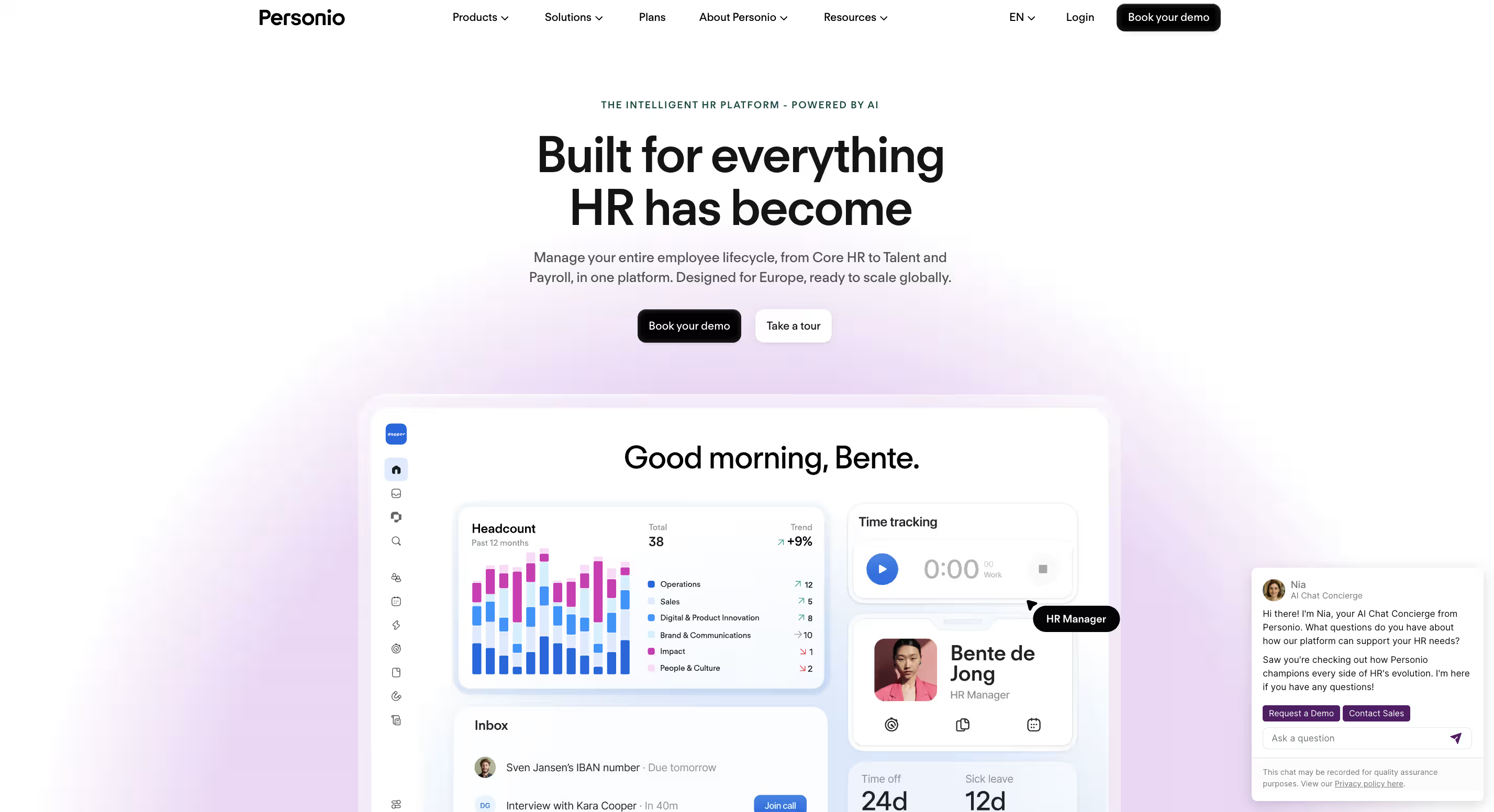
Best for European HR teams
If you're a European company, Personio should be near the top of your list. It's built around European HR requirements — labor law compliance, regional payroll, recruiting workflows, and core HR administration — in a way that generic global platforms often aren't.
HiBob is a solid product for distributed and culture-forward teams, but it's not specifically optimized for European regulatory complexity. If you're in Germany, the UK, Spain, or anywhere else in Europe and you've been running into compliance friction, Personio's regional focus can make it a better fit for many European HR teams.
Core strengths
Core HR designed around European requirements. Built-in recruiting and applicant tracking alongside HR. Digital document management and contract workflows. Time tracking and absence management with local labor law compliance. A wide integration ecosystem — check Personio's integrations page for the current list of available connections.
Limitations
Less relevant for teams outside Europe. Engagement and performance depth is more limited than dedicated platforms for those workflows.
Feature snapshot
Pricing: Personio pricing varies by company size, selected modules, and region. Contact Personio for current pricing.
Choose Personio if you're a European company that needs core HR, recruiting, payroll, and compliance workflows built around European requirements — not adapted from a US-first platform.
7. Deel
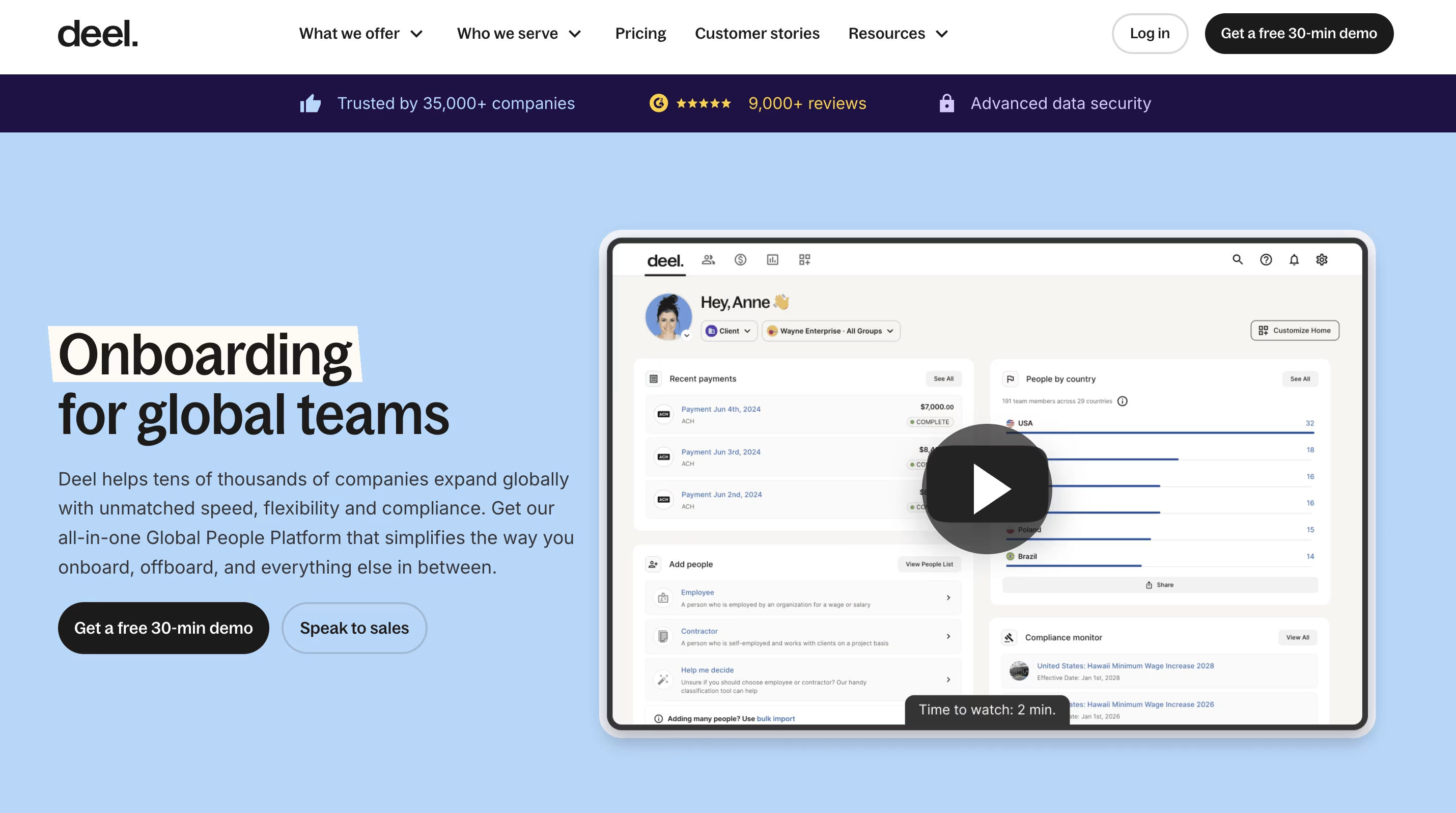
Best for global payroll and contractor management
Teams don't usually switch from HiBob to Deel because HiBob fell short on the HRIS side. They add Deel when they're hiring internationally and realize that managing payroll, compliance, and contractor relationships across a large number of countries needs a specialist platform.
Deel makes international hiring genuinely more manageable. Compliant contracts, local entity setup, contractor payments across a wide range of currencies, and global payroll — all from one dashboard. Check Deel's website for the current list of supported countries and currencies, as availability expands regularly.
Core strengths
Hire full-time employees in a large number of countries without setting up local entities. Manage contractors and employees from a single dashboard. Automated compliance checks and contract generation for each location. 24/7 in-app support.
Limitations
Engagement features are minimal. No performance reviews, 360 feedback, or goal tracking. If employee experience is your gap, Deel won't solve it.
Feature snapshot
Pricing: Deel lists pricing for contractor, EOR, and global payroll plans on its website. Check Deel's pricing page for the latest details.
Choose Deel if your main challenge is managing a globally distributed workforce — payroll, compliance, and contractor relationships — and you'll pair it with a separate engagement tool.
8. Gusto
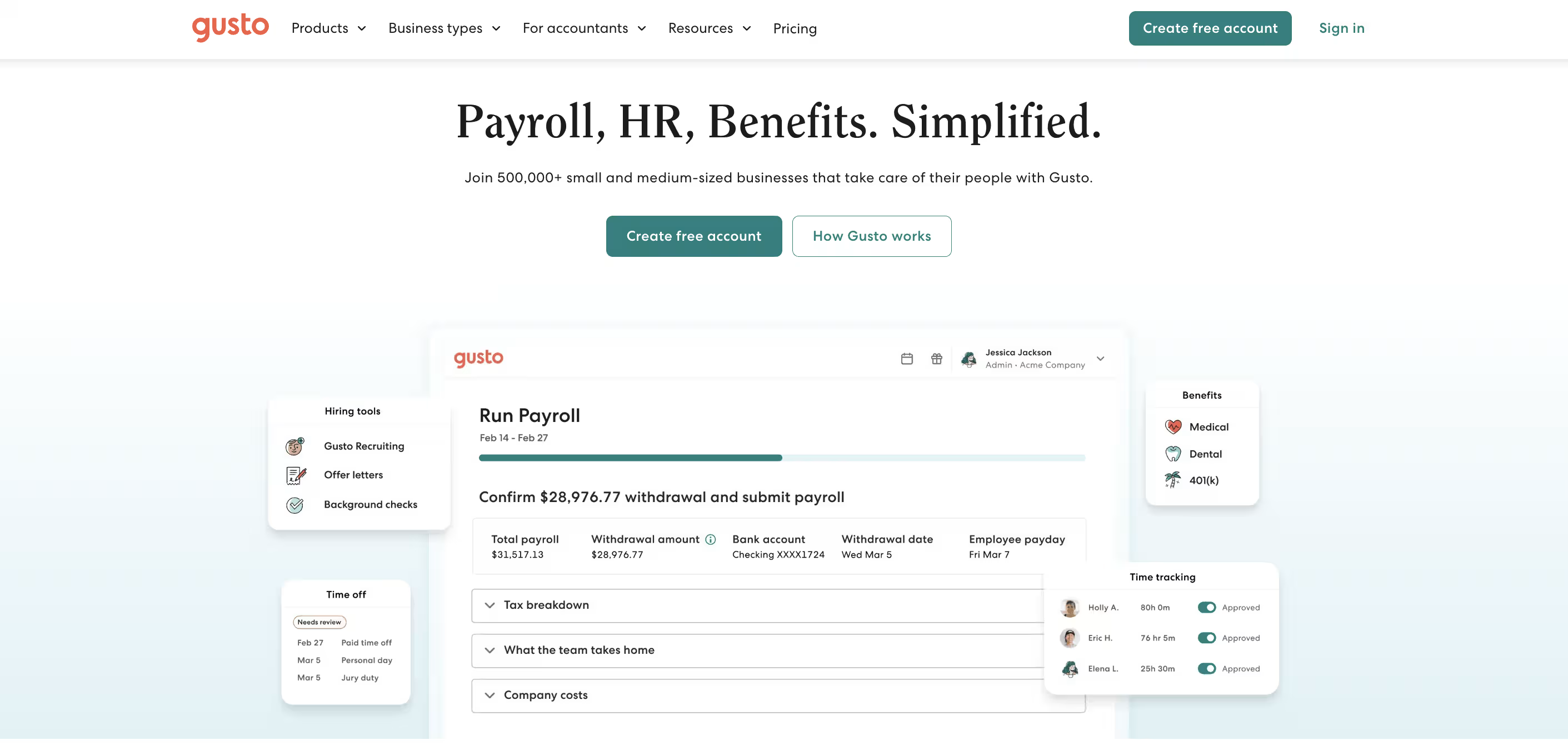
Best for US small business payroll
Gusto started as a payroll tool and grew into a clean, accessible HR platform for small US-based teams. If you're a smaller US company and your main frustration with HiBob is that you're paying for features you don't use, Gusto is a strong option to evaluate.
Payroll runs automatically. Tax filings are handled. Benefits administration is built in. And the onboarding and HR basics are solid without being overwhelming.
Core strengths
Unlimited payroll runs with automatic tax calculations across all 50 states. Benefits administration built in. AutoPilot feature sets payroll to run automatically. Time tracking, hiring, and basic HR in one place.
Limitations
US-only — not suitable for global teams. Engagement and performance depth is limited. Better suited to smaller and growing teams than large enterprises.
Pricing: Gusto publishes plan pricing on its website. Check their pricing page for the latest details, as plans and rates change periodically.
Choose Gusto if you're a small to mid-sized US team that wants simple, reliable payroll, benefits, and basic HR — without the complexity or cost of a full HRIS platform.
9. ADP Workforce Now
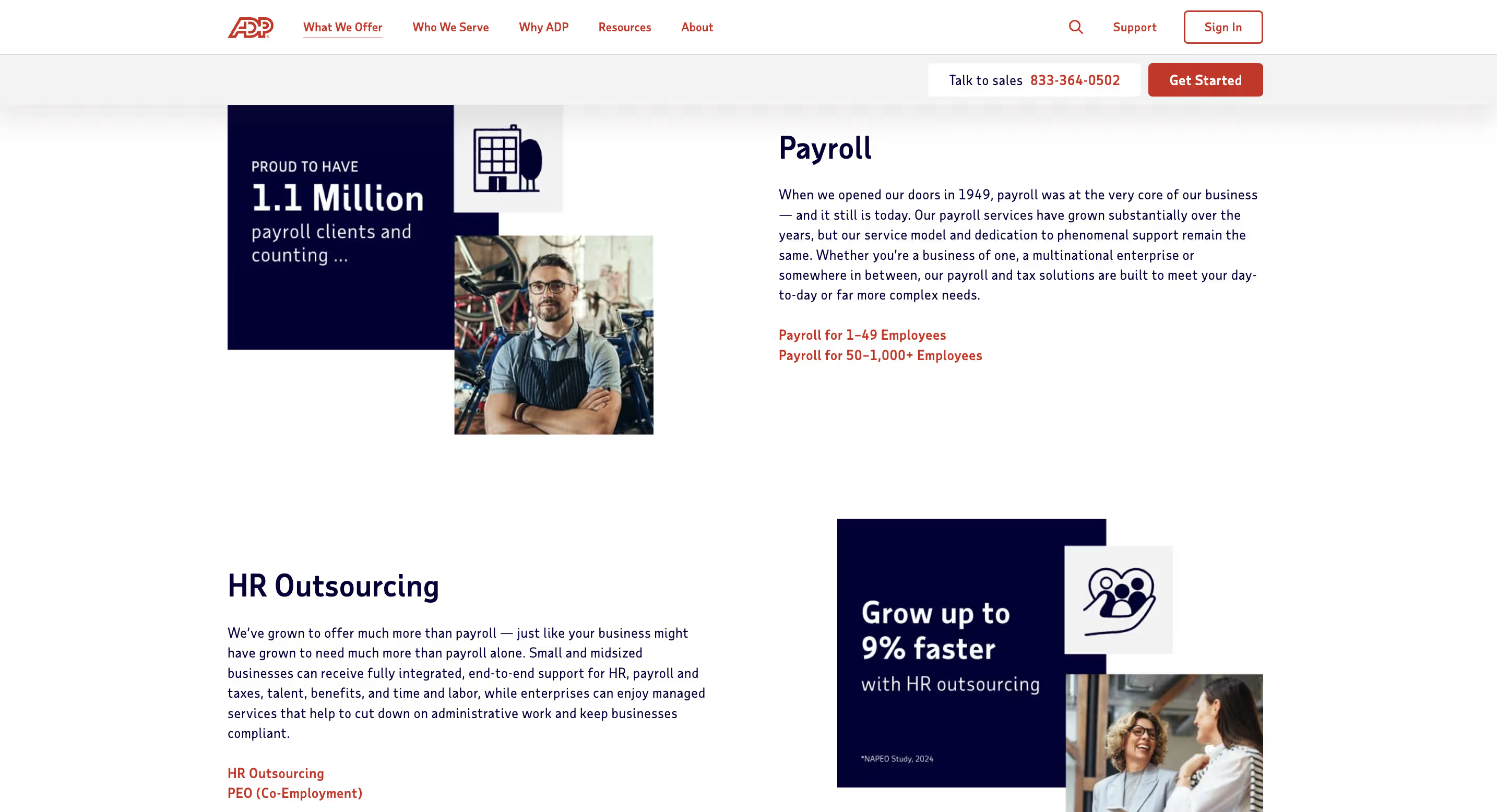
Best for payroll-heavy mid-market teams
If payroll compliance and workforce management at scale are the real drivers of your search, ADP Workforce Now is one of the most established options available. It handles complex payroll scenarios, multi-state compliance, benefits administration, and workforce reporting in a way that few platforms match for mid-market companies.
It's not a lightweight tool and it's not the easiest to set up. But for companies where payroll complexity is genuinely high, the depth is there.
Core strengths
Payroll processing with strong multi-state and compliance coverage. Benefits, time, attendance, and workforce reporting in one system. Long track record and deep integration ecosystem.
Limitations
Interface can feel dated compared to newer platforms. Setup and configuration require meaningful HR or IT involvement. Less focused on the employee experience side.
Pricing: Contact ADP or check their website for current pricing — plan costs vary based on modules selected and company size.
Choose ADP Workforce Now if payroll compliance and workforce management depth at mid-market scale are your primary requirements.
10. Paylocity
Best for US payroll and HCM with employee experience features
Paylocity sits between a pure payroll tool and a full HCM platform. It handles payroll, benefits, compliance, and time tracking well for US companies, but it also has a more developed employee experience side than most payroll-native tools — community features, recognition, surveys — which gives it a broader footprint.
If you're a US mid-market company that wants payroll handled properly but also wants some engagement and communication features built in, Paylocity is worth evaluating.
Core strengths
Strong US payroll and compliance. Built-in community and recognition features alongside HR. Solid mobile app experience.
Limitations
US-focused — not suited for global teams. Engagement features aren't as deep as dedicated engagement platforms.
Pricing: Contact Paylocity or check their website for current pricing.
Choose Paylocity if you're a US-based mid-market company that wants payroll, HR, and some employee experience features in a single platform.
11. Workday
Best for enterprise HCM
Workday is the answer when scale and organizational complexity are what actually drive the requirements. Large enterprises with complex HR operations, workforce planning needs, global presence, and high governance standards tend to land here.
It's genuinely enterprise-grade. The implementation is significant, the cost is significant, and the value is significant — but only at a certain scale. It's not the right answer for most SMB or mid-market teams.
Core strengths
Built for large organizations with complex HR, financial, and workforce planning needs. Deep reporting and analytics. Strong global capabilities and compliance framework.
Limitations
Complex and expensive to implement. Too heavy for most smaller teams. Not where you should look if simplicity or speed to value are priorities.
Pricing: Custom enterprise pricing. Contact Workday's sales team for current details.
Choose Workday if you're a large enterprise with genuinely complex HR operations, and you need a platform built for that scale.
12. SAP SuccessFactors
Best for enterprise talent and HR
SAP SuccessFactors serves large enterprises that need structured talent management, workforce planning, and HR at scale. It's particularly strong for companies already running SAP infrastructure.
Like Workday, the value is clearest at enterprise scale. Mid-market teams will find it overpowered and overly complex for most use cases.
Core strengths
Strong enterprise HR, performance management, and workforce planning. Deep integration into the broader SAP ecosystem. Solid compliance coverage for global operations.
Pricing: Custom enterprise pricing. Contact SAP or a certified partner for current details.
Choose SAP SuccessFactors if you're a large enterprise that needs enterprise talent management and is already invested in the SAP ecosystem.
13. Zoho People
Best for budget-friendly HR for small and growing teams
Zoho People is what you look at when HiBob feels expensive and you need to cover the HR basics without a heavy investment. It's affordable, accessible, and covers the core workflows — employee records, time tracking, leave management, performance reviews, and basic surveys — at a price point that works for smaller teams.
It won't win on depth or sophistication. But for teams that don't need enterprise-level analytics or complex workflow automation, it gets the job done.
Core strengths
Affordable pricing relative to what's included. Core HR, time tracking, and performance basics covered. Part of the broader Zoho ecosystem, which matters if you're already using other Zoho products.
Pricing: Check Zoho People's website for current plan pricing — they publish tiered options based on features.
Choose Zoho People if you need budget-friendly core HR and basic performance management, and you're not looking for deep engagement analytics or complex workflow features.
14. Factorial
Best for SMB HR management
Factorial covers the HR management layer for small and mid-sized businesses — HR administration, time tracking, document management, and payroll support — at a price point and complexity level that makes sense for growing teams that aren't ready for an enterprise platform.
It's particularly relevant in Europe, where its compliance and document management features align well with regional requirements.
Core strengths
HR, time tracking, documents, and payroll support in one place. Clean interface that doesn't require a dedicated HR admin to maintain. European compliance awareness built in.
Pricing: Check Factorial's website for current plan pricing.
Choose Factorial if you're an SMB that needs solid HR management without the cost or complexity of a full enterprise HRIS.
Are You Replacing HiBob Completely or Just Fixing One Gap?
This is the most important question in this entire guide — and it's the one most comparison articles skip entirely.
Not every team looking for HiBob alternatives needs to replace the whole HRIS. Sometimes the core HR setup is working fine. Employee records are there. Time-off is tracked. Onboarding is running. The real frustration is somewhere more specific.
Maybe the issue is:
- Payroll doesn't fit your region or the compliance overhead is becoming unmanageable
- Engagement surveys are going out but nothing is actually changing because of them
- Performance reviews feel like a disconnected process managers tolerate rather than use
- The data is there but no one knows what to do with it
- Pricing feels high for a platform you're using at 40% capacity
- You need stronger tools for global teams, APAC operations, or European compliance
If your core HRIS is doing its job, replacing HiBob entirely may create more disruption than it solves. You'd be migrating employee data, re-training your team, rebuilding integrations, and managing change — all to fix a problem that might have a much simpler answer.
In a lot of these cases, the better move is adding a focused platform for the workflow that's actually broken. If the gap is specifically around surveys, manager follow-through, and employee listening, it also helps to understand what to look for in employee engagement software before assuming you need a full HRIS replacement.
For example, if your real issue is employee engagement, performance, recognition, and action planning, ThriveSparrow can strengthen that layer without you touching your HRIS at all. It's not a full HiBob replacement — it is a strong fit for teams whose real gap is the employee experience layer, not the HRIS itself.
HiBob Pricing: What to Know Before Comparing Alternatives
If you searched "HiBob pricing" and ended up here, you're not alone. This comes up constantly when teams start comparing alternatives.
HiBob does not publicly list standard pricing on its website. What you'll pay usually depends on company size, the modules you select, your region, implementation requirements, and contract length. Most buyers only get a number after going through a sales conversation.
This lack of pricing transparency is one of the more common frustrations buyers mention when they start looking at alternatives — especially if they need to build a business case or compare options internally.
Before you evaluate cost on any HRIS or HR platform, look beyond the license fee. The real number typically includes:
- Implementation costs
- Add-on modules (many platforms price core HR separately from payroll, performance, or engagement)
- Support tiers
- Integration setup
- Contract length and renewal terms
- Per-employee cost increases as you scale headcount
HiBob may feel expensive if you're only using part of the platform. That's a common situation. Teams buy into a full HRIS, end up using three modules out of eight, and wonder why they're paying full price.
Here's a quick pricing-focused view of the alternatives:
If pricing is your concernConsiderNeed simple HR at lower costBambooHR, Zoho People, FactorialNeed payroll-first HR softwareGusto, ADP Workforce Now, PaylocityNeed global payrollDeel, RipplingNeed only employee engagement and performanceThriveSparrowNeed enterprise HCMWorkday, SAP SuccessFactors
HiBob Reviews: Common Pros, Cons, and Buyer Concerns
Buyers often evaluate these areas when comparing HiBob with alternatives.
Common pros users mention:
- Modern, well-designed interface
- Strong core HR workflows
- Useful employee profiles and people data
- Good fit for distributed and culture-focused teams
- Solid people analytics for HR teams
Common concerns buyers evaluate:
- Pricing is not publicly listed, which makes budget planning harder
- Some teams may need more payroll depth than the platform provides
- Smaller companies may not need — or be able to justify — the full HRIS setup
- Talent, engagement, or performance workflows may not be deep enough for every team depending on how the modules are configured
- Some teams prefer simpler reporting or faster implementation timelines
None of these are reasons to dismiss HiBob. For the right company, it's a genuinely solid platform. But if any of those concerns match your situation, they're worth taking seriously.
Where HiBob May Fall Short and What to Look for Instead
1. Payroll
HiBob is an HRIS first. Payroll capabilities vary depending on your region, and for teams that need payroll as the core workflow — especially in the US — a payroll-native platform may serve you better.
If payroll is the issue, look for payroll-first HR tools. The best-fit options here are Gusto, ADP Workforce Now, Paylocity, Deel, and Rippling.
2. Global HR and Compliance
Managing a distributed team across countries isn't just a payroll problem — it's a compliance, contracting, and workforce management problem. If multi-country operations are the real issue, you need a platform built around global workforce management.
Best-fit options: Deel, Rippling, Remote, Workday.
3. Employee Engagement and Action Planning
This is probably the most common gap teams describe when talking about HiBob. The surveys go out. The data comes in. And then nothing happens. Managers don't know what to do with the results. HR can't easily turn insight into action. The feedback loop just stops.
If survey results aren't leading to change, the problem usually isn't that you're measuring the wrong things. It's that your platform doesn't have the structure to help you act on what you find. That's a fundamentally different kind of problem from core HRIS, and it calls for a different kind of tool. A strong employee engagement action plan is usually what separates teams that collect feedback from teams that actually improve because of it.
Best-fit options: ThriveSparrow, Culture Amp, Leapsome, Lattice.
4. Performance Reviews and Goals
For some teams, HiBob's performance module doesn't go deep enough. Review cycle customization feels limited. Goals aren't tightly connected to performance outcomes. Managers aren't using the tools consistently.
If performance workflows are the gap, a performance-first platform will serve you better. And if you're still comparing what “good” looks like in this category, this guide to the best performance management software gives a broader view of the options and tradeoffs.
Best-fit options: Lattice, Leapsome, ThriveSparrow, 15Five.
5. Reporting and Analytics
HiBob has analytics, but teams with complex reporting needs — multiple regions, workforce planning, executive dashboards — sometimes find they need more depth.
Best-fit options: Workday, SAP SuccessFactors, Rippling, ThriveSparrow for engagement analytics.
6. Recruiting and ATS
HiBob covers some recruiting functionality, but if applicant tracking and recruiting automation are your primary need, a dedicated ATS will outperform it.
Best-fit options: Greenhouse, Lever, Workable, Personio for HR + recruiting in Europe.
Best HiBob Alternatives by Use Case
This is worth bookmarking if you're still narrowing things down.
Head-to-Head Comparisons
HiBob vs BambooHR
Choose HiBob if you want a modern HRIS with strong people data, culture-focused workflows, and mid-market HR capabilities.
Choose BambooHR if you want a simpler HRIS for small and growing companies — especially for onboarding, employee records, time-off, and easy admin workflows.
The key tradeoff: HiBob is richer and more feature-complete. BambooHR is generally easier to run with a small HR team and a tighter budget.
HiBob vs Rippling
Choose HiBob if people experience and HR workflows are your main priority.
Choose Rippling if you want HR, payroll, IT, app access, devices, and workflow automation in one system.
The key tradeoff: HiBob goes deeper on the people side. Rippling goes deeper on operational and IT automation. They're solving different problems.
HiBob vs Personio
Choose HiBob if you want a culture-forward HRIS for distributed or mid-market teams.
Choose Personio if you're a European company that needs core HR, recruiting, payroll, and compliance workflows built around European requirements.
The key tradeoff: If you're in Europe and compliance complexity is real, Personio's regional focus can make it a better fit than a platform not built specifically for that context.
HiBob vs Namely
Choose HiBob if you want a modern HRIS with strong employee experience and people analytics.
Choose Namely if you're a US-based mid-market company looking for HR, payroll, benefits, and compliance support in one place.
HiBob vs Lattice
Choose HiBob if you need a full HRIS to manage employee data and core HR workflows.
Choose Lattice if your main need is performance reviews, goals, engagement surveys, and manager enablement.
The key tradeoff: These tools serve different primary purposes. HiBob is the HRIS. Lattice is the performance layer. Some teams use both.
Best HiBob Alternatives by Company Size
Best HiBob Alternatives by Region
Best HiBob Alternatives by Feature Need
What to Check Before Switching from HiBob
Before you start evaluating replacements, it's worth a quick audit of what you're actually dealing with. A lot of teams start this process thinking they need a full platform switch and end up discovering the gap is much more specific.
Before replacing HiBob, check:
- Are you replacing the full HRIS or only one workflow?
- What employee data needs to move, and what does migration actually involve?
- Do you need payroll in the same system, or can you keep it separate?
- What integrations are critical and which of those will break in a switch?
- Do managers actually use the current tool — and if not, why not?
- What reports does leadership actually rely on week to week?
- Do you need regional payroll or compliance support for specific countries?
- How long will implementation realistically take, and who owns it?
- Will the new tool actually solve the real problem, or just create another system to manage?
That last question is the one most teams skip. Adding a new HRIS doesn't automatically fix engagement or performance issues. The tool is only as good as the workflows and habits built around it.
How to Choose the Right HRIS Beyond HiBob
When you're comparing HRIS options more broadly, the biggest mistake is starting with the feature list. Feature lists are long. Every platform has most of them. The more useful starting point is the workflows your team actually uses every week — and the ones they're supposed to use but don't.
Check these areas when evaluating any platform:
- Core HR and employee records
- Payroll and benefits
- Time-off and attendance tracking
- Recruiting and onboarding
- Performance and engagement
- Reporting and analytics
- Integrations with your existing stack
- Mobile accessibility (a platform that doesn't work well on mobile won't get used by most employees)
- Regional compliance requirements
- Ease of use for non-HR employees, not just the admin team
- Total cost — license, implementation, support, and per-employee scaling
The best HRIS isn't the one with the most features. It's the one your team will actually use consistently, that fits your current scale, and that doesn't create more overhead than the problems it's supposed to solve.
Which HiBob Alternative Should You Choose?
The best HiBob alternative depends on what you're actually trying to fix.
If you need a simpler HRIS, BambooHR or Zoho People may be enough. If you need HR, payroll, and IT automation, Rippling may be a better fit. If you need European HR workflows, Personio or Factorial may make more sense. If you need global payroll, Deel or Remote may be better. If you need enterprise HCM, Workday or SAP SuccessFactors may be the right direction.
But if your main issue is employee engagement, performance, recognition, feedback, and action planning, you may not need to replace HiBob at all. You may need a focused employee experience layer — one that strengthens those workflows without touching your HRIS.
That’s where ThriveSparrow fits in — helping you connect engagement surveys, performance, goals, feedback, and recognition in one place, while working alongside your existing systems.
Start your 14-day free trial — no credit card required.
.svg)
Frequently Asked Questions
Q1: What are the best HiBob alternatives in 2026?
The best option depends on what you're trying to fix. For employee engagement, performance, and recognition: ThriveSparrow. For simple HRIS: BambooHR. For HR + IT automation: Rippling. For European teams: Personio. For global payroll: Deel. For US payroll: Gusto or ADP Workforce Now. For enterprise HCM: Workday or SAP SuccessFactors. For performance reviews: Lattice or Leapsome.
Q2: What is the best cheaper alternative to HiBob?
If you want a full HRIS at lower cost, BambooHR, Zoho People, and Factorial are the most commonly evaluated options. For payroll specifically, Gusto keeps pricing transparent and accessible for small US teams. If your real need is only the employee experience layer — engagement, performance, and recognition — ThriveSparrow starts at $2/user/month, which makes it one of the more accessible options for that specific problem. Check each vendor's pricing page for the latest details before comparing.
Q3: Is HiBob better than BambooHR?
It depends on what you need. HiBob is richer — stronger people analytics, more modern interface, built for culture-focused teams. BambooHR is simpler and generally more affordable — better for small to mid-sized companies where core HR is the priority and you don't need the full HRIS depth. If you have a small HR team and a tight budget, BambooHR is often the easier fit. If people data and employee experience workflows matter more, HiBob has more to offer.
Q4: Is Rippling better than HiBob?
For different things, yes. Rippling is a better fit if you need HR, payroll, IT, and app management automated together — especially for distributed teams. HiBob is a better fit if your priority is the people experience side: profiles, culture data, engagement, and HR workflows rather than IT automation. They're genuinely solving different problems, so the comparison depends almost entirely on which problem you actually have.
Q5: What is the best HiBob alternative for employee engagement?
ThriveSparrow is a strong fit for this specific gap. It's built for the engagement, performance, recognition, and action planning workflows that sit on top of an HRIS. If your current setup isn't turning survey data into actual change, that's the problem ThriveSparrow is designed to address. Culture Amp and Leapsome are also worth evaluating for teams that need deeper analytics or want an all-in-one talent management suite.
Q6: What is the best HiBob alternative for global teams?
Deel is the most direct answer for global payroll and contractor management. Rippling covers a broader set of global HR and IT workflows. Remote is worth evaluating for EOR and international employment. Workday is the enterprise answer for large, complex global operations. The right pick depends on whether your main challenge is payroll compliance, contractor management, or full workforce operations across regions.
Q7: What is the best HiBob alternative for APAC teams?
For regional HRMS needs in APAC and India, Darwinbox, Keka, Zoho People, and PeopleStrong are the most commonly used options. They're built around local workflows, compliance requirements, and regional HR operations in a way that global platforms often aren't — things like local statutory compliance, regional payroll structures, and language support tend to be handled better by tools that were built for those markets. For the employee experience layer specifically — engagement, performance, and recognition — ThriveSparrow works well across regions and is worth evaluating alongside whichever HRMS you choose.
Q8: Should I replace HiBob or add another tool?
If your core HRIS is working — employee records are clean, time-off is managed, onboarding runs smoothly — but engagement, performance, or recognition workflows are weak, you probably do not need to replace HiBob.


