










Managing leadership development across 60 countries is hard enough.
Doing it while your assessment platform actively works against you is a different problem entirely.
For the Global Learning & Development team at APL Logistics, every 360-degree feedback cycle started the same way: configuration, reminders, follow-ups, spreadsheets, more reminders. Weeks of coordination work to close out a single assessment round. By the time results came in, the L&D team had spent more time managing the process than using the data.
That's the quiet cost most L&D leaders don't talk about. Not the platform fee — the time. The hours spent chasing evaluators across time zones. The evening emails to regions that hadn't responded. The trust that slowly erodes when employees stop understanding how their scores are calculated.
APL Logistics eventually hit the point most global L&D teams recognize: the administrative overhead of running 360 feedback had become larger than the development work it was supposed to support.
Here's what changed — and what other L&D teams running distributed leadership programs can learn from it.
About APL Logistics

APL Logistics is a global supply chain and logistics provider operating across 60+ countries, with over 6,000 employees, 110+ locations, and 200+ logistics facilities. They serve automotive, retail, consumer, and industrial sectors worldwide. Coordinating leadership development at that scale requires systems that work equally well in Singapore, Brazil, and everywhere in between. That's not a feature request. It's a baseline requirement.
The Problem:
1. When the Assessment Tool Becomes the Bottleneck
Before ThriveSparrow, APL Logistics ran leadership development programs built heavily around 360-degree feedback — used for coaching initiatives, leadership transitions, and measuring growth over time. The platform they were using created three distinct problems that compounded each other.
2. The Scoring Logic Was Broken — and Employees Knew It
This is where trust broke down first. "Not applicable" responses were being counted as part of score averages. If an evaluator marked a competency N/A because it genuinely didn't apply to that person's role, it still dragged the final score down.
Evaluators figured this out. Some abandoned assessments midway rather than risk skewing results. Others needed multiple reminders and still didn't complete. Once employees stopped trusting how scores were calculated, participation became increasingly difficult to sustain — not because people didn't want to engage, but because the math felt arbitrary.
That's a credibility problem. And it's very hard to recover from once it takes hold.
3. The Interface Failed Multilingual Teams
APL Logistics operates across 60 countries. What worked intuitively for one region didn't work for another. Non-native English speakers hit usability barriers. Participation dropped unevenly across regions — not because those teams were less engaged, but because the platform made it harder for them to participate.
Uneven participation in global leadership programs isn't just an operational inconvenience. It creates an equity problem. If your feedback data is systematically skewed because certain regions can't complete assessments easily, every coaching decision downstream is built on incomplete information.
4. The L&D Team Was Running a Coordination Operation, Not a Development Program
Nitika Malik and her colleagues — the team responsible for APL Logistics' global leadership development — spent significant time each week on assessment logistics. Reminder emails. Spreadsheet trackers. Follow-ups across time zones that stretched into evenings.
None of that work developed a single leader.
The programs themselves were growing. Completion rates weren't. Administrative overhead kept climbing. The team couldn't scale leadership development while manually coordinating every assessment cycle from scratch.
Why They Chose ThriveSparrow
When APL Logistics evaluated alternatives, they prioritized operational fit over feature lists.
1. Scoring transparency was non-negotiable. "Not applicable" responses needed to be handled correctly — excluded from averages, not counted against employees. That single fix addressed the biggest source of distrust with the previous system.
2. Multilingual support had to actually work. Not just exist as a checkbox feature. The platform needed to support consistent participation across regions with different primary languages. ThriveSparrow's multilingual survey support across 100+ languages addressed this directly.
3. Setup needed to be self-sufficient. The L&D team couldn't afford to depend on technical support for every configuration change. Admins needed to configure assessments, test workflows, and roll out programs without opening a support ticket every time.
4. Customer responsiveness mattered. When APL Logistics raised feedback or requested improvements, the ThriveSparrow team acted on it. That might sound like a soft factor. For a global team with highly specific program requirements, it's actually decisive.
How They Implemented It
APL Logistics integrated ThriveSparrow's 360-degree feedback into three core program structures:
- Leadership transition programs — supporting individual contributors moving into management roles
- Coaching initiatives — giving coaches structured, reliable feedback data to work from
- Pre- and post-program assessments — measuring whether leaders actually improved over time
That last point matters more than it might seem. Running 360 feedback once gives you a snapshot. Running it before and after a development intervention tells you whether the program worked. APL Logistics built measurement into the program design itself — not as an afterthought.
The Before-and-After Framework
Each leadership cohort followed a structured sequence:
- Pre-program 360 assessment — establish baseline strengths and development areas
- Development intervention — coaching, training, structured support
- Post-program 360 assessment — measure behavioral change and growth
This gave the L&D team demonstrable evidence of program impact. Not anecdotal. Not survey sentiment. Actual before-and-after behavioral data at the cohort level.
AI-Generated Development Plan Cut a Week From the Process
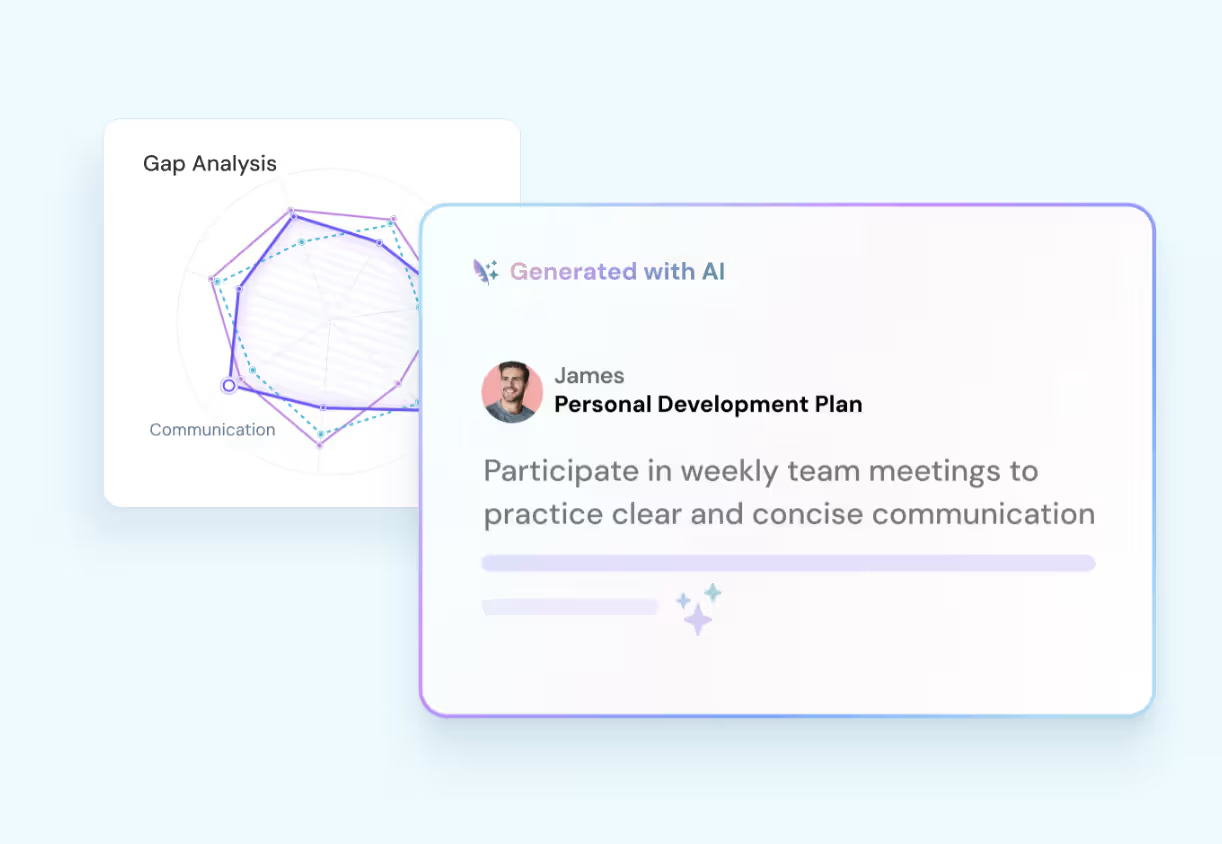
One feature that materially accelerated turnaround: AI-powered Personal Development Plan generation.
Instead of manually synthesizing feedback into development recommendations for each leader, the platform generated structured PDP drafts automatically. Coaches reviewed them, customized them, added context specific to each person — but they started with a structured draft instead of a blank document.
That saved roughly one week per leadership cohort. Across multiple cohorts running simultaneously, that time compounds quickly. Coaches started sessions sooner. Development work began earlier. The cycle from assessment to action got meaningfully shorter.
Take a look at a sample ThriveSparrow 360-degree feedback report — exactly the kind of structured output APL Logistics' coaches used to cut reporting turnaround by one week per cohort.

.svg)
The Results
OutcomeResultSelf-completed evaluations75% increaseReporting turnaround1 week faster per cohortManual follow-up volumeReduced substantiallyParticipation consistency across regionsImproved across distributed global teamsLeader trust in feedback scoringRestored through transparent scoring logic
1. 75% More Self-Completed Evaluations
This is the headline number — and it's a direct consequence of fixing the two root causes simultaneously: scoring clarity and interface usability.
When employees understood how their scores were calculated and when the interface didn't create barriers for non-native speakers, completion rates jumped. Less reminder fatigue. Fewer abandoned assessments. More consistent data across the full leadership cohort.
2. One Week Faster Per Cohort — Compounded Across Programs
AI-generated PDPs cut one week from each reporting cycle. For a team managing multiple leadership cohorts in parallel, that's not a marginal efficiency gain. It's coaches starting sooner, development interventions landing faster, and programs completing on schedule rather than running weeks behind.
3. The L&D Team Got Their Time Back
This outcome doesn't fit neatly into a metric, but it's arguably the most significant one.
Time previously spent chasing evaluators went back into coaching and program design. The coordination overhead that had been consuming the team's capacity — the reminder emails, the spreadsheet trackers, the cross-timezone follow-ups — shrank substantially. The L&D team could spend time on work that actually developed leaders.
That's what the platform was supposed to enable in the first place.
4. Participation Became Equitable Across Regions
Employees across different countries and different primary languages could complete assessments without hitting usability barriers. Participation became more consistent globally — which meant the feedback data became more representative, and coaching decisions became better informed.
Your L&D team should be developing leaders — not chasing evaluators. Try ThriveSparrow free for 14 days →
.svg)
What L&D Teams Running Global Programs Can Learn From This
These aren't generic best practices. Each one maps directly to something APL Logistics encountered.
1. Scoring Credibility Is the Foundation — Not a Feature
APL Logistics didn't lose participation because employees were disengaged. They lost it because the scoring logic was opaque and employees stopped trusting the results. Once that trust breaks, participation becomes an uphill battle regardless of how many reminders you send.
Before deploying any 360 platform globally, test the scoring logic with real scenarios. What happens when someone marks N/A? How are incomplete assessments handled? If you can't explain the math simply to an employee who asks, your platform has a credibility problem waiting to surface.
2. Multilingual Support Needs to Be Tested, Not Assumed
Most platforms claim multilingual support. APL Logistics learned that what works in one region doesn't automatically work in another. Non-native English speakers hit barriers that showed up only in actual use — not in demos.
Test with real users in at least three different regions before committing. Participation drop-off in specific geographies is almost always a usability problem, not an engagement problem.
3. Measure Before and After — or Don't Measure at All
A single 360 assessment tells you where someone is. It tells you nothing about whether your program moved them anywhere. APL Logistics built pre- and post-program assessments into their program structure from the start — which meant they could demonstrate ROI on coaching investments with actual behavioral data, not program attendance rates.
If you're running leadership development without before-and-after measurement, you're spending budget on programs you can't prove are working.
4. Administrative Overhead Compounds Faster Than You Think
One manual follow-up per person per cycle sounds manageable. Across 50 leaders, two cohorts, multiple regions, and weekly reminders — it becomes the L&D team's primary job. APL Logistics reached that tipping point when their programs started growing faster than their capacity to coordinate them manually.
Look for platforms that automate completion tracking and reminders. Not because chasing people is hard — but because every hour your L&D team spends on logistics is an hour not spent on developing leaders.
5. AI Assistance in PDPs Works Best as a Starting Point, Not an Endpoint
APL Logistics used AI-generated development plans to save time — not to replace coaching judgment. Coaches reviewed every PDP, customized it, and added context specific to each person. But starting with a structured draft instead of a blank document saved roughly a week per cohort.
The gain isn't in removing human judgment from the process. It's in removing the blank-page problem from every single reporting cycle.
The Bigger Picture
APL Logistics didn't just replace a 360 feedback platform.
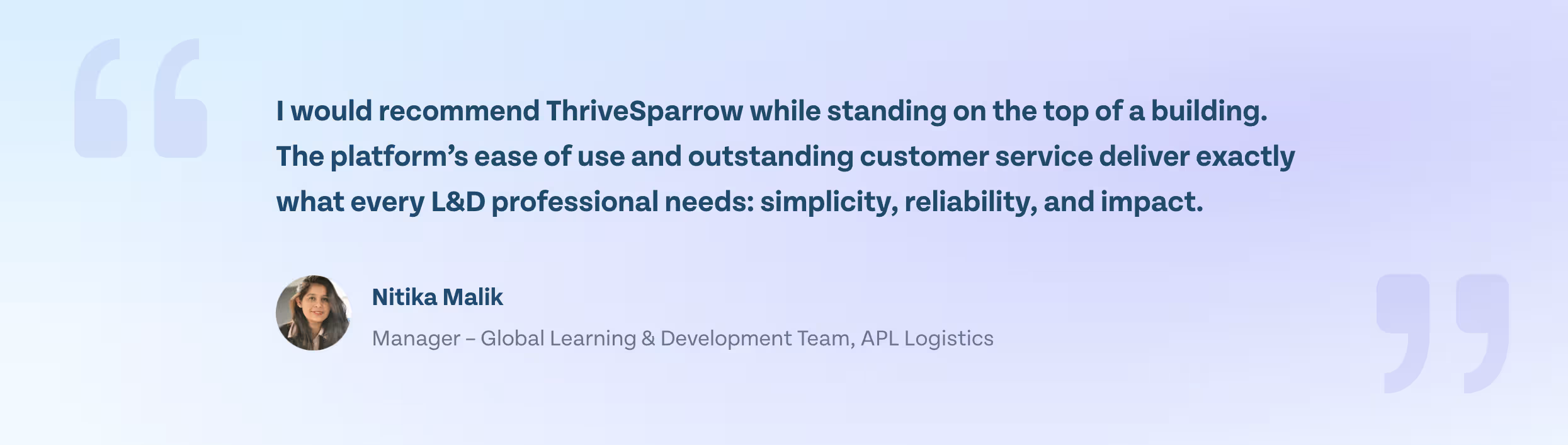
They reclaimed the capacity their L&D team needed to actually run leadership development — instead of spending it on coordinating assessments. The 75% completion lift and one-week faster turnaround are real numbers. But the operational shift underneath them is what made those numbers possible: a team no longer drowning in coordination work, running programs that could scale, and producing data that leaders and coaches actually trusted.
That's what good 360 feedback infrastructure is supposed to do. It's not supposed to be the hard part. Run 360 Feedback That Actually Gets Completed When assessment administration becomes the biggest item on your L&D team's to-do list, leadership development takes a back seat.
ThriveSparrow's Performance module gives global L&D teams transparent 360-degree feedback, AI-generated development plans, and multilingual assessment support — so your team spends time developing leaders, not chasing evaluators.
See how it works for global teams →