Bradford Factor Calculator
Measure employee absence impact instantly with our Bradford calculator. Simply enter the number of absence spells and total days missed, and the tool does the rest.

Calculate your Bradford Factor
Bradford Factor Calculator: Calculate Your Absence Score in Seconds
Managing employee absence is one of the biggest challenges HR teams face. Unplanned absences disrupt workflows, increase costs, and place extra pressure on the employees who do show up. The Bradford Factor gives you a clear, numerical way to measure how disruptive an employee’s absence pattern really is — so you can take action before small problems become big ones.
Use our free Bradford Factor calculator below to get an instant score. Simply enter the number of absence spells and total days missed, and the tool does the rest.
What Is the Bradford Factor?
The Bradford Factor (sometimes called the Bradford Score or Bradford Points) is a formula developed by the Bradford University School of Management. It measures the impact of employee absence on an organisation by weighting frequent, short-term absences more heavily than occasional, longer ones.
The reasoning is simple: an employee who takes ten separate single-day absences causes far more operational disruption than an employee who is off for ten consecutive days due to surgery. With the consecutive absence, you can plan cover. With sporadic absences, every new spell forces the team to scramble.
The Bradford Factor turns this principle into a single number that HR teams can track, compare, and act on.
The Bradford Factor Formula: How Is It Calculated?
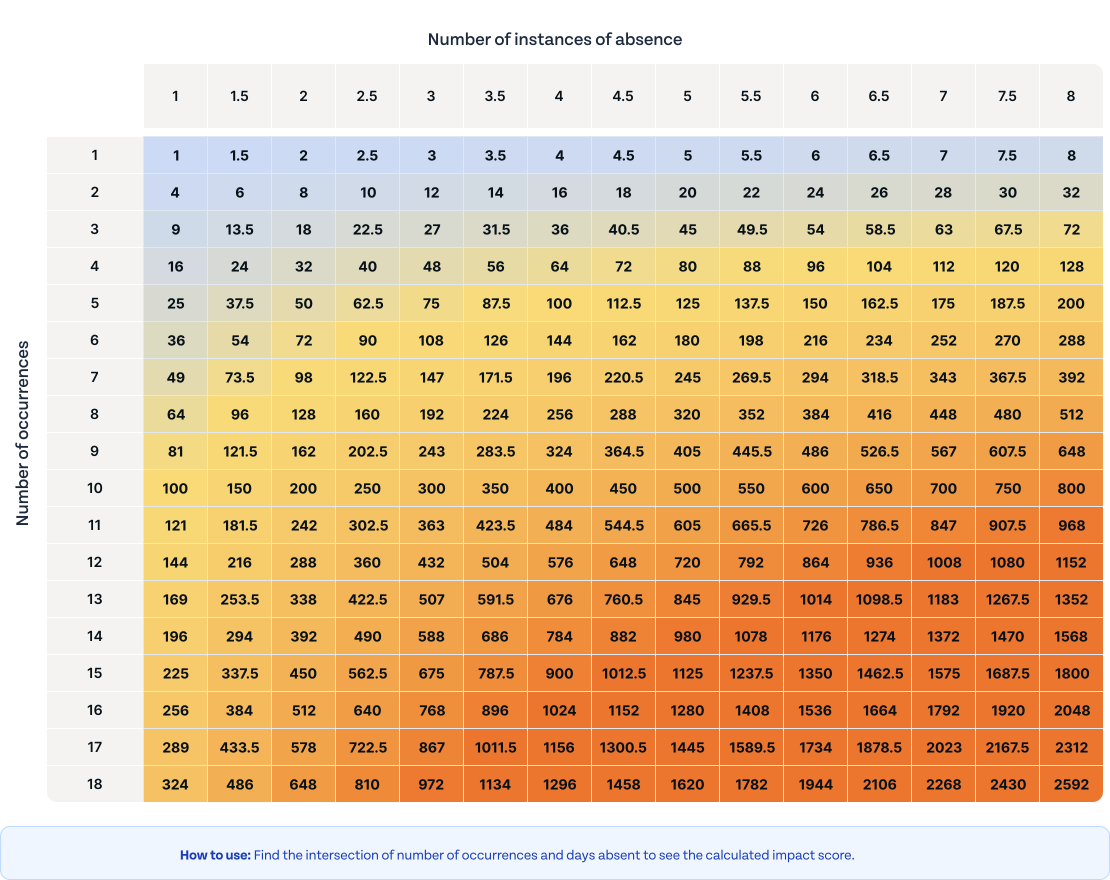
The formula is: B = S² × D
Where:
- B = Bradford Factor score
- S = Number of separate absence spells (instances) in a rolling 52-week period
- D = Total number of days absent across all spells in the same period
The squaring of S is what makes frequent absences disproportionately expensive in the scoring. Two spells of absence will always produce a higher score than one spell of the same total duration.
Bradford Factor Worked Examples
Let’s say both Sarah and James have been absent for a total of 10 days in the past year. Their Bradford Factor scores tell very different stories:
Same total absence. Wildly different scores. This is exactly the point — the Bradford Factor highlights the pattern, not just the volume.
Bradford Factor Trigger Points: What the Scores Mean
Most organisations set trigger points — score thresholds that prompt a specific management action. While every company should set its own thresholds based on industry and culture, here is a widely used framework:
Bradford Factor Scale
A visual chart makes the scoring system instantly understandable. Place a horizontal colour-coded bar showing the scoring bands from green (0–50) through amber (51–124) to red (650+), with icons representing the recommended HR action at each level.
How to Use the Bradford Factor in Your Organisation
Step 1: Define Your Rolling Period
The standard measurement window is 52 weeks (one year), calculated on a rolling basis. Some organisations reset annually on a fixed date (e.g. 1 January or the start of the financial year), while others use a true rolling window that recalculates every day. The rolling approach is more accurate but harder to manage manually.
Step 2: Record Every Absence Spell Accurately
An absence spell is one continuous period of absence, regardless of how many days it lasts. If an employee calls in sick on Monday, comes to work Tuesday, then calls in sick Wednesday — that’s two spells, not one. If they’re off Monday through Friday, that’s one spell of five days.
Consistency is critical. Ensure all managers record absences the same way, using the same system. Inconsistent recording will produce unreliable scores.
Step 3: Set Trigger Points That Fit Your Culture
The thresholds above are a starting point. Adjust them based on your industry (warehouse operations may need tighter thresholds than creative agencies), your company size, and your values. Document your trigger points in your absence policy so employees know what to expect.
Step 4: Have the Conversation, Not Just the Calculation
A high Bradford Factor score is a signal, not a verdict. Before taking formal action, sit down with the employee. There may be underlying health issues, caring responsibilities, workplace stress, or personal circumstances that the number alone can’t capture. The goal is to support the employee back to regular attendance, not to punish them.
Is the Bradford Factor Fair? Pros, Cons & Limitations
Advantages
- Provides an objective, consistent measure across all employees
- Highlights disruptive absence patterns that might otherwise go unnoticed
- Gives HR teams a defensible basis for starting absence conversations
- Easy to calculate and understand (the formula is simple)
- Widely recognised in UK employment law and HR best practice
Limitations
- Does not distinguish between absence types (e.g. a migraine vs. a family emergency vs. a mental health day)
- Can unfairly penalise employees with disabilities or chronic conditions protected under the Equality Act 2010
- Ignores context — an employee going through cancer treatment will score high, but disciplinary action would be both unfair and potentially unlawful
- Can discourage employees from taking legitimate sick days (presenteeism), which ultimately harms productivity
- Only measures short-term absence patterns; long-term sickness is better managed through occupational health referrals
What Should You Do After Calculating the Score?
A Bradford Factor score is only useful if it leads to the right action. Here’s what smart HR teams do at every level — and how to act before a small pattern becomes a serious problem.
Score 0–50 — All Good. Keep It That Way.
Nothing to worry about. But don’t let good attendance go unnoticed, people who feel appreciated keep showing up. A quick shout-out, a peer recognition, even a simple “thanks for being reliable” in a team meeting matters more than most managers think.
→ ThriveSparrow’s Kudos makes this effortless — recognise someone in 10 seconds flat, and the whole team sees it.

Score 51–124 — Something Might Be Off. Ask, Don’t Assume.
This is the stage most companies ignore — and it’s exactly where you should pay attention. The absences might be random. But they might also be the first sign that someone’s struggling with their team, their workload, or their workspace.
Don’t schedule a formal meeting. Instead, send a short, anonymous pulse survey:
- "Are you facing any challenges in your team?"
- ""Do you feel supported by your manager?" “Is anything about your work environment making it harder to do your best work?”
- Three questions. Two minutes. You’ll know more from the answers than from any spreadsheet.
Instead of waiting for Bradford scores to rise, check in early. A quick pulse survey can surface small challenges before they turn into bigger attendance patterns.
Use ThriveSparrow’s Bradford Factor Pulse Survey Template below to understand what employees need to work better going forward.
You can trigger these surveys in minutes, and the AI sentiment analysis reads between the lines — flagging frustration, disengagement, or team friction before they turn into a pattern.
Score 125–399 — The Pattern Is Real. Have the Conversation.
At this point, you can’t chalk it up to bad luck anymore. Frequent short absences are hitting the team, and ignoring it will make things worse for everyone — including the employee.
Schedule a proper 1-on-1 with their manager. Not a disciplinary chat — a real one. Come prepared. What have their survey responses been saying? Are there signs of burnout, conflict, or disengagement? Lead with “how are you doing?” not “why were you off?” Most of the time, people just need someone to ask the right question.
You've identified the pattern. Now have the conversation that actually addresses it. ThriveSparrow's 1-on-1 tools arm managers with guided agendas, real survey context, and clear next steps — so nothing important gets left unsaid.
.avif)
Score 400+ — This Is Urgent. Build a Plan, Not a Paper Trail.
At this level, absence is seriously impacting operations. But here’s what separates good HR teams from average ones: they don’t reach for the warning letter first. They reach for the full picture.
Why is this person consistently absent? Is it burnout? A toxic team dynamic? A role that doesn’t fit? A health issue they haven’t disclosed?
Combine the Bradford score with engagement data, recent feedback, and performance trends to understand the root cause. Then build a personal development plan together — clear goals, regular check-ins, genuine support.
And if one team’s scores are climbing across the board? The problem isn’t the individuals. It’s the environment. That’s when you need to zoom out.
→ ThriveSparrow’s Infer AI connects survey data, performance metrics, and engagement trends into one view — so you spot whether it’s one person struggling or an entire team heading for burnout.
The Bradford Factor gives you the score. What you do next is what actually reduces absence.
Try ThriveSparrow free for 14 days! → Turn absence data into action.
Bradford Factor FAQ
1. Does the Bradford Factor reset every year?
Most organisations reset annually on a rolling 52-week basis. Some use a fixed annual reset date aligned with the financial year. The rolling method is more accurate for identifying ongoing patterns.
2. Can I use the Bradford Factor for part-time employees?
Yes, but you may need to adjust your trigger thresholds. A part-time employee working 2 days per week will naturally have fewer absence spells than a 5-day-per-week employee. Some organisations pro-rata the thresholds accordingly.
3. Is the Bradford Factor legal?
Yes, using the Bradford Factor is legal in the UK and most countries. However, you must ensure that its application does not discriminate against employees with disabilities or long-term health conditions. Under the Equality Act 2010 (UK), reasonable adjustments may include excluding disability-related absences from the Bradford calculation.
4. What counts as one absence spell?
One continuous period of absence. If an employee is off Monday through Wednesday, that’s one spell. If they return Thursday then are off again Friday, that’s two spells. Bank holidays and scheduled leave days in between do not break a spell.
5. What if an employee has a high score but a genuine health condition?
The score is a starting point, not a conclusion. For employees with known health conditions, exclude those absences from the calculation or adjust the trigger points. Always consult with occupational health and ensure you meet your legal obligations.
6. Can I calculate the Bradford Factor for an entire team?
Absolutely. Some HR teams calculate average Bradford scores per department to identify team-level issues (e.g. a toxic manager, unsafe working conditions, or burnout). If one team’s average score is significantly higher than others, it’s worth investigating the root cause.
7. How is the Bradford Factor different from a simple absence rate?
A simple absence rate (total days absent ÷ total working days) treats all absences equally. The Bradford Factor weights frequency over duration, making it far better at identifying disruptive, short-term absence patterns.
Related Free HR Tools from ThriveSparrow
- eNPS Calculator — Measure employee loyalty and satisfaction in seconds
- Turnover Rate Calculator — Calculate your employee turnover rate instantly
- Free OKR Generator — Generate clear, outcome-driven OKRs for your teams
- HR Toolkit — Access ready-to-use resources to streamline HR operations

















Make everyday a success story for your people