












Every HR leader has lived this moment:
- The 360 degree feedback cycle closes
- The dashboard lights up green
- The average competency score ticks up half a point from last year.
Someone on the leadership team calls it a win. Six months later, the same manager is running the same one-way meetings, the same peer is still hoarding credit, and the same "collaboration" score that looked so healthy on paper hasn't translated into a single visible behavior change.
Nobody lied on the survey. That's the uncomfortable part. The scores are technically accurate and still useless. The reason usually isn't the competency model, the rating scale, or even the manager being rated.
It's one of the most common anonymous feedback problems in 360 programs, and the very specific way it breaks down once you look at it closely: a quiet, structural gap in 360 review reliability that no dashboard flags on its own.
Anonymity was supposed to buy you honesty. It bought you something else.
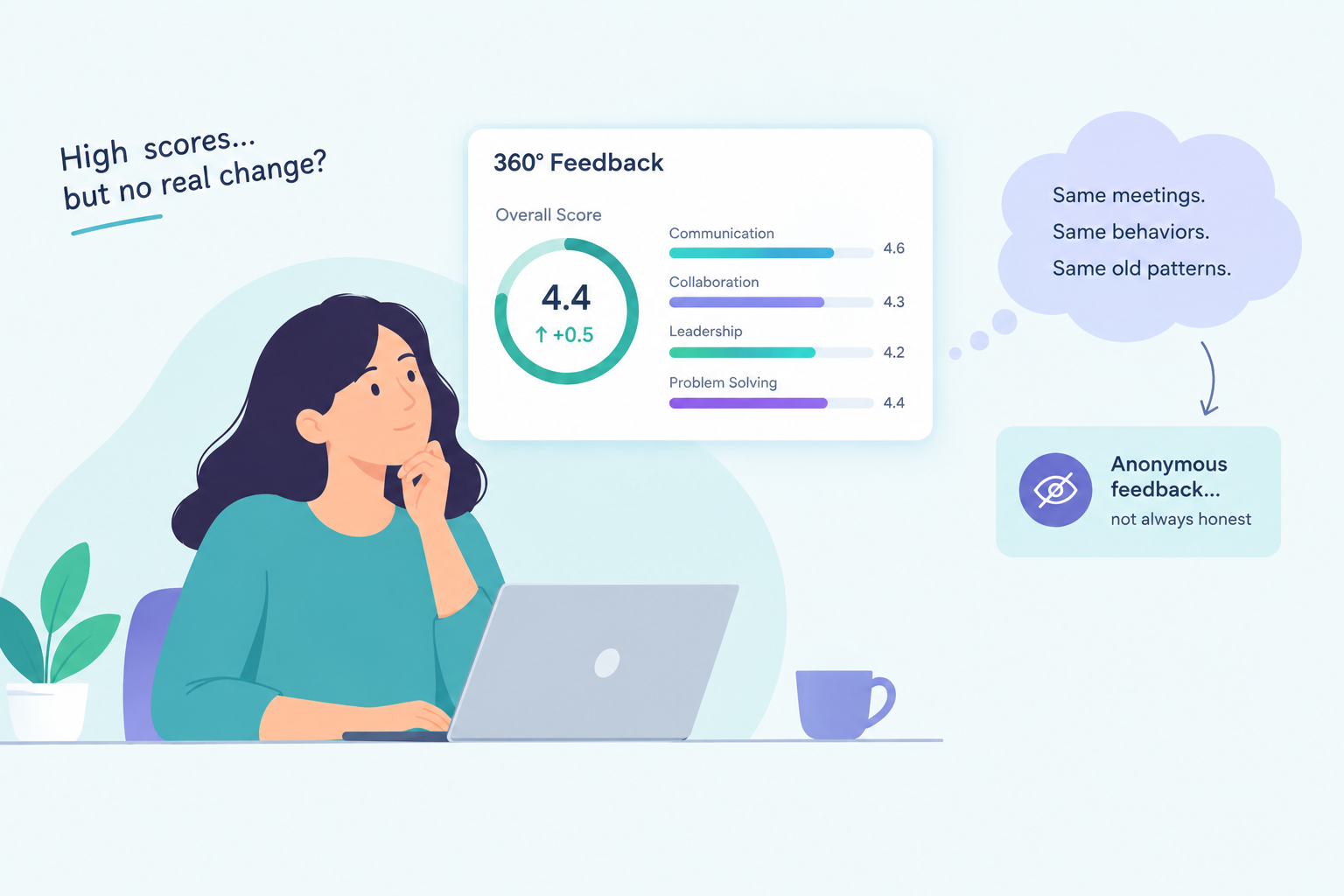
The entire architecture of 360 degree feedback rests on one bet: strip away identity, and people will tell the truth. It's a reasonable bet.
Research on rater behavior consistently shows that when people believe their responses can't be traced back to them, they're more willing to raise something critical instead of defaulting to safe, generic praise, which is exactly why so many programs treat anonymity as shorthand for 360 feedback honest responses.
But "more willing to be honest" and "will be honest" are not the same thing. Anonymity removes the risk of speaking up. It does nothing to build the belief that speaking up is worth it. Those are different problems, and most 360 programs only solve the first one which is where anonymous feedback problems start to show up in the data without ever showing up as a red flag.
Here's the gap in practice. A direct report sitting down to rate their manager isn't thinking "is this survey anonymous?" They're thinking:
- Will this actually change anything, or is it going into a drawer?
- Could my manager guess it was me anyway, I'm the only one on the team who deals with this?
- Last cycle I said something honest and nothing happened. Why would this time be different?
None of those questions are answered by a checkbox that says "your responses are confidential." And when the answer to any of them is no, raters do something predictable: they don't lie, exactly, they round up.
A 3 becomes a 4. A blunt comment becomes a vague one. The sharpest, most useful piece of feedback in someone's head never makes it into the free-text box at all. It gets left in the parking lot, the group chat, the exit interview six months later.
This is the quiet failure mode of anonymous 360 degree feedback not fabrication, but erosion. And it's nearly invisible in the aggregate data, because everyone is eroding their honesty in roughly the same direction: up.
The math makes it worse, not better
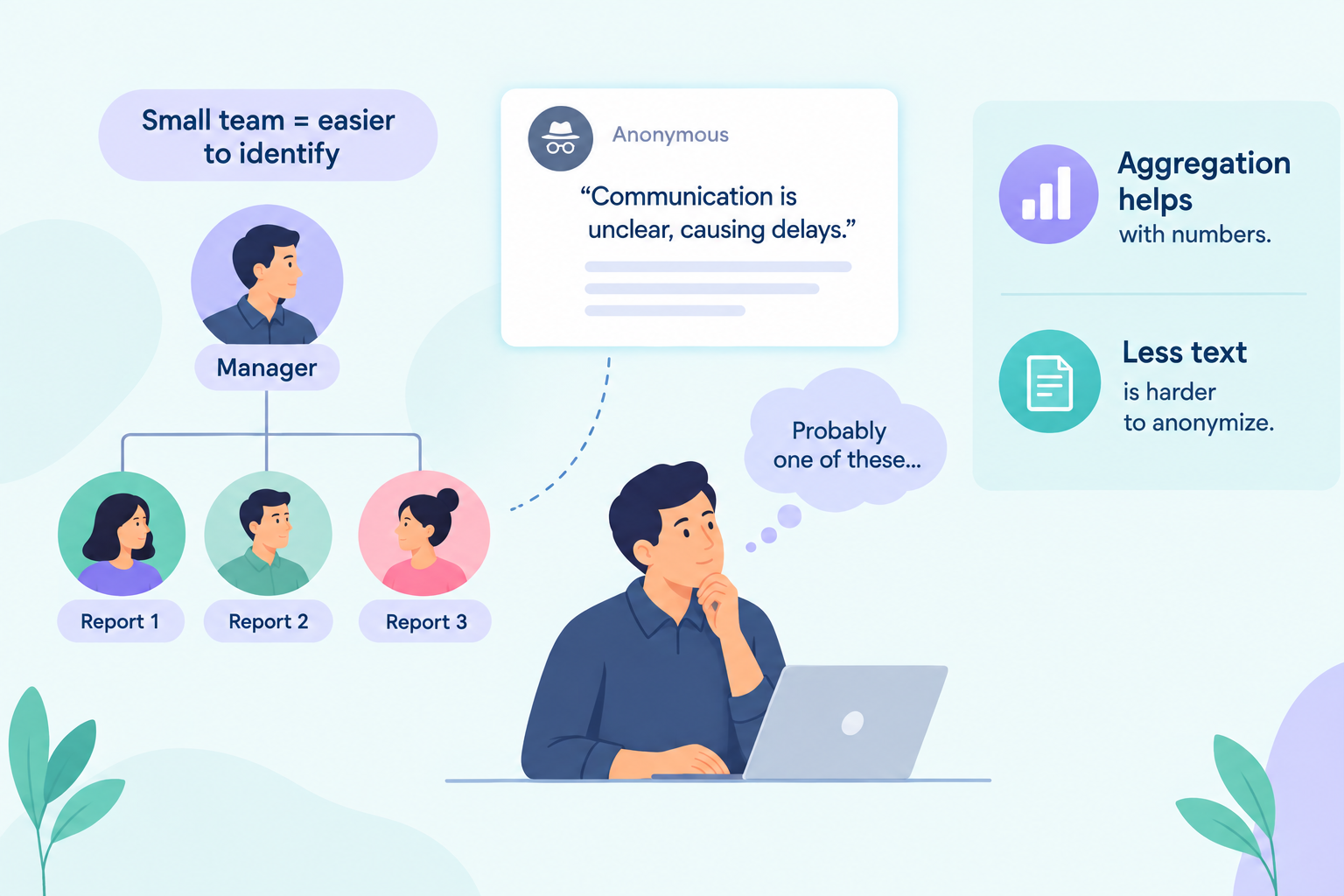
Small teams make one of the most common anonymous feedback problems sharper.
If a manager has three direct reports and one of them writes something specific and pointed, "anonymous" is a technicality, the manager can often narrow it down to one or two names just from the content and the org chart. Raters know this.
So on small teams, the very structure meant to protect the most vulnerable feedback-givers protects them the least, and they self-censor accordingly. Ironically, it's often the most operationally important feedback from the person who works closest with the manager day to day that gets softened the most, precisely because that person is also the easiest to identify.
Aggregation is supposed to fix this by blending enough responses together that no single voice stands out. It works but only at a scale most mid-sized companies don't have for every rated employee, and only for the quantitative scores.
Free-text comments, the part of a 360 that actually contains the specific, actionable insight, are much harder to anonymize without gutting them of the detail that made them useful in the first place. This is the trade-off at the heart of 360 review reliability: the more you protect identity, the more you flatten the very detail that made the feedback worth collecting.
Why the scores go up even when nothing gets better
There's a second layer to this that most people miss: 360 degree feedback scores tend to rise on their own, independent of whether real behavior change happened another quiet hit to 360 review reliability that's easy to mistake for progress. A few forces push in that direction every cycle:
- Raters recalibrate downward on repeat cycles less often than you'd think. Once someone rates a manager a 4, giving a 3 next time feels like an accusation, even if the underlying behavior hasn't moved. Scores develop their own inertia.
- Familiarity softens judgment. The longer people work with someone, the more context they extend them "that's just how they are" starts doing the work that a lower score used to do.
- Leniency bias compounds at the top. People who already score well tend to get rated even more generously over time, a pattern researchers have long noted in repeat-cycle feedback data not because they've stopped needing to grow, but because raters run out of appetite to keep pointing it out.
Put those three together and you get exactly the pattern that frustrates HR teams most: a heat map that's greener every year, sitting on top of a workplace where the same three managers still get the same complaints in exit interviews.
What actually closes the gap
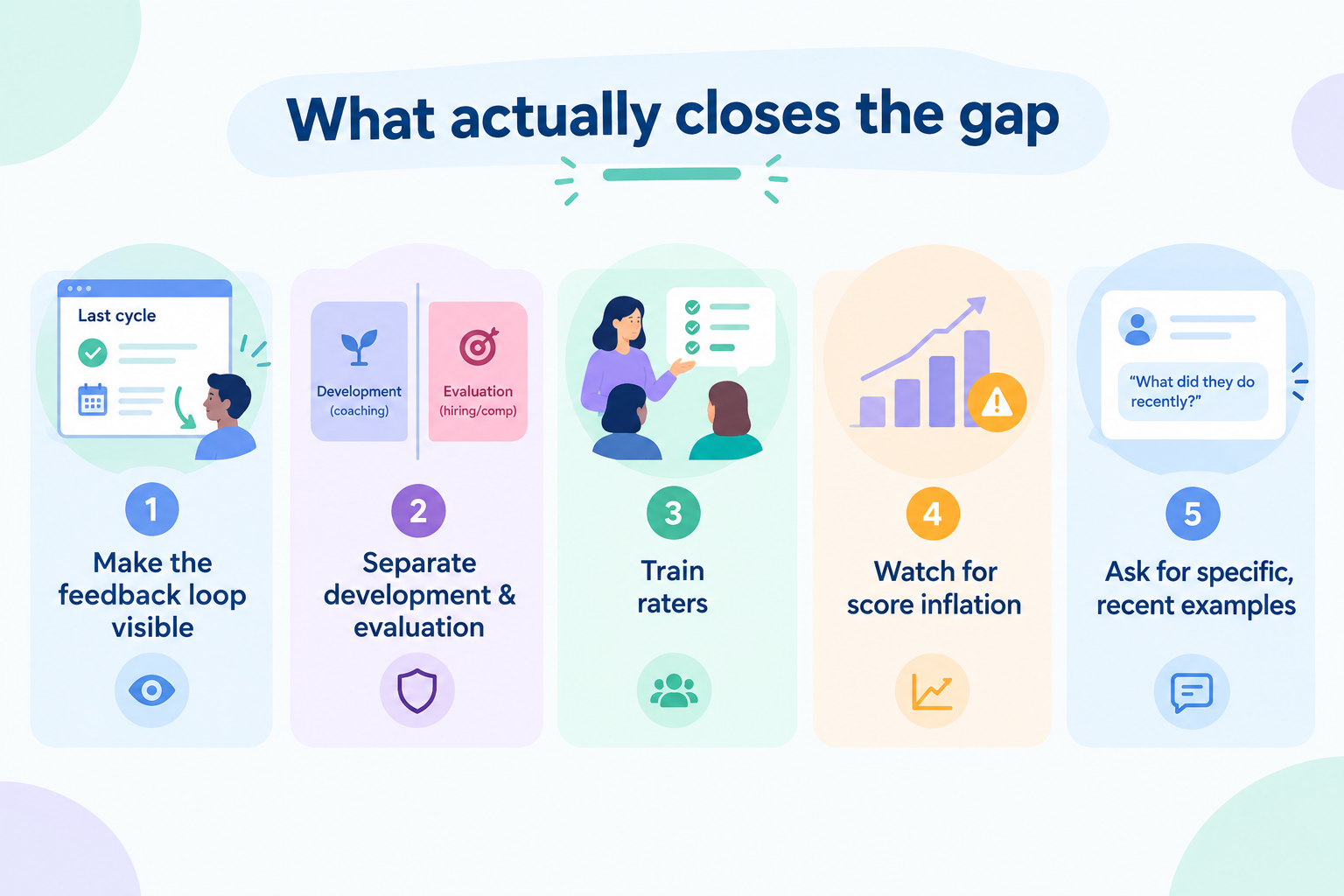
None of this means 360 degree feedback is broken as a concept. It means anonymity alone was never going to be the mechanism that made it work.
The organizations that get real behavior change out of 360 processes and genuinely solve for 360 feedback honest responses instead of just assuming them tend to do a few things differently. Notably, none of them is "make the survey more anonymous."
- They make the feedback loop visible. Not the identities, the outcomes. When people can see that last cycle's feedback led to a specific, named change (a manager stopped scheduling 8pm meetings, a team started rotating who runs standup), the calculation shifts from "will this go into a drawer" to "this is how things actually move around here." Visibility of impact, not anonymity of input, is what rebuilds the incentive to be honest.
- They separate development feedback from evaluation feedback. The moment a 360 score quietly becomes an input into a promotion or compensation decision, every rater's incentives change, and anonymity stops being enough to counteract that. The programs that hold up longest are explicit, in writing, that 360 data drives coaching conversations, not headcount decisions.
- They train raters, not just ratees. Most 360 training focuses on how to receive feedback gracefully. Far fewer programs teach people how to give specific, behavioral feedback in the first place, the difference between "communication could be better" and "you interrupted three people in Tuesday's planning meeting." Specificity is a skill, and it's the thing anonymity was supposed to unlock but can't teach on its own.
- They watch for score inflation as a signal, not a success. A rising average isn't automatically good news. If scores climb while manager-effectiveness complaints in engagement surveys or exit interviews stay flat, that's the tell that recalibration and leniency are doing more work than actual change and it's one of the simplest ongoing checks on 360 review reliability you can run without redesigning the whole process.
- They ask a different question in the free text. Instead of "how would you rate this person's collaboration," the sharper prompt is "what's one specific thing this person did in the last quarter that helped or hurt the team." Specific, recent, behavioral prompts are harder to answer vaguely, which means they're harder to answer dishonestly, anonymous or not.
In practice, most of this comes down to what your 360 tool actually shows people after the survey closes not just to HR, but to the manager and the raters themselves.
A platform like ThriveSparrow is built around that gap specifically: 360 feedback that ties directly into visible action plans, so raters can see a past comment turn into a real change instead of disappearing into a report nobody reads twice.
When people can trace the line from "I said this" to "this happened," the incentive to round up starts to disappear on its own no extra layer of anonymity required.
See Real 360 Results with ThriveSparrow
.svg)
The real fix isn't more anonymity. It's more trust.
Anonymity was always a proxy for something harder to build: a workplace where people believe honesty won't cost them anything, whether their name is attached to it or not.
A 360 degree feedback process can't manufacture that belief with a settings toggle. It can only reflect however much of it already exists which is exactly why the scores can look great while nothing underneath them moves, and why 360 feedback honest responses have to be earned cycle over cycle, not assumed from the start.
If your last cycle came back glowing and your team still feels the same, the process didn't fail. It told you the truth about how much psychological safety you actually have just not in the column you were looking at.
Want to see what a 360 process that actually closes the loop looks like?
Take a look at how ThriveSparrow handles 360 degree feedback from collection through to visible, trackable action plans and see whether your next cycle can finally move the numbers that matter.
FAQs
1. Why do 360 degree feedback scores go up even when nothing actually changes?
Scores tend to rise on their own over repeat cycles because raters rarely lower a score once they've given someone a good one, dropping it feels like an accusation even if behaviour hasn't moved. Add in familiarity bias and leniency toward already-high performers, and averages climb while real behaviour stays flat.
2. Is anonymous 360 feedback actually anonymous?
Not always in practice. On small teams, a specific comment often narrows down to one or two people just from context, even without a name attached. This is one of the most common anonymous feedback problems, the raters who work closest with someone, whose input is usually most valuable, are also the easiest to identify and most likely to self-censor.
3. Why don't people give honest answers in anonymous surveys?
Anonymity removes the risk of being identified, but it doesn't build the belief that speaking up will actually lead somewhere. If people don't see feedback translate into visible change, they round scores up rather than lie outright, which quietly erodes 360 feedback honest responses over time without ever showing up as a red flag in the data.
4. How reliable is 360 degree feedback data?
360 review reliability depends heavily on process design, not just the survey itself. Small sample sizes, rater leniency, vague competency questions, and a lack of follow-through on past feedback all reduce reliability even when the aggregate scores look statistically clean.
5. Should 360 feedback be anonymous or confidential?
Anonymous feedback fully hides the rater's identity, while confidential feedback allows some traceability for follow-up. Neither format alone fixes anonymous feedback problems, what matters more is whether feedback is tied to visible outcomes, kept separate from pay or promotion decisions, and asked through specific, behavioral questions rather than vague ratings.
6. How can companies improve 360 review reliability?
Separate development feedback from performance evaluation, train raters to give specific behavioral examples instead of vague ratings, track whether scores are rising for the whole team or for specific improved individuals, and make sure people can see past feedback turn into real, trackable action.