










Most teams don't struggle with setting goals, it's keeping them alive that's hard.
Quarterly OKRs start strong, then get buried in spreadsheets, scattered across tools, or quietly sidelined by urgent tasks until leadership asks "how are we doing?" and nobody has a clean answer.
That's where OKR software comes in: a central place where goals stay visible and updated, so you're not hunting for status or relying on memory.
In this guide, I'll walk you through 15 of the best OKR software platforms in 2026, with transparent pricing, honest pros and cons, and clear recommendations for startups, mid-sized teams, and enterprises whether you're an HR team moving off spreadsheets, a founder comparing tools for the first time, or a People Ops team that wants OKRs connected to reviews and engagement.
How We Evaluated These Tools
Full disclosure: ThriveSparrow is on this list, and we built it. That doesn't mean we're going to sandbag the competition or oversell ourselves every tool below, including ours, is scored the same way: hands-on setup, real pricing (not "contact sales" guesses), and the honest limitation we'd want to know about before buying. If a tool has a real edge over ThriveSparrow for a specific use case, we say so.
We evaluated each platform on:
- Setup time: how fast a team can go from signup to first OKR cycle
- Pricing transparency: whether real numbers are published or hidden behind a demo
- Adoption: whether the tool holds up after the first quarter, not just in a demo
- Depth of integration: with performance reviews, engagement, or just OKRs alone
TLDR: Best OKR Software in 2026
- Best overall for HR teams: ThriveSparrow
- Best for performance-led teams: Lattice
- Best for structured OKR templates: Profit.co
- Best for weekly check-ins: Weekdone
- Best for goal and project alignment: Asana
- Best for productivity-focused teams: ClickUp
Watch this quick video for a fast overview of the best OKR software tools featured below.
Quick Comparison of the Best OKR Software
Note: Pricing may change, so check the official pricing page before making a final decision.
Use this table as a shortlist first. Then read the individual tool sections to understand where each platform fits best.
Editor's Pick
For HR teams that want OKRs connected to performance reviews, engagement signals, and feedback, ThriveSparrow is one of the strongest fits. It is not just a goal tracker. It helps teams connect goals with the employee experience data around them. For enterprise teams focused mainly on strategy dashboards and KPIs, WorkBoard may be a better fit.
15 Best OKR Software in 2026 (Ranked by Use Case)
1. Culture Amp

Best for: Engagement-first teams that want goals tied to employee feedback
Overview:
Culture Amp provides a flexible goal structure allowing you to customize your goal management process and manage goal visibility. Integrated nudges assist goal owners with continuous support at each phase of the journey.
With science-backed insights and reporting capabilities, your teams can track their progress and achieve their goals proactively. From real-world use cases, Culture Amp works best when you already care deeply about engagement and feedback and want goals to live in that same ecosystem, rather than as a separate "OKR-only" tool.
Key Features:
- Goal alignment: Align employee goals with business objectives with visibility for leaders
- Science-backed guidance: Assistance for employees in setting precise, measurable, and motivating goals
- Integrated nudges: Continuous support and progress tracking throughout the goal-setting process
- Employee surveys: Strong employee engagement and survey capabilities with solid reporting
- Self-service tools: Help HR teams interpret results and act on them
Why Choose It Over Competitors: Choose Culture Amp if you want OKRs integrated with employee engagement surveys and science-backed feedback tools.
Limitations: Goal-setting and performance modules are not as customizable or deep as some dedicated performance/OKR tools. Integrations for performance/goal workflows and 360 reviews can feel limited or less flexible than expected.
Pricing: Pricing is not disclosed. You can request a custom quote.
G2 rating: 4.5/5
Best-Fit Summary: Choose Culture Amp if employee engagement and feedback are your top priorities, and you want goal tracking tied to survey insights.
2. Lattice

Best for: Enterprise performance management with deep OKR integration
Overview:
Lattice is an OKR software that brings goal tracking into regular performance conversations, employee development, and employee engagement processes. The platform connects OKRs to one-on-ones, performance reviews, and other work-related tasks.
In practice, Lattice tends to work best in larger organizations that already run performance reviews and talent programs. Smaller teams sometimes feel it's more platform than they really need.
Key Features:
- OKR integration with meetings: Integrate OKRs into regular meetings and ensure continuous focus on goals in daily operations
- Wide integrations: Integration with popular tools like Jira, Salesforce, and Slack keeps OKRs visible across teams
- Manager tracking: Managers can easily track progress and adjust strategies, helping employees develop their individual OKRs
- Performance reviews: Tie goal progress directly to performance evaluations and development conversations
- Analytics and surveys: Strong analytics and survey capabilities give HR and leaders a broad view of performance and engagement
Why Choose It Over Competitors: Choose Lattice if you're an enterprise that needs OKRs deeply integrated with performance reviews, compensation planning, and talent development. It's built for organizations that want one system for performance and goals.
Limitations: Noticeable learning curve for new users; mastering all the modules takes time. Customization of certain templates and reports can feel limited, and the interface can be confusing for people new to HR software.
Pricing:
Lattice offers bucket plans:
- Talent Management: Starts at $11/seat/month, billed annually (includes Performance and Goals & OKRs)
- Add-ons: Engagement ($4/seat/month), Grow ($4/seat/month), and Compensation ($6/seat/month)
- HRIS: $5/seat/month
Lattice also allows Performance and Goals & OKRs to be purchased individually, starting at $8/user/month, according to its pricing page.
G2 rating: 4.7/5
Best-Fit Summary: Choose Lattice if you're an enterprise that needs deep performance management integration with OKRs, and you have the resources to support a full rollout and training.
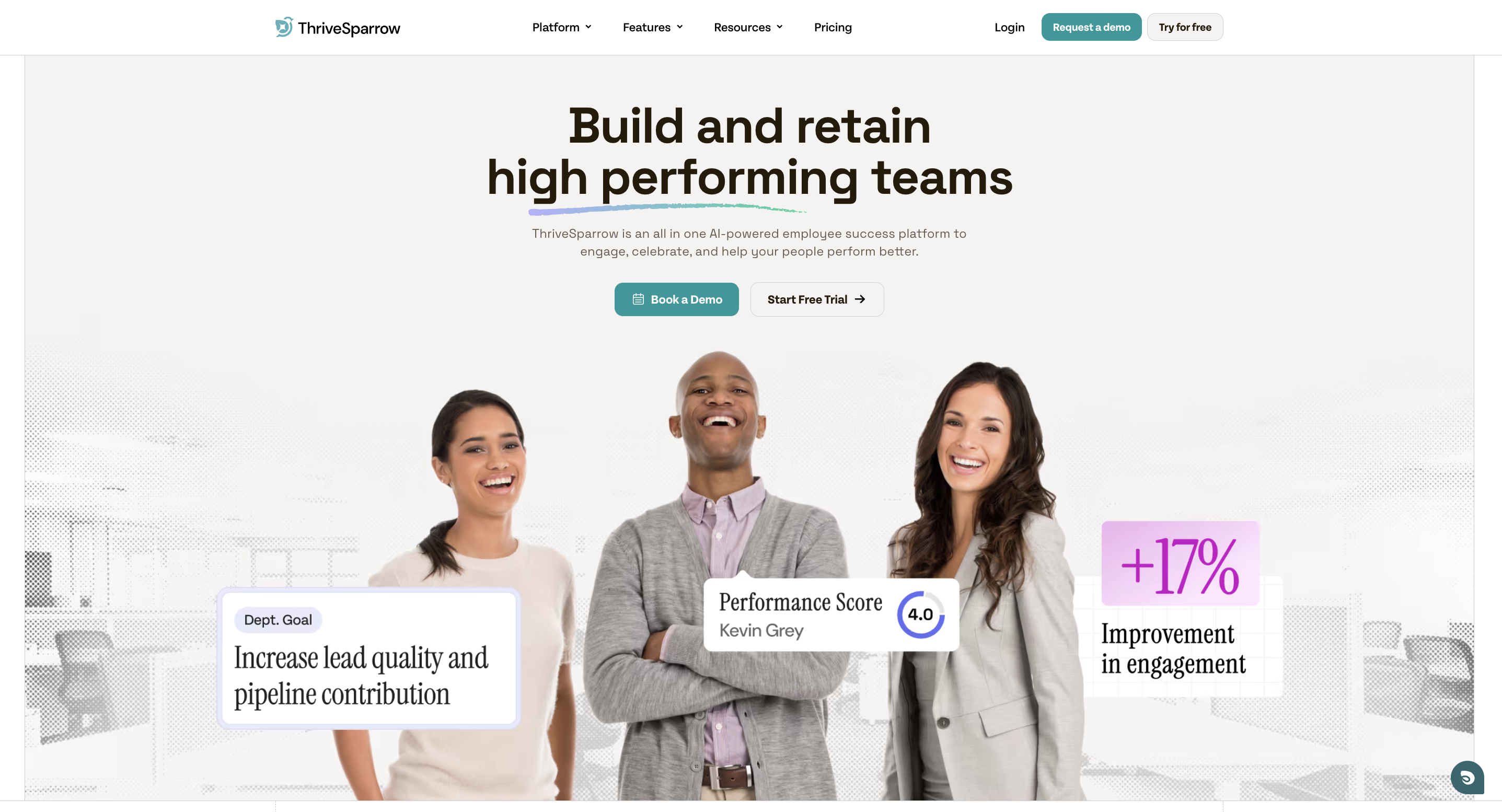
3. ThriveSparrow
Best for: HR teams that want OKRs connected to performance and engagement
Overview:
ThriveSparrow is an employee success platform that connects goal alignment, performance reviews, and engagement surveys. It's built for growing HR teams that want to move beyond scattered tools and static spreadsheets.
Unlike standalone OKR platforms, ThriveSparrow lets you tie goals directly to performance feedback and pulse surveys. This means you can see how engagement and performance connect to goal progress in one place.
ThriveSparrow works best for teams that want lightweight setup, transparent pricing, and a platform that scales without requiring a full HR tech stack overhaul.
Key Features:
- Goal alignment and cascading: Connect individual goals to team and company objectives with visual tree views
- Progress tracking: Weekly check-ins and automated reminders keep goals alive throughout the cycle
- Performance integration: Tie OKRs directly to performance reviews and 360 feedback
- Engagement insights: See how pulse survey results connect to goal progress
- AI-powered development plans: Generate personalized development plans based on goal performance
- Slack and MS Teams integration: Keep goal updates and team conversations closer to daily workflows
- Transparent pricing: $3/employee/month for Goals, with no hidden fees or minimums
Why Choose It Over Competitors: Choose ThriveSparrow if you want more than just OKR tracking. Unlike tools that focus only on goal alignment, ThriveSparrow connects OKRs to performance reviews and engagement surveys so you can measure both goal progress and employee sentiment in one platform.
Limitations: Advanced customization and deeper analytics can feel limited compared to enterprise-focused platforms like WorkBoard.
Pricing:
- Goals (OKRs): $3/employee/month, billed annually
- Performance: $5/employee/month, billed annually
- Engage: $3/employee/month, billed annually
- Kudos: $2/employee/month, billed annually
All plans include 24x5 email and chat support. Modules can be combined with the add-on model.
G2 rating: 4.5/5
Best-Fit Summary: Choose ThriveSparrow if your HR team wants goals to stay connected to reviews, feedback, and engagement signals instead of sitting in a standalone OKR tracker.
ThriveSparrow Goals helps HR teams connect company, team, and individual goals in one place, so progress doesn't disappear between review cycles.
👉 Try ThriveSparrow free for 14 days!
.svg)
4. Leapsome

Best for: Teams that want OKRs, feedback, and learning in one platform
Overview:
Like ThriveSparrow, Leapsome's OKR software allows you to set recurring goal cycles with fixed timelines. One useful feature is that it lets you create company goals based on the goal-setting framework you use. It also allows you to leave comments and request feedback for better context on the goals you and your team set.
With AI-powered goal setting, Leapsome generates actionable recommendations instantly. Features like feedback sharing, progress tracking, and integration with JIRA make Leapsome a solution for effective OKR management.
Leapsome works best for organizations that want OKRs, feedback, and learning in one place; the trade-off is more configuration up front compared to ultra-simple OKR-only tools.
Key Features:
- AI Co-Pilot: Speeds up creation for company objectives and development goals
- Goal ownership and dependencies: Admins can highlight goal ownership and dependencies
- Integrations: Integrate with existing tools and workflows, ensuring goals remain relevant across platforms and meetings
- Visual alignment: Show how individual goals connect to company-level objectives
- Rich engagement features: Surveys, development tools, and feedback in one platform
Why Choose It Over Competitors: Choose Leapsome if you want OKRs tied to employee feedback, development plans, and learning—all in one platform with AI-powered recommendations.
Limitations: UI can feel unclear and time-consuming when trying to find specific data, especially for busy managers. Goal updates are more manual (no API for some goal updates), and users report notification overload and complex setup for larger organizations.
Pricing: Pricing is not disclosed. You can request a demo and custom quote. Leapsome provides discounts on multi-module purchases.
G2 rating: 4.8/5
Best-Fit Summary: Choose Leapsome if you want OKRs, feedback, learning, and AI-powered goal creation in one platform.
5. Profit.co
Best for: Teams that want structured OKR templates and AI assistance
Overview:
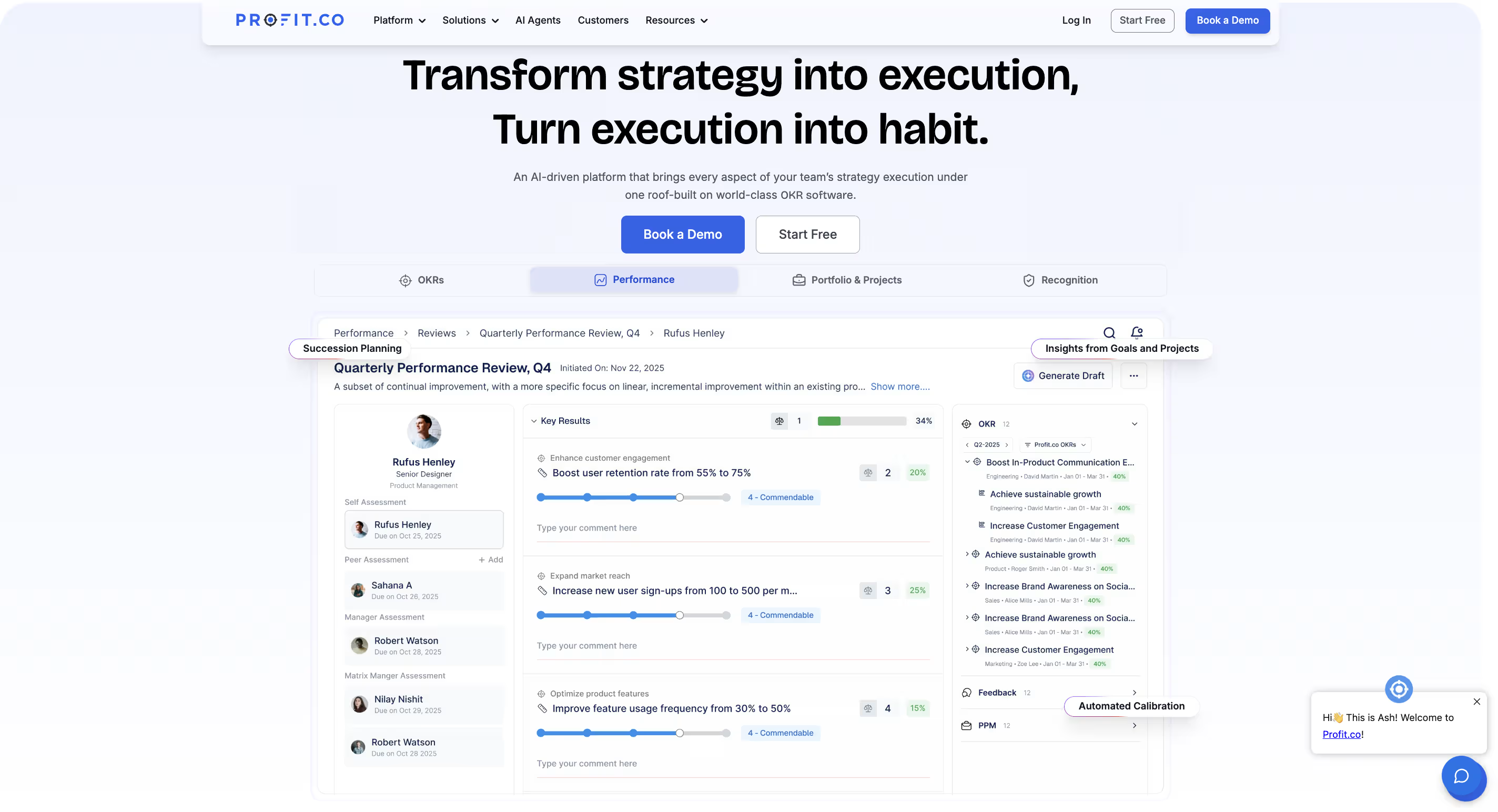
Profit.co's pre-built templates and AI Chatbot let you create OKRs instantly in just a few clicks.
Profit.co offers diverse alignment dashboards that clarify how individual contributions support company goals, and it provides six types of key results to track both measurable and non-measurable outcomes. Additionally, real-time dashboards and heatmaps enable managers to monitor team performance and quickly identify potential challenges.
In evaluation, Profit.co is a better fit for teams that need more structure and rich alignment views; if you're looking for something extremely minimal, its depth can feel a bit more than you need.
Key Features:
- AI-powered OKR creation: AI bot and pre-installed OKR templates help managers create OKRs instantly
- Wide integrations: Integrate with popular tools like Jira, Slack, G Suite, and Office 365
- Real-time dashboards: Customizable reports help visualize progress, spot roadblocks, and drive decision-making
- Alignment dashboards: Visual alignment maps show how individual goals connect to company objectives
- PowerPoint reports: Generate PowerPoint reports for stakeholder presentations
Why Choose It Over Competitors: Choose Profit.co if you want structured OKR templates, AI assistance for goal creation, and rich visual alignment maps that show how goals cascade across the organization.
Limitations: Some users report limitations around report export options and check-in history management. The platform can take more time to set up than lighter OKR tools.
Pricing: Pricing is not publicly listed. You can book a demo to request a custom quote.
G2 rating: 4.7/5
Best-Fit Summary: Choose Profit.co if you want structured OKR templates, AI-powered goal creation, and detailed alignment dashboards.
6. Weekdone
Best for: Teams that want a weekly OKR rhythm with simple check-ins
Overview:
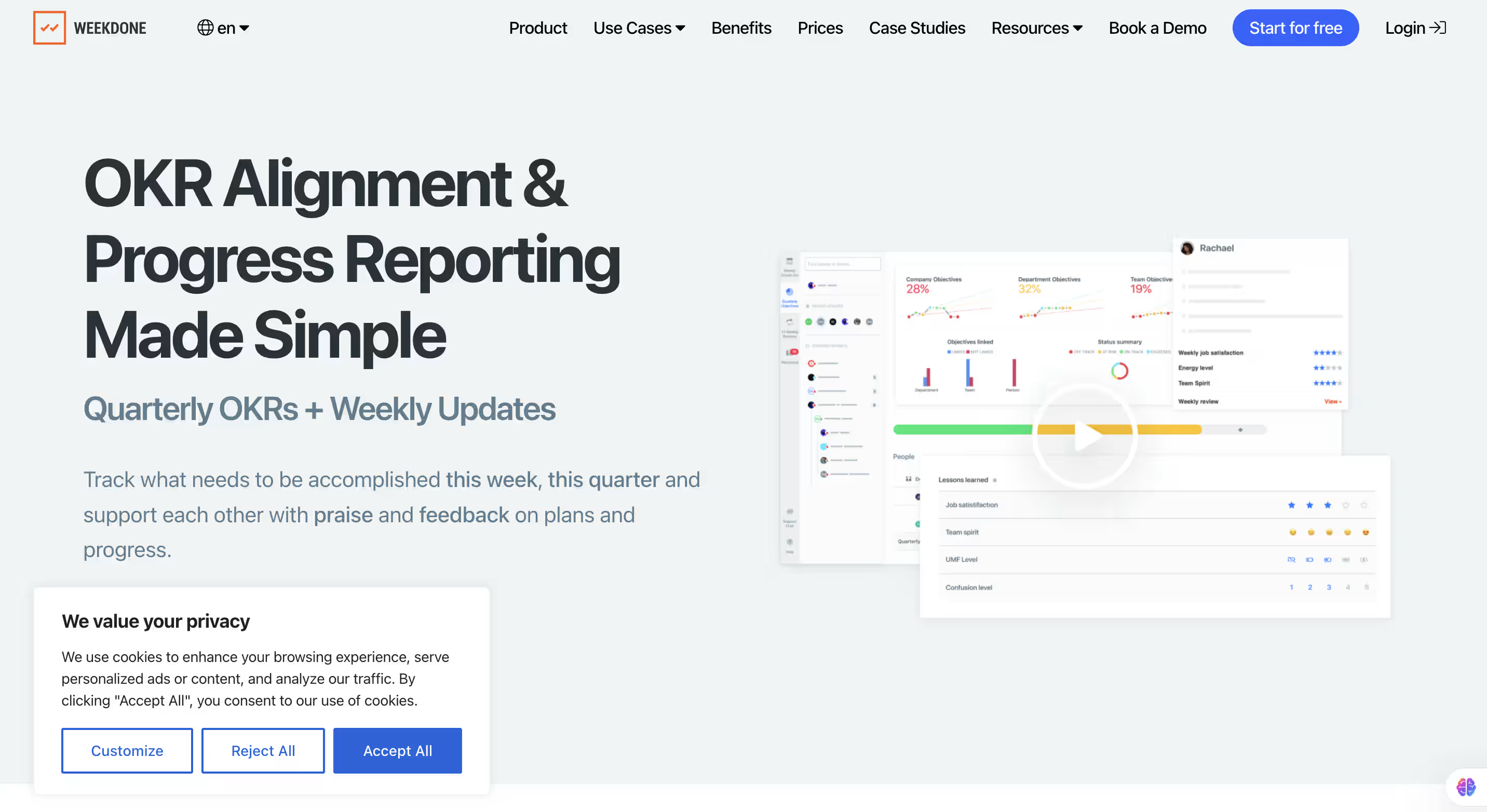
Weekdone provides both a hierarchical and tree view for your organization's goals. Built-in OKR examples and a writing tool help you write OKRs quickly.
With Weekdone, managers can make OKRs part of weekly check-ins and discussions, helping improve performance and reduce bottlenecks. In practice, Weekdone is strongest when you want that weekly rhythm: the check-ins and summaries make OKRs feel like part of the routine, not just a quarterly planning exercise.
Key Features:
- Automated weekly status reports: Get automated weekly status reports with insights into employee plans, progress, and well-being
- Project tracking: Plan and track both individual and group projects easily, ensuring that tasks are aligned with overall objectives
- 1:1 check-ins: Unite employee goals with feedback through 1:1 check-ins to foster ongoing performance improvement
- Newsfeed: One useful feature where progress updates, announcements, and awards can be viewed in one place
- Visual goal views: Hierarchical and tree view for goal visualization
Why Choose It Over Competitors: Choose Weekdone if you want a tool that makes OKRs feel weekly, not quarterly. The automated status reports replace outdated manual updates and help teams focus on progress one week at a time.
Limitations: Less suited for very large or highly complex organizations that need extensive custom workflows. Reporting and structure are optimized for weekly cadence; if your team doesn't like that rhythm, value may feel lower.
Pricing:
- Free version available for 1-3 users
- Paid plans: Start at $9/user/month
G2 rating: 4.6/5
Best-Fit Summary: Choose Weekdone if you want affordable, simple OKR tracking with a strong weekly check-in rhythm.
7. 15Five
Best for: Manager coaching and weekly check-ins tied to OKRs
Overview:
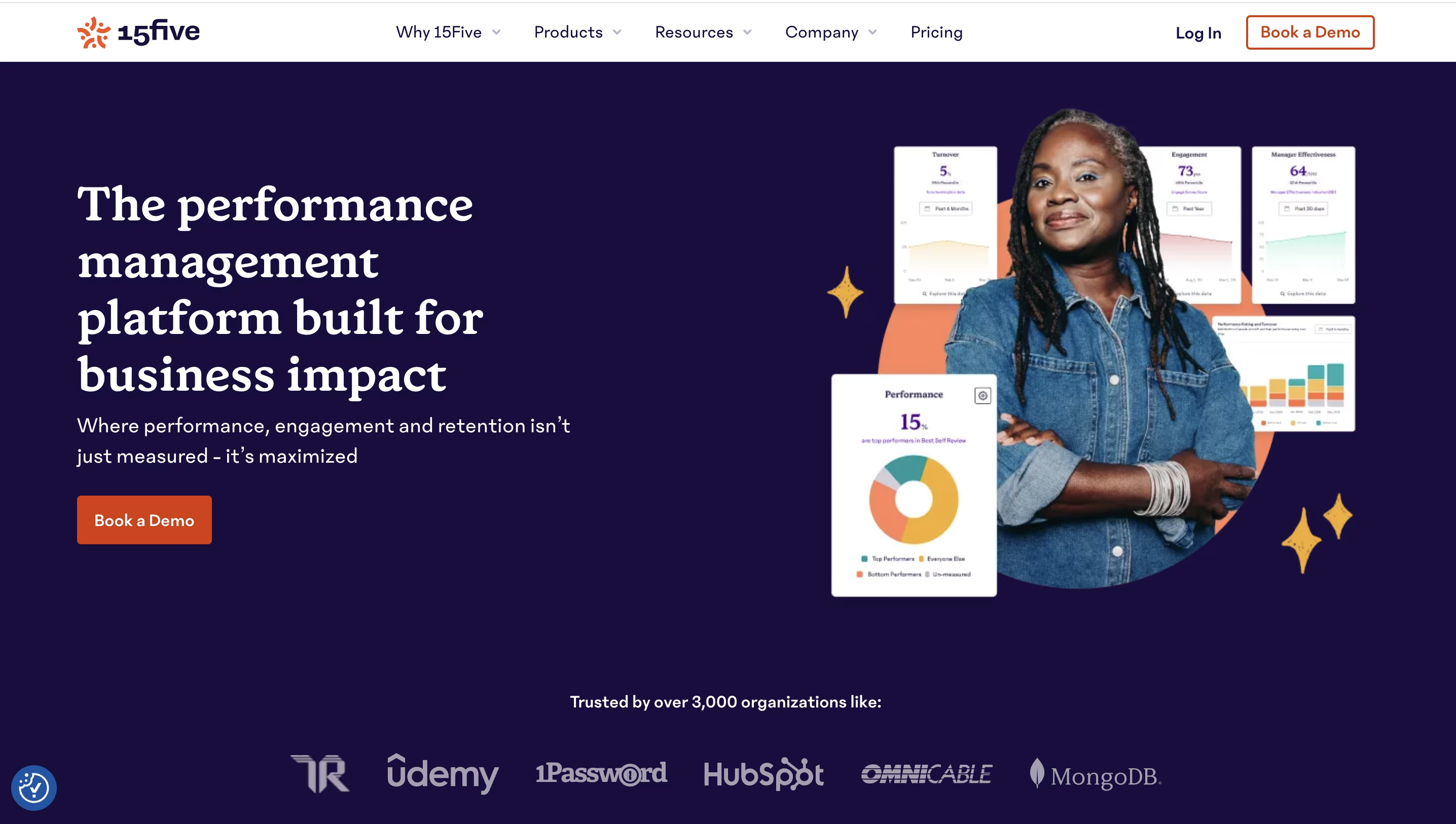
Like Lattice, 15Five brings goal tracking into regular performance conversations. Managers can check in on employees' progress for everyday tasks, which comes in handy during performance reviews as each employee's progress is stored in one place.
Backed by research from The Center for Evidence-Based Management (CEBMa), 15Five is designed to enhance goal achievement through a science-based approach.
In practice, 15Five works best for teams that want OKRs tied tightly to weekly check-ins and coaching conversations; if you only care about high-level OKR dashboards, its manager-focused workflows may feel like overkill.
Key Features:
- Spark AI: Assists managers with interpreting sentiment from feedback, writing performance reviews faster, and creating action plans
- Science-backed approach: Backed by the latest scientific research
- Manager enablement: Helps managers check in on employee and team progress in real time
- Continuous performance: Check-ins, feedback, and OKRs live together
- Weekly rhythm: OKRs tied to weekly check-ins
Why Choose It Over Competitors: Choose 15Five if you want OKRs integrated with weekly check-ins, manager coaching, and continuous feedback in one platform.
Limitations: While it supports OKRs, some reviewers see gaps versus dedicated OKR-only tools (e.g., grading, confidence levels, detailed OKR notes). Best suited when you need a full performance/engagement stack, not just a focused OKR tracker.
Pricing:
- Engage: $4/user/month
- Perform (includes OKRs): $11/user/month, billed annually
- Total Platform: $16/user/month, billed annually
G2 rating: 4.6/5
Best-Fit Summary: Choose 15Five if you want OKRs tied to weekly check-ins and manager coaching, with a science-backed approach to performance.
8. Asana
Best for: Teams that need goals connected to projects and tasks
Overview:
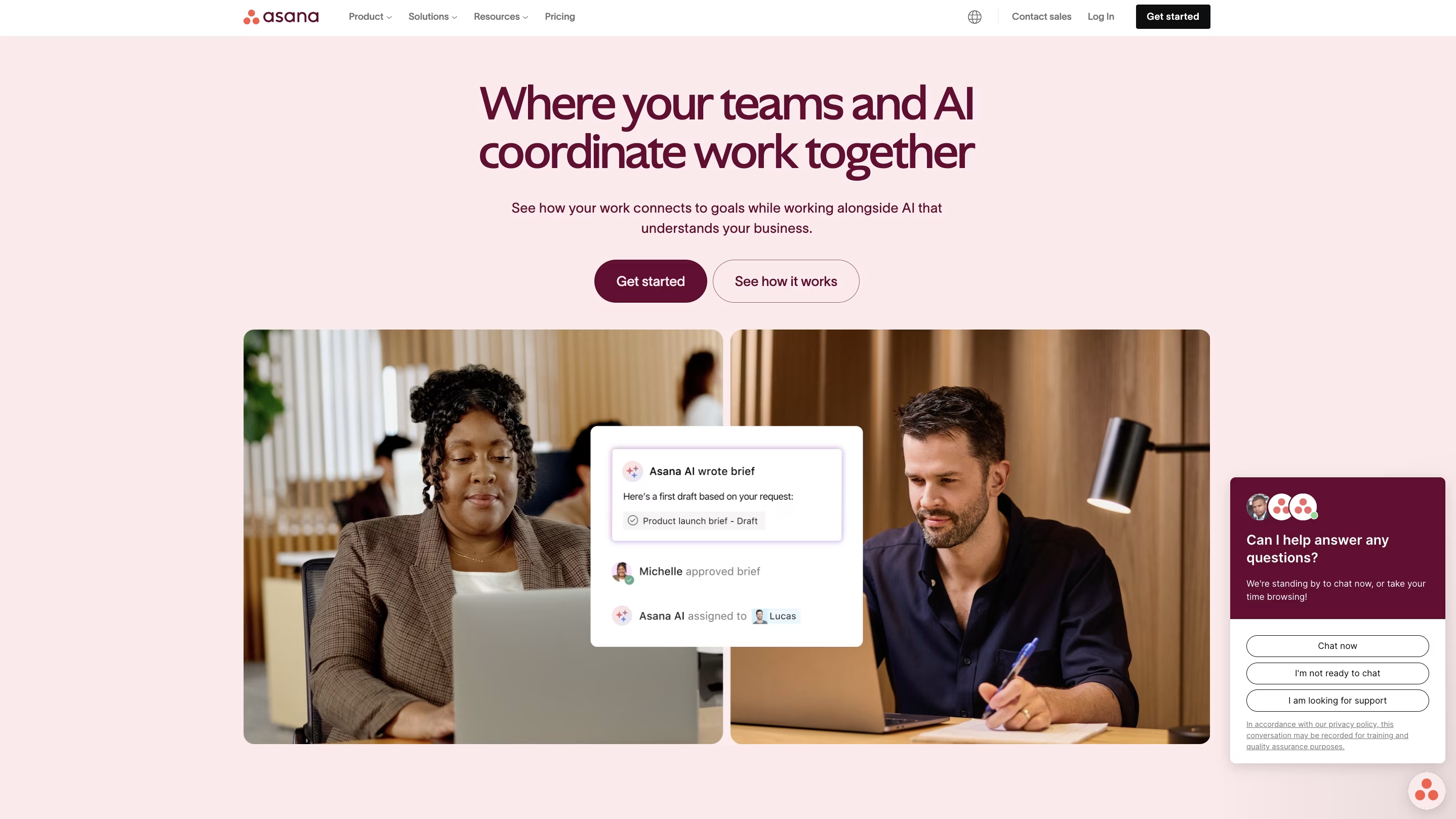
Asana is a project management tool designed to help teams organize, track, and manage their work efficiently. Features like reporting dashboards, portfolios, and status updates bring a great addition to the goal-setting process on Asana and help keep everyone in sync.
Asana integrates with over 200 applications, allowing teams to connect their workflows. This connectivity means teams can see updates in one place, making it easier to manage goals across different projects.
In real use, Asana works best for OKRs when your projects are already in Asana—then connecting goals to day-to-day work feels natural, instead of asking people to log into a separate goal tool.
Key Features:
- Customizable inputs: Customize inputs to view metrics like budget and performance alongside goals
- Portfolio view: Monitor all your projects in one place and label each by priority and type
- Real-time visibility: Let stakeholders see manager and employee portfolios in real time with status update nudges
- Task-to-goal connection: Integration with tasks and projects ensures goals remain connected to daily activities
- 200+ integrations: Wide integration ecosystem keeps work, updates, and goals in a central place
Why Choose It Over Competitors: Choose Asana if your team already uses it for project management and you want to add goal tracking without switching tools. The task-to-goal connection makes it easy to see how daily work contributes to objectives.
Limitations: Goal and OKR features are not as specialized as in dedicated OKR tools; some teams still rely on extra structure outside Asana. Can feel complex for users who only need OKRs and not the full project management stack.
Pricing:
- Personal plan: Free for up to 2 users
- Starter: $10.99/user/month, billed annually
- Advanced: $24.99/user/month, billed annually
G2 rating: 4.3/5
Best-Fit Summary: Choose Asana if you want goals tied directly to projects and tasks, and your team already uses Asana for work management.
9. ClickUp
Best for: Productivity-focused teams that want highly customizable goals
Overview:
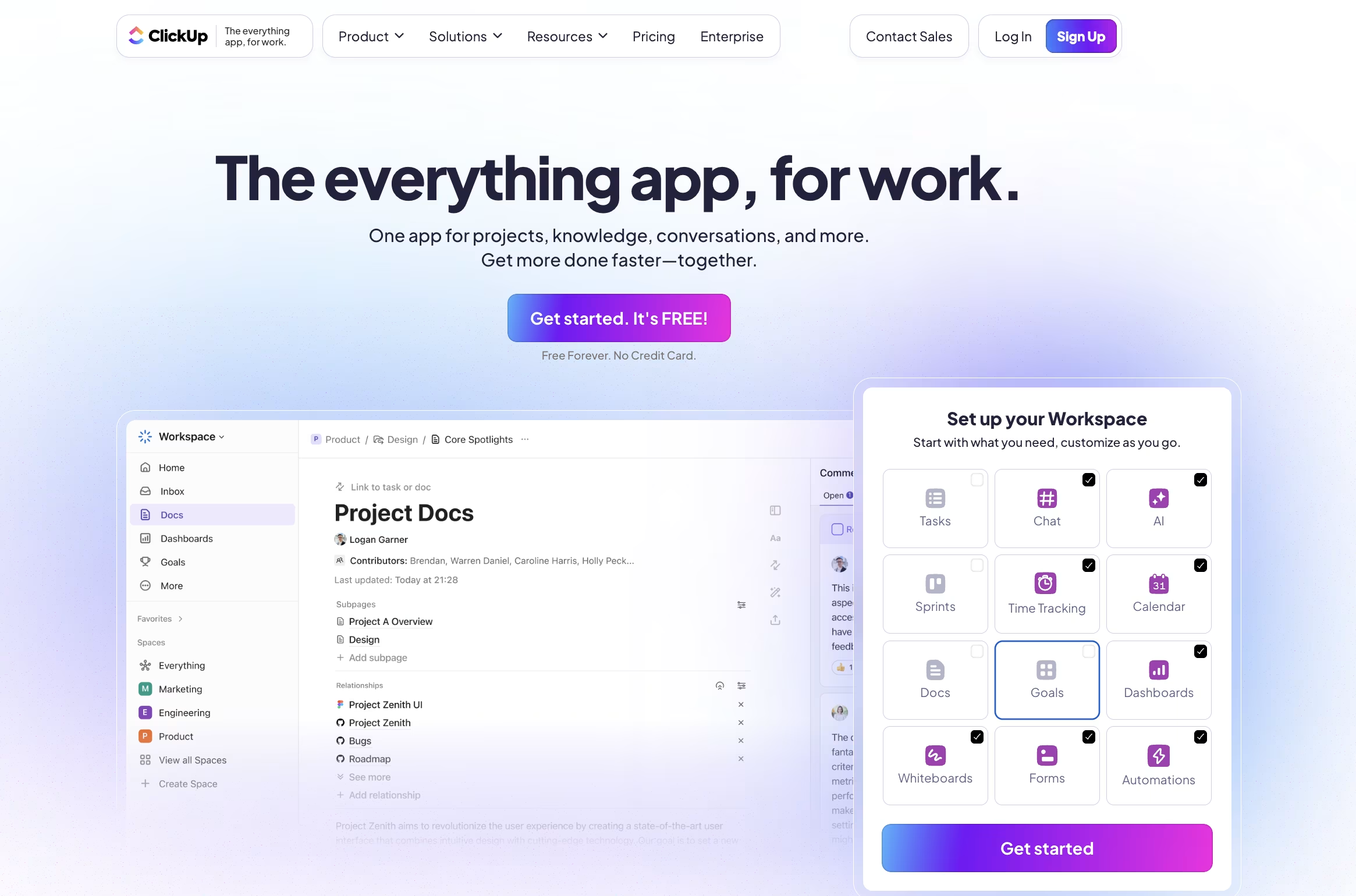
ClickUp works best for teams that want goals, tasks, docs, dashboards, and project workflows in one place.
ClickUp is trusted for its approach to goal management and project tracking. From a practical point of view, ClickUp works best when your team already runs projects and tasks there—then OKRs become just another view on top of work you're already doing, rather than a separate system to maintain.
Key Features:
- Flexible goal categories: Set specific, measurable goals that can be categorized into various folders for easy tracking of multiple objectives
- Custom targets: Define custom targets for your team's goals, including numerical, monetary, and true/false metrics
- Task-to-goal linking: Link tasks directly to goals for clear tracking of completion toward objectives
- Multiple views: Customization of goal targets and views
- All-in-one workspace: Goals, tasks, docs, and sprints in one place
Why Choose It Over Competitors: Choose ClickUp if you want a highly flexible workspace where goals, tasks, docs, and sprints live together. The customization options let you build the exact workflow your team needs.
Limitations: May feel too broad if you only need focused OKR tracking. Some users report that configuration and navigation can be complex until the workspace is well structured.
Pricing:
- Free forever plan: Best for personal use
- Unlimited plan: $7/user/month, billed annually
- Business plan: $12/user/month, billed annually
- Enterprise plan: Custom quote
G2 rating: 4.7/5
Best-Fit Summary: Choose ClickUp if you want a highly customizable productivity platform where OKRs are part of a broader work management system.
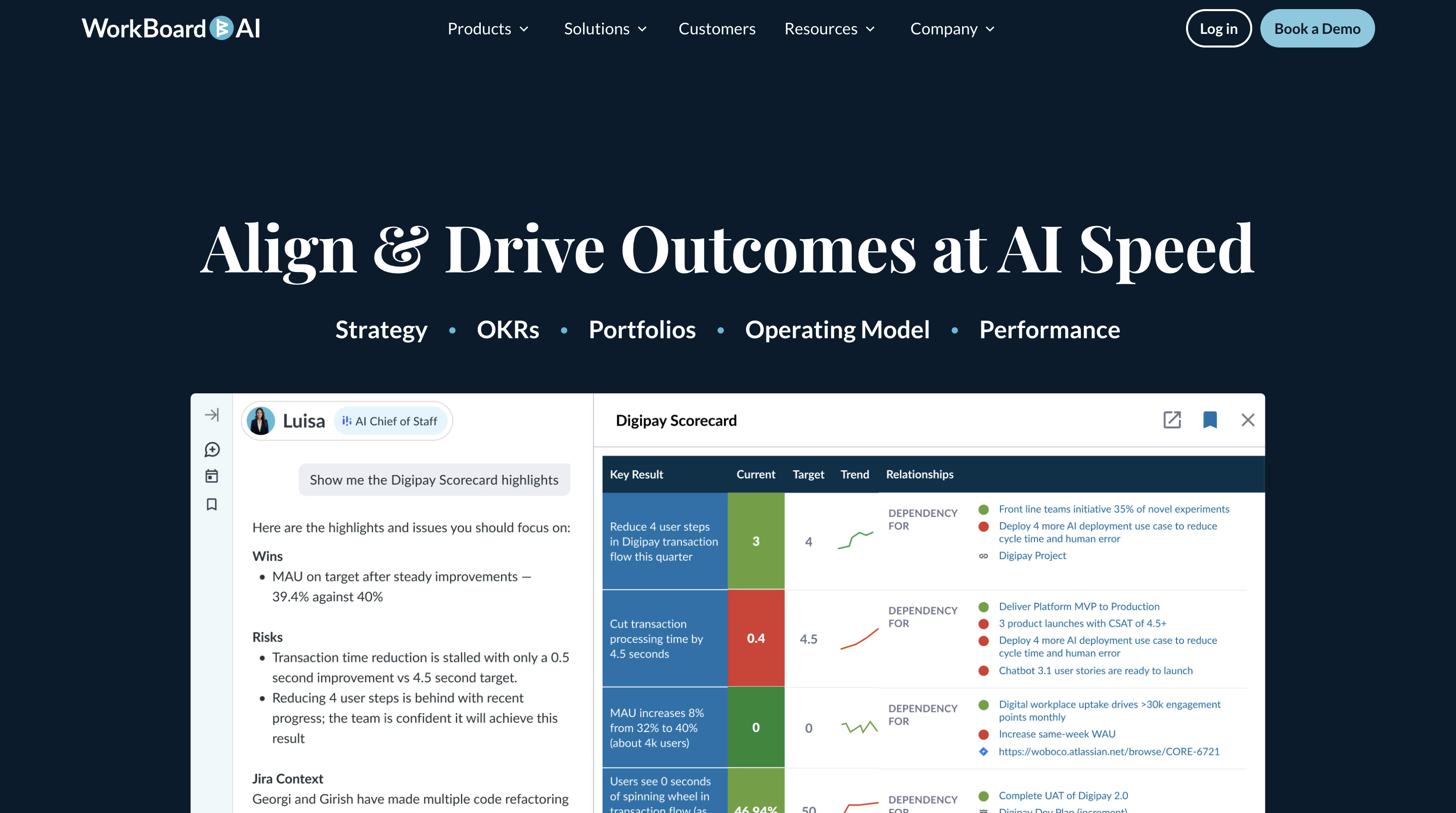
10. WorkBoard
Best for: Enterprise strategy execution with executive-level reporting
Overview:
WorkBoard is a strategy execution platform designed to enhance enterprise performance through tools like OKRs and generative AI capabilities.
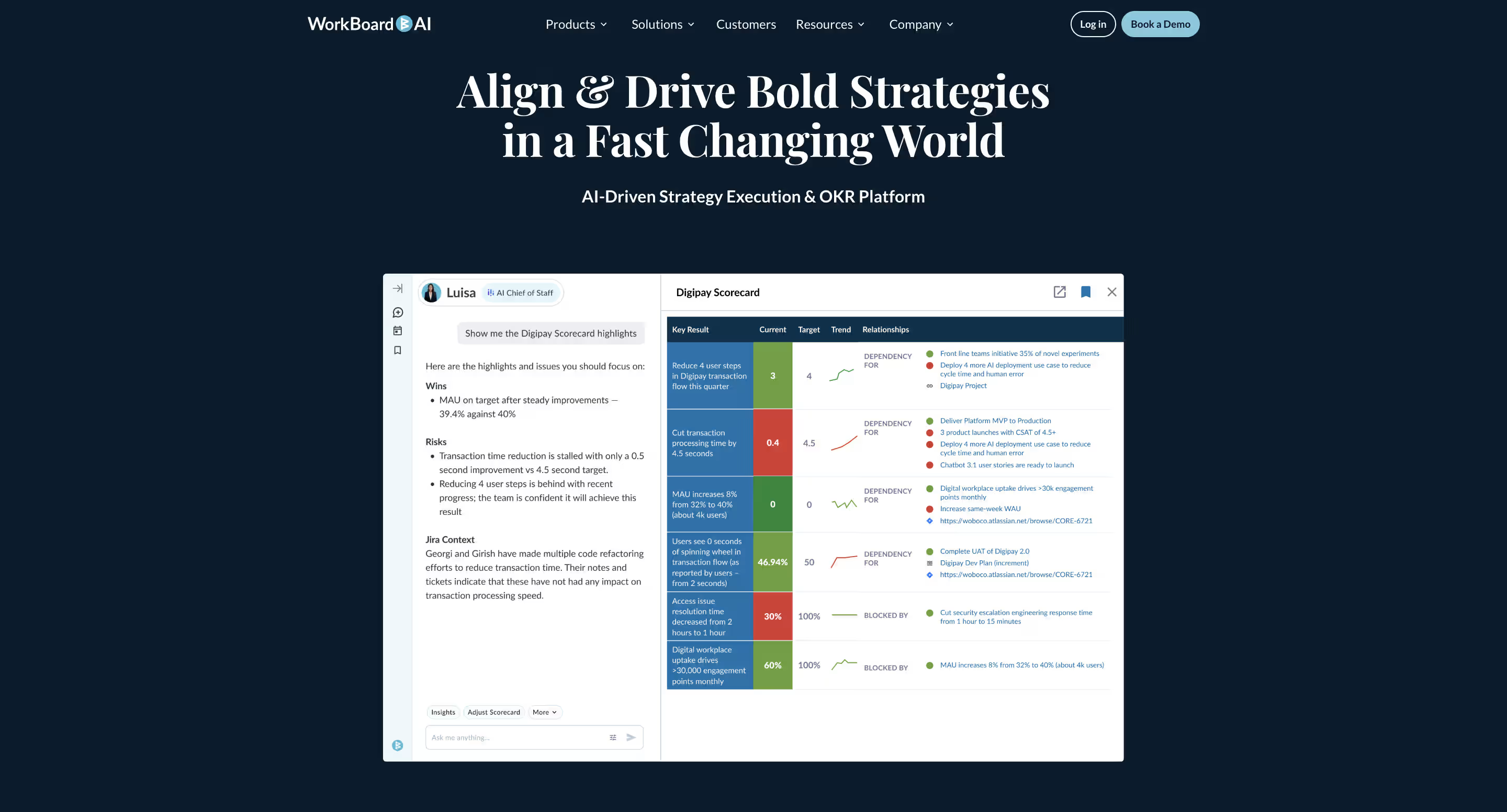
With a strong emphasis on strategy execution, WorkBoard is a trusted solution for organizations looking to improve their operational effectiveness and achieve their business goals. The platform features scorecards and executive briefings to facilitate this strategy execution.
In practice, WorkBoard works best for leadership teams that want a clear line of sight from strategy to execution; it's less suited to very small teams that just need a simple OKR tracker.
Key Features:
- Generative AI: Integrated AI simplifies aligning strategies and enhances decision-making capabilities
- Collaboration: Promotes collaboration across teams for better alignment
- Continuous feedback: Allows for continuous feedback and performance tracking
- Executive reporting: Scorecards and executive briefings for leadership
- Strategy execution: Strong link between high-level strategy, OKRs, and execution
Why Choose It Over Competitors: Choose WorkBoard if you're an enterprise that needs a platform built for strategy execution, with executive-level scorecards and briefings that connect strategic goals to operational execution.
Limitations: Overkill for small teams that just want basic OKR tracking instead of full strategy execution. Requires a more formal rollout and ongoing leadership involvement to get full value.
Pricing: Pricing is not publicly available. You can book a demo with the WorkBoard team.
G2 rating: 4.7/5
Best-Fit Summary: Choose WorkBoard if you're an enterprise that needs strategy execution tools with executive reporting and cross-functional alignment.
11. Workleap
Best for: Startups that need modular, budget-friendly OKR tools
Overview:
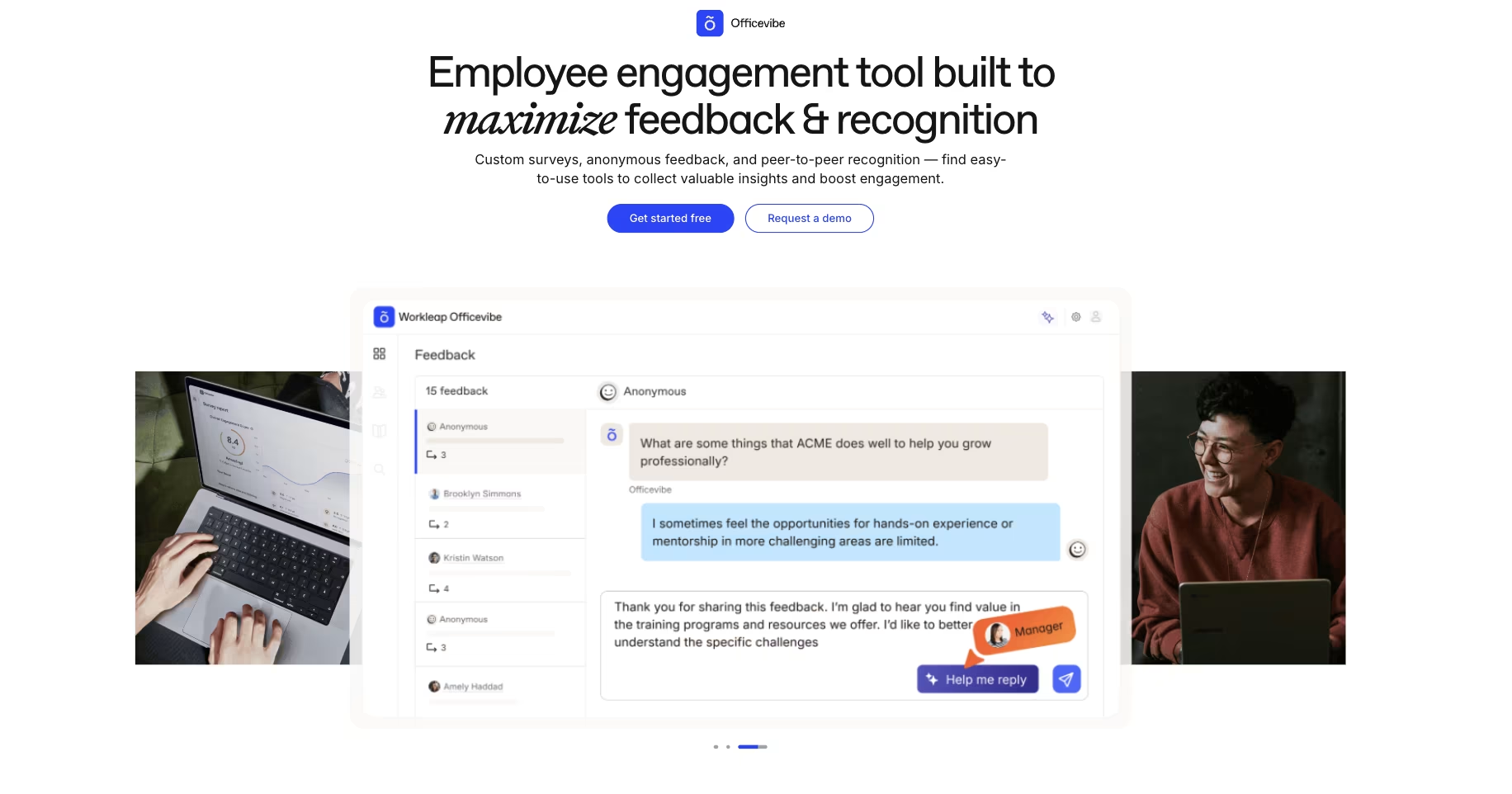
Workleap integrates into your goal-setting and performance management processes, allowing teams to stay focused on what truly matters.
From a practical standpoint, Workleap tends to work best for small to mid-sized teams that want a clean, intuitive experience and don't have the time or appetite for a complex enterprise rollout.
Key Features:
- Visual OKR displays: Display OKRs in a way that everyone can see their role in achieving team goals, promoting collaboration and support
- Flexible goal adjustment: Teams can easily adjust their goals as needed, keeping everyone aligned with changing priorities
- Task prioritization: Help your teams prioritize tasks that make a real difference, especially when resources are tight
- Progress reports: Get reports on goal progress for teams and individuals, allowing leaders to track performance and make informed decisions
- Continuous reviews: Support for continuous performance reviews and 360 feedback
Why Choose It Over Competitors: Choose Workleap if you're a startup or small team that needs modular pricing with the option to add features as you grow.
Limitations: Not a full HRIS; it doesn't handle core HR like payroll or benefits, so you still need additional systems. Some users find customization and mobile experience limited, and the modular pricing structure can feel confusing.
Pricing:
- Free forever plan available for small teams
- Essential Plan: $3.50/person/month
- Pro: $5/person/month
G2 rating: 4.7/5
Best-Fit Summary: Choose Workleap if you're a startup that wants modular, budget-friendly tools with the option to scale features as you grow.
12. Betterworks
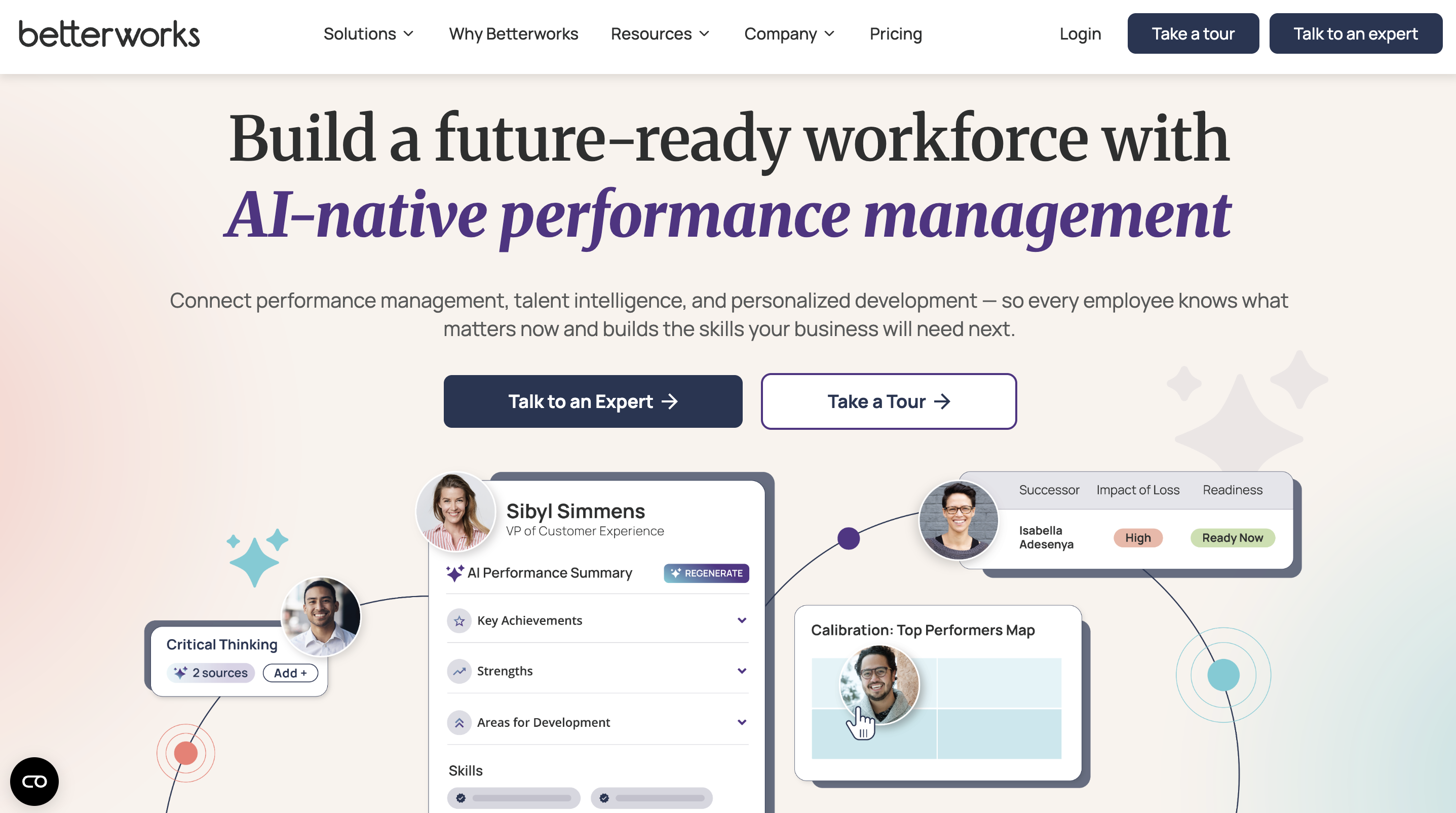
Best for: Enterprises that want continuous performance management and OKRs in one system
Overview:
Betterworks combines OKR tracking with continuous performance management, built for large organizations that want goal-setting, ongoing feedback, and formal reviews running in the same platform rather than stitched together across tools.
In practice, Betterworks works best for enterprises with a mature performance-management process already in place; smaller teams that just want lightweight OKR tracking may find it more platform than they need.
Pros:
- Strong continuous feedback and check-in tools built around goal progress
- Highly customizable performance review forms
- Solid integration capabilities for larger tech stacks
Cons:
- Pricing isn't publicly disclosed — requires a custom quote regardless of team size
- Skews heavily toward enterprise use cases; overkill for small or early-stage teams
Pricing: Not publicly disclosed. Request a custom quote.
G2 rating: 4.3/5
Best-Fit Summary: Choose Betterworks if you're an enterprise that wants OKRs tightly bundled with continuous performance management and can commit to a custom rollout.
13. Perdoo
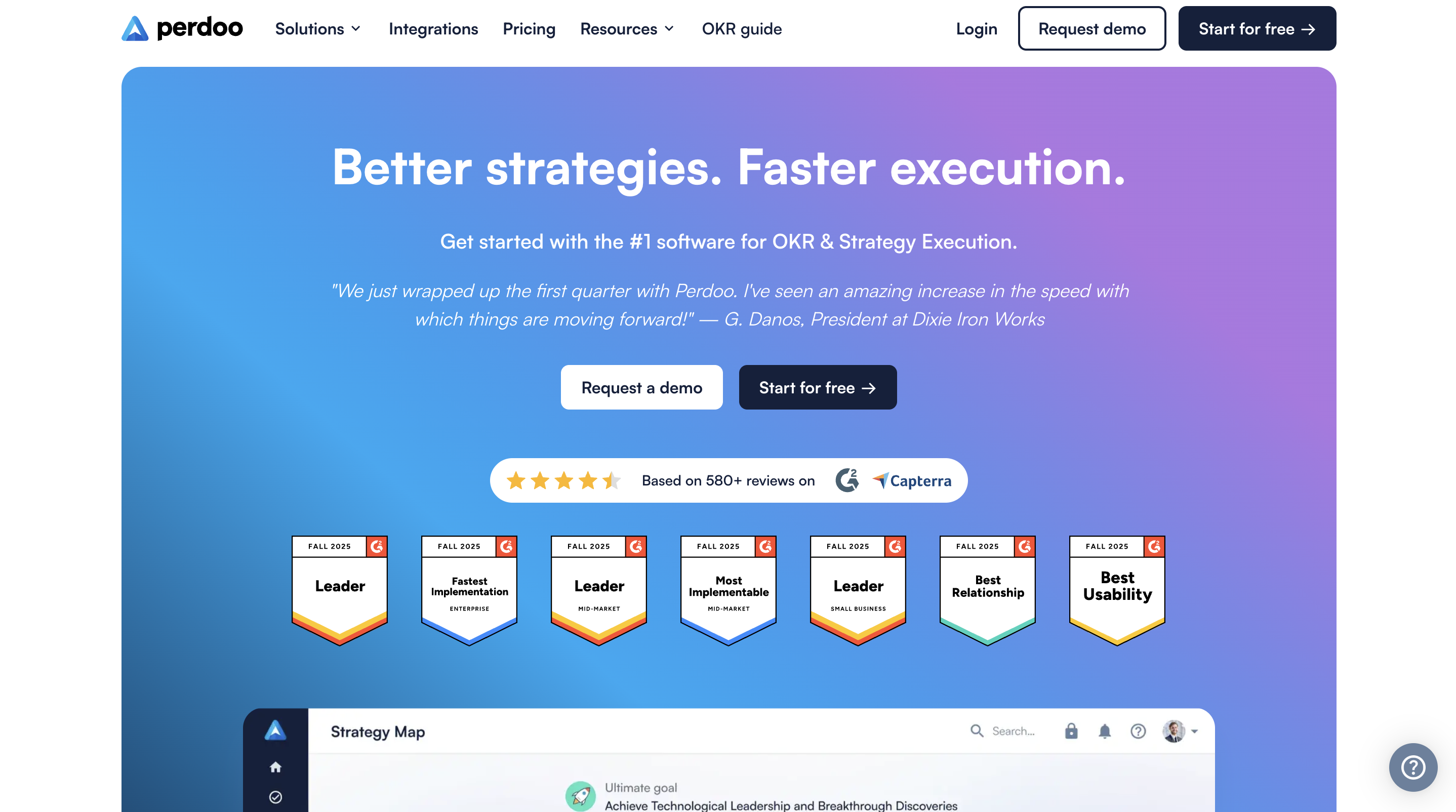
Best for: Teams that want OKRs explicitly cascaded from a documented company strategy
Overview:
Perdoo positions itself less as an "OKR tracker" and more as a strategy execution platform — Strategy Maps and Cascade Views connect company-level strategic pillars down through team and individual OKRs, so goal-setting stays visibly tied to the bigger plan rather than existing as a standalone list.
Perdoo works best for organizations that want to start from strategy and cascade down; teams that just want a simple, lightweight goal tracker may find the strategic layer more than they need.
Pros:
- Free plan for up to 5 users one of the most generous free tiers in this category
- Strong strategic cascading tools (Strategy Maps, Cascade Views, Strategic Pillars)
- High G2 rating with a large review base
Cons:
- Ease-of-use ratings trail lighter, more minimal competitors on G2
- Better suited to strategy-first organizations than teams wanting a quick, no-frills tracker
Pricing: Free for up to 5 users. Paid plans scale from there verify current tiers on Perdoo's pricing page before publishing.
G2 rating: 4.4/5
Best-Fit Summary: Choose Perdoo if you want OKRs visibly and explicitly tied to a company strategy map, and you're a small team that can take advantage of the free tier.
14. Peoplebox
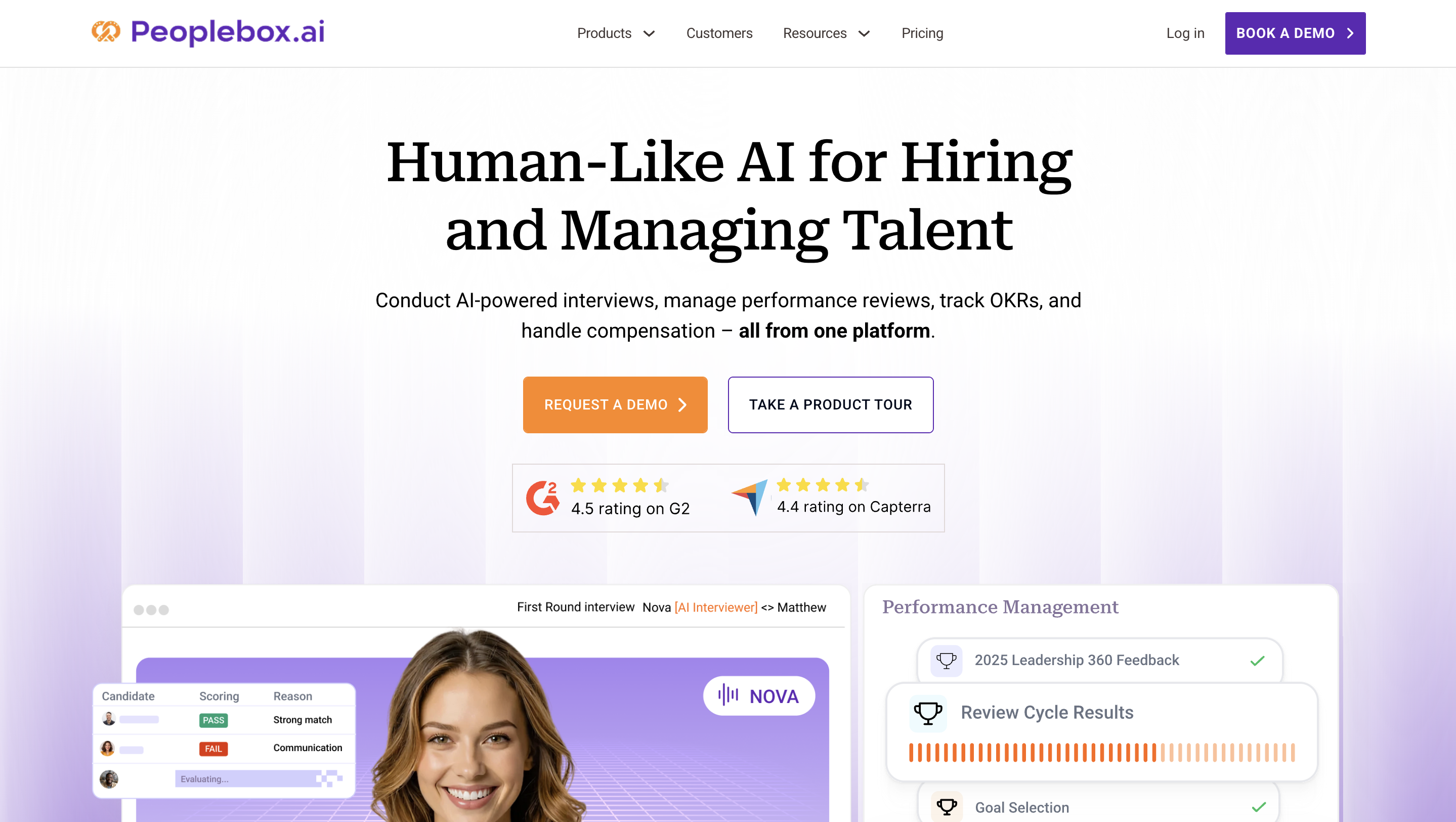
Best for: Teams that want OKRs bundled with business reviews and project management, not just a standalone tracker
Overview:
Peoplebox combines OKR tracking with business review workflows, KPI dashboards, and project management integrations. It's aimed at teams that want goal check-ins to happen inside existing review cadences rather than as a separate quarterly ritual in a disconnected tool.
Peoplebox works best for teams that want OKRs, project tracking, and business reviews under one modular pricing structure; teams wanting deep, dedicated performance-management features may prefer a tool built specifically around that.
Pros:
- Transparent, published pricing across all tiers
- Modular plans pay for OKRs alone or bundle with performance/engagement
- Business review and KPI-board features not common in pure OKR tools
Cons:
- Some reviewers note less depth in performance-management-specific features compared to dedicated tools like Lattice
Pricing:
- OKR Platform: $8/user/month
- Full Suite – Professional: $12/user/month
- Full Suite – Premium: $15/user/month
- Enterprise: Custom quote
G2 rating: 4.5/5
Best-Fit Summary: Choose Peoplebox if you want OKRs bundled with business reviews and project management under transparent, modular pricing.
15. Quantive
Best for: Enterprises in the Microsoft ecosystem, especially those migrating off the now-retired Viva Goals
Overview:
Quantive (formerly Gtmhub) is a strategy execution platform built around OKRs, with AI-powered planning tools and native integrations across Microsoft Teams, Azure DevOps, Power BI, Planner, and Excel.
Worth knowing: Microsoft officially retired Viva Goals on December 31, 2025, citing low adoption, and is not replacing it with another in-house product. Quantive has positioned itself as a direct migration path for former Viva Goals customers, with dedicated migration tooling and promotional first-year pricing for switchers.
Pros:
- Deep, genuine integration with the Microsoft ecosystem (Teams, Azure DevOps, Power BI)
- Active, dedicated migration tooling for former Viva Goals users
- AI-powered planning and real-time progress dashboards
Cons:
- Standard pricing isn't public requires a custom quote outside the migration promotion
- Best fit skews toward larger orgs already invested in Microsoft tools; less natural fit otherwise
Pricing: Not publicly listed for standard plans. Migration-specific promotional pricing has been offered to former Viva Goals customers (verify current terms before publishing). Request a quote for standard pricing.
G2 rating: 4.6/5 (Quantive StrategyAI)
Best-Fit Summary: Choose Quantive if you're already deep in the Microsoft ecosystem, or if you're migrating off the retired Viva Goals and want the closest, best-supported transition path.
Best OKR Software for Startups
- ThriveSparrow – Employee success platform with OKRs, performance, and engagement
- Weekdone – Affordable and easy-to-use with weekly check-in rhythm
- ClickUp – Flexible goal-setting alongside project management
- Profit.co – Structured OKR templates with AI assistance
- Workleap – Cost-effective with modular pricing
Best OKR Software for Enterprises
- Lattice – Integrates OKRs with performance management for large organizations
- WorkBoard – Built for enterprise-scale strategy execution
- Leapsome – OKRs, feedback, and learning in one platform
Best Free OKR Software Options
If you're a small team or startup looking to test OKR software without upfront costs, these platforms offer free plans:
- Asana – Free for up to 2 users; good if you want goals tied to tasks
- ClickUp – Free forever plan with customizable goal tracking
- Weekdone – Free for 1-3 users with weekly check-in rhythm
- Workleap – Free plan available for small teams
Important note: Free plans are good for small teams, but growing HR teams usually need better reporting, performance connection, and manager visibility. If goal tracking becomes critical to your business, consider paid plans with stronger analytics and integrations.
Best OKR Software by Use Case
What to Look for in OKR Software
When evaluating OKR platforms, focus on these factors:
1. Goal Alignment and Cascading: Can individual goals connect to team and company objectives? Look for visual alignment maps or tree views that show how goals cascade. This helps employees understand how their work contributes to bigger priorities.
2. Real-Time Progress Tracking: Does the platform support check-ins, status updates, and automated reminders? Weekly or biweekly tracking keeps goals alive. Without this, OKRs become quarterly documents that nobody updates until the review meeting.
3. Reporting and Analytics: Do managers get dashboards that show progress by team, department, or individual? Look for heatmaps, trend analysis, and drill-down capabilities. Good analytics help leaders spot patterns and make decisions faster.
4. Integrations: Does it connect with tools your team already uses—Slack, MS Teams, Jira, or Google Workspace? Native integrations reduce friction. If people have to log into a separate tool to update goals, adoption will drop.
5. Ease of Use: Is the interface intuitive? If updating goals feels like admin work, adoption will drop. Look for clean dashboards and simple workflows that don't require heavy training.
6. Pricing Clarity: Is pricing transparent? Avoid platforms that hide pricing behind sales calls unless you're evaluating enterprise-level tools. Transparent pricing helps you budget and compare options faster.
7. Performance Management Features: Do you need OKRs connected to performance reviews, 360 feedback, or development plans? Some platforms bundle these; others focus only on goals. If you want performance reviews tied to goal progress, look for integrated tools.
8. AI-Powered Insights: Does the platform use AI to generate goal recommendations, analyze text feedback, or spot trends? This can save time and surface patterns you'd miss manually.
OKR Software vs Goal Management Software
OKR software is built around objectives, key results, alignment, ownership, and progress tracking. Goal management software is broader. It may include employee goals, performance goals, personal development goals, or project goals.
If you need structured OKRs with cascading objectives and quarterly cycles, use dedicated OKR software. If you need flexible goal-setting across multiple contexts (personal, team, project), goal management software may fit better.
Why Teams Need OKR Software
Spreadsheets are fine when five people are tracking goals. They break down when multiple teams, managers, and departments need visibility.
That's when OKR software becomes useful. It gives every objective an owner, every key result a progress update, and every leader a clear view of what is on track.
Why teams switch to OKR software:
- They need more than static goal documents
- They want real-time progress tracking
- They need manager-level reports without manual work
- They want goal alignment across departments
- They need check-ins and accountability built in
- They want goals connected to performance reviews
- They need employee engagement tied to outcomes
- They want AI-powered insights from goal data
- They need transparent pricing and scalable tools
- They want one connected platform instead of stitching tools together
According to Gallup, companies with highly engaged teams see:
- 21% higher profitability
- 41% lower absenteeism
- 59% less turnover
Source: Gallup workplace engagement research
For any growing organization, using an OKR system isn't about adding control, it's about creating clarity, focus, and momentum.
How to Choose the Right OKR Software
Ask yourself:
1. Do you only need OKR tracking? If yes, Weekdone or Profit.co might be enough.
2. Do you need OKRs connected to performance reviews? Look at ThriveSparrow, Lattice, or Leapsome.
3. Do you need OKRs connected to engagement surveys? ThriveSparrow or Culture Amp.
4. Do managers need real-time reports without manual work? Look for dashboards with drill-down analytics (ThriveSparrow, Lattice).
5. Do you need AI-powered insights from goal data? ThriveSparrow, Profit.co, or Leapsome.
6. Do you need goals connected to tasks and projects? Asana or ClickUp.
7. What's your budget?
- Free plans: Asana (up to 2 users), ClickUp, Weekdone (1-3 users), Workleap
- Affordable: ThriveSparrow ($3/employee/month), Weekdone ($9/user/month)
- Enterprise: Lattice, WorkBoard (custom quotes)
8. How easy is it for employees to use?
- Simplest: ThriveSparrow, Weekdone, Workleap
- More complex: Lattice, Leapsome, WorkBoard
Want goal tracking that connects with performance reviews and engagement data?
Try ThriveSparrow Goals free for 14 days. 👉 Start your free trial!
When Should You Not Use OKR Software?
OKR software is not always the answer. Here's when you should wait:
- If your team has fewer than 5 people and simple goals, a spreadsheet may work fine
- If your biggest problem is task tracking, use Asana or ClickUp first for project management
- If your company has no goal-setting rhythm yet, fix the process before buying software
- If managers will not update goals regularly, even the best OKR tool will fail
OKR software only works when leadership supports regular check-ins and progress updates. Without that commitment, the tool becomes another unused login.
Final Verdict: Which OKR Software Should You Choose?
1. Choose ThriveSparrow if you want OKRs connected with performance reviews, engagement surveys, and employee feedback in one platform.
2. Choose Lattice if performance management is your main priority and your team has time for a heavier rollout.
3. Choose Profit.co if you want a dedicated OKR platform with templates and structured goal-setting workflows.
4. Choose Weekdone if your team wants simple weekly check-ins and lightweight OKR tracking.
5. Choose Asana or ClickUp if you want goals tied closely to daily tasks and project workflows.
Choosing OKR software is not just about tracking goals. It is about making sure goals stay visible, owned, and useful after planning week is over.
Before committing, take advantage of the free trials each platform offers. Testing them hands-on will give you valuable insight into usability, responsiveness, and whether the tool truly fits your team's way of working.
The best choice is the one that helps employees stay focused and accountable while giving leaders the visibility they need to support their teams.
Want OKRs that stay connected to performance reviews, feedback, and engagement insights? Try ThriveSparrow free for 14 days and see how your team can track goals without chasing updates.
👉 Try ThriveSparrow free for 14 days!
FAQs
1. What is the best OKR software?
The best OKR software depends on your team size, budget, and needs. For most growing HR teams, ThriveSparrow is a strong choice because it connects goal alignment, performance reviews, and engagement surveys in one platform starting at $3/employee/month. For startups on a budget, Workleap has modular pricing options.
2. What is the best OKR software for startups?
For startups, look at ThriveSparrow (simple setup, $3/employee/month), Workleap (modular pricing), Weekdone (affordable, weekly check-ins), or ClickUp (free tier with flexible goal tracking). Choose based on whether you need just OKRs or a full employee success platform.
3. What is the best OKR software for enterprises?
For enterprises, Lattice, and WorkBoard are top choices. Lattice integrates OKRs with performance management, and WorkBoard focuses on strategy execution with executive scorecards.
4. What is the cheapest OKR software?
Workleap, Asana (up to 2 users), and ClickUp offer free plans for small teams. Weekdone is free for 1-3 users. For paid plans, ThriveSparrow Goals starts at $3/employee/month, and Weekdone starts at $9/user/month.
5. Which OKR software integrates with Slack?
ThriveSparrow, Lattice, Profit.co, Weekdone, and Asana all integrate with Slack. ThriveSparrow and Lattice offer native Slack integration for goal updates and recognition workflows.
6. Can I use OKR software for performance reviews?
Yes. Platforms like ThriveSparrow, Lattice, Leapsome, and 15Five connect OKRs to performance reviews, so managers can tie goal progress directly to employee evaluations and development plans.
7. What is the difference between OKR software and project management software?
OKR software focuses on strategic goal alignment and progress tracking (objectives and key results). Project management software (like Asana or ClickUp) focuses on task execution and workflow management. Some tools, like Asana and ClickUp, offer both—so you can connect goals to day-to-day tasks.
8. Do I need OKR software if I use spreadsheets?
Spreadsheets work for small teams with simple goals, but they break down as you scale. OKR software gives you real-time tracking, automated reminders, visual alignment, and manager dashboards—without manual updates or version control issues.
9. What is the best free OKR software?
The best free OKR software depends on your use case. Asana (up to 2 users), ThriveSparrow (all in one employee engagement soaftware) and ClickUp work well if you want goals tied to tasks. Weekdone may work for small teams (1-3 users) that want a weekly OKR rhythm. Free plans are helpful, but larger teams usually need stronger reporting and admin controls.