






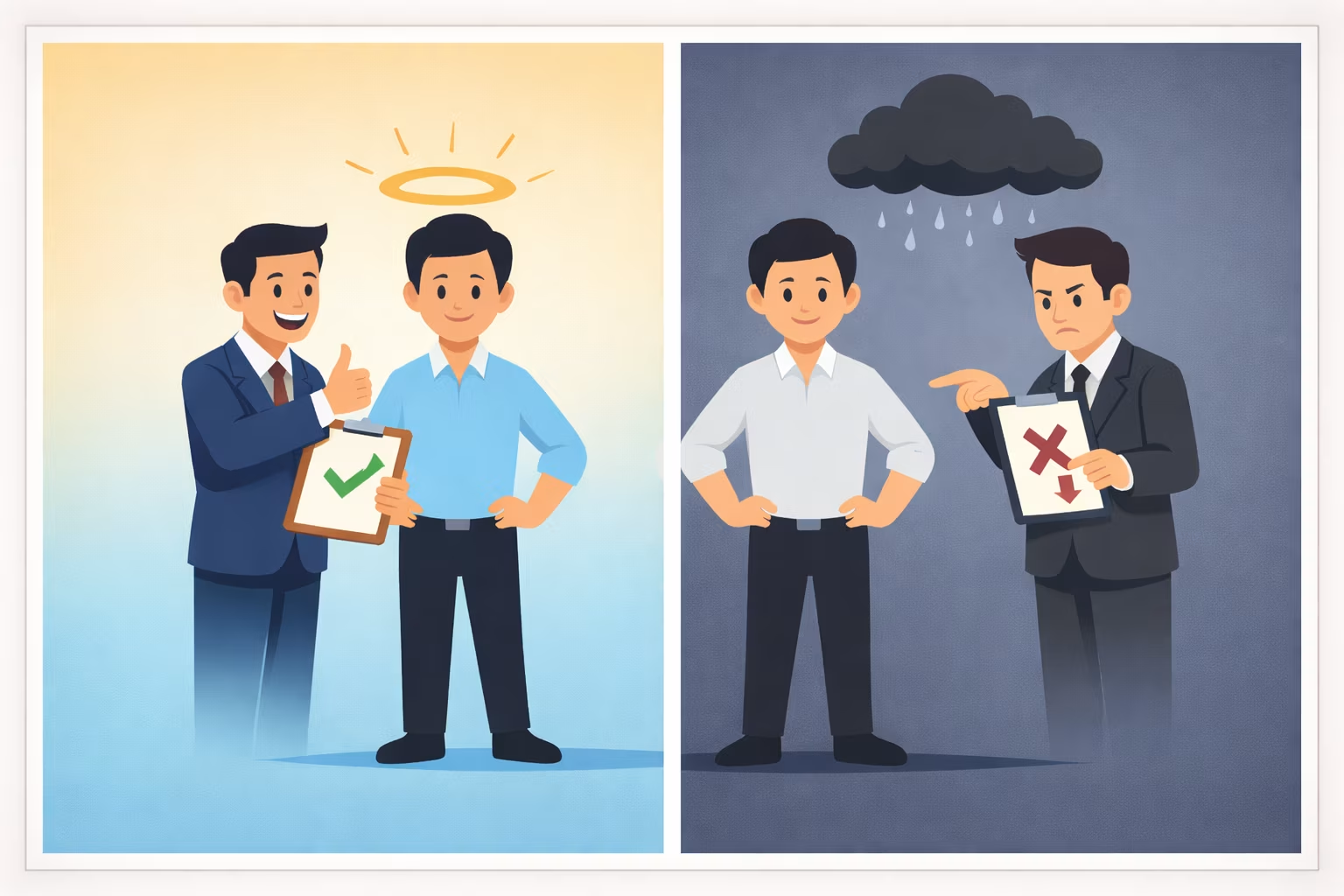





One positive trait shouldn't make someone a star performer — and one bad day shouldn't tank an entire career. But that's exactly what happens when the halo and horn effect creeps into your performance reviews.
These cognitive biases trick your brain into letting a single trait — good or bad — color an entire evaluation. The employee who nails presentations gets rated highly on leadership and teamwork without real evidence. The one who botched a project six months ago can't catch a break, no matter how solid their recent work is.
You're not a bad manager for doing this. You're human. But when bias drives reviews, the wrong people get promoted, the right people leave, and your team stops trusting the process. Many organizations address this challenge by combining structured review processes with standardized performance evaluation methods that reduce subjective decision-making.
Here's how to spot the halo and horn effect, understand why these cognitive biases happen, and—most importantly—build a performance review process that evaluates employee performance instead of personality. You'll also learn how to build a performance review process that helps managers make fairer decisions using structured criteria, multiple feedback sources, and objective performance data.
What Is the Halo and Horn Effect?
The halo and horn effect are cognitive biases where a single positive or negative trait unfairly influences how we evaluate someone's overall performance. In performance reviews, these biases cause managers to judge employees based on one standout strength or one isolated mistake instead of their overall contributions. Left unchecked, they can lead to unfair ratings, poor promotion decisions, and lower employee trust. These biases have been shaping workplace decisions since psychologist Edward Thorndike first identified them in the 1920s. They're mental shortcuts your brain uses to make faster judgments—but faster doesn't always mean accurate.
What Is the Halo Effect?
The halo effect is a cognitive bias where one positive quality causes people to assume someone performs well in unrelated areas. In performance reviews, this often leads managers to overrate employees because of one standout strength rather than evaluating each competency independently. Using competency-based evaluation criteria makes it easier to assess employees fairly instead of relying on first impressions.
Think about that colleague who always speaks confidently in meetings stands up, makes eye contact, uses the right buzzwords. Before you know it, you're assuming they're also great at problem-solving, project management, and team leadership. But do you actually have evidence for any of that? Probably not. Your brain just filled in the blanks.
Research shows this bias often starts with something as superficial as physical appearance. It's called the "what is beautiful is good" principle people perceived as conventionally attractive are more likely to be rated as trustworthy, intelligent, and emotionally stable. But it's not just about looks. An impressive presentation style, an Ivy League degree, or even something as simple as showing up five minutes early can trigger the same effect.
What Is the Horn Effect?
The horn effect works in reverse — and it can be even more damaging.
One negative impression spreads across everything else about a person, like a drop of ink in a glass of water. Named after the devil's horns (versus a saint's halo), this bias means a single bad moment can define someone's entire reputation in your mind.
Consider an employee who stammers during a high-stakes presentation. After that one rough moment, you might unconsciously start questioning their intelligence, their work ethic, and their ability to handle complex tasks. None of those things are related to public speaking anxiety, yet the horn effect ties them all together.
And this isn't just a psychological theory — it's something researchers have observed in real workplace evaluations. A study by Scullen, Mount, and Goff, published in the Journal of Applied Psychology, analyzed ratings from 4,492 managers and found that rater bias explained 62% of the variation in performance ratings, while actual performance explained only 21%. In other words, managers' impressions often influenced ratings more than employees' real performance.
The consequences don't stop there. Once someone earns a negative reputation, every future action is often viewed through that same lens. A missed deadline, one difficult client interaction, or a single presentation gone wrong can quietly shape months of future evaluations, even when the employee consistently performs well afterward.
The research backs this up beyond the workplace too. Studies have found that individuals perceived less favorably often receive harsher treatment across a wide range of situations, including legal settings where they receive longer and more severe sentences. If first impressions can influence courtroom decisions, imagine how easily they can shape everyday performance reviews.
Halo Effect vs Horn Effect: How Bias Impacts Performance Reviews
Both are cognitive biases that let one trait hijack an entire judgment — the difference is direction. The halo effect takes a single positive trait and lets it inflate everything else. The horn effect takes a single negative trait and lets it drag everything else down. Same mental shortcut, opposite outcome.
These biases become even more noticeable when organizations don't have a structured review framework. A well-designed performance management process ensures managers evaluate measurable outcomes instead of isolated incidents.
Picture two employees on the same team. One nails every client presentation and gets rated "strong leader" — despite never having led a project. The other fumbles a single all-hands demo and gets rated "needs improvement" across the board, even though her actual deliverables are ahead of target. Neither rating reflects the work. Both reflect a manager's brain doing what brains do: taking a shortcut instead of checking the evidence.
How These Biases Work in the Brain
Your brain relies on mental shortcuts called heuristics to process the overwhelming amount of information you encounter every day. Researchers Fisicaro and Lance identified three specific ways the halo effect operates: through overall impressions that override details, individual traits that color everything else, or simply our inability to separate different behaviors into distinct categories.
But there's something deeper going on. Your mind craves consistency. When you encounter information that contradicts your first impression of someone — say, a "disorganized" employee delivers a flawless project — it creates psychological discomfort. Psychologists call this cognitive dissonance. Rather than update your mental model, your brain automatically reinterprets the new information to fit what you already believe. ("Oh, they probably had a lot of help on that project.")
Once you've formed an opinion — positive or negative — it becomes surprisingly hard to see someone any other way. That's not a character flaw; it's how human cognition works. But when you're responsible for evaluating people, it's a problem you need to actively work against.
How Does the Halo and Horn Effect Affect Performance Reviews?
Performance reviews should reflect what someone actually contributes. But when the halo and horn effect takes hold, a single trait can hijack an entire evaluation — and the ripple effects go far beyond one unfair review.
When a Single Positive Trait Skews the Entire Review
An employee consistently hits their deadlines. Quarter after quarter, things come in on time. Their manager notices this reliability — and suddenly rates them highly on creativity, leadership, and teamwork too. Areas where there's no real evidence of strong performance.
The manager isn't being deliberately unfair. Maybe the employee is charismatic in meetings, or made a great first impression during onboarding. But personal feelings aren't the same as performance data. And this is especially problematic during annual reviews, where managers evaluate months of work in a single sitting. When you're recalling an entire year, your brain gravitates toward the strongest emotional impressions — not necessarily what matters most.
When a Single Negative Trait Overshadows Everything
Take an employee who botched a presentation six months ago — slides froze, data was wrong, the whole thing was a disaster. Everyone has bad days. But now, every piece of work they submit gets scrutinized through that lens. Their manager can't unsee it, even when this employee is consistently producing solid results.
That negative impression sticks around long after everyone else has moved on. And it creates an ongoing disadvantage that's incredibly difficult to overcome — because how do you fight something your boss doesn't even realize they're doing?
The Impact on Team Morale and Career Growth
Evaluations directly influence who gets promoted, who receives raises, and who gets assigned to high-visibility projects. When those decisions are rooted in impressions rather than contributions, you're building your organizational hierarchy on a foundation of bias.
Employees experiencing the horn effect feel like they can't win no matter what they do, that frustration kills motivation fast. Those benefiting from the halo effect may advance beyond their actual capabilities, setting them up for failure in roles they're not ready for.
Over time, pay gaps widen. Career trajectories diverge based on perception rather than merit. And the people who see it happening — the ones whose quiet, consistent work gets overlooked — those are the people who leave.
Common Triggers in Performance Appraisals
Physical appearance, confidence levels, and speaking ability are frequent triggers. The employee who speaks up confidently in every meeting might be perceived as more productive than equally valuable colleagues who contribute behind the scenes through deep, focused work.
Even seemingly minor things carry disproportionate weight: punctuality, dress code, speech patterns. These can all influence how managers rate overall performance especially when reviews lack clear, objective criteria. Without deliberate safeguards, subjective feelings get dressed up as objective assessments, and fair evaluation becomes nearly impossible.
Real Examples of Halo and Horn Effect in Performance Reviews
The numbers tell a sobering story. Research from Textio found that Black women receive nearly 9x as much non-actionable feedback as white men under 40 and a Harvard Business Review audit revealed that only 9.5% of people of color received mentions of "leadership" in their evaluations, compared to over 80% of white women.
Behind these statistics are real people whose careers get shaped by cognitive biases their managers might not even be aware of.
Example of Halo Effect in Action
Meet John, a marketing manager everyone likes. He's friendly, always has time for a quick chat, remembers your kid's name, brings donuts on Fridays. When performance reviews come around, that likability works magic — colleagues assume John must be crushing it in leadership and productivity.
But look at the actual numbers: his campaign metrics are average and his project timelines frequently slip. His warm personality creates a "glow" that makes everything else look better than it is. Come review time, John gets high marks across the board — not because of what he's accomplished, but because people enjoy being around him.
Being likable matters for team dynamics. But it's not the same thing as performance, and conflating the two shortchanges the people actually driving results.
This is the halo effect in action: one positive trait—John's likability—influences how every other aspect of his performance is evaluated.
Example of Horn Effect in Action
Now consider Sarah. Six months ago, she delivered a presentation that went sideways — slides wouldn't load, data was outdated. Embarrassing? Sure. A reflection of her overall capabilities? Not even close.
But that single moment became the lens through which her manager, Jess, viewed everything afterward. Every small mistake got documented as further "proof" that Sarah couldn't be trusted. At annual review time, Jess marked Sarah "unsatisfactory" across every category, writing: "Sarah makes many mistakes and can't be trusted to work alone."
Meanwhile, Sarah's project delivery rates were above team average and her client satisfaction scores were strong. One bad day had defined an entire year of solid work.
This is the horn effect: a single negative incident overshadows months of strong performance, leading to an unfair evaluation.
How to Avoid the Halo and Horn Effect in Performance Reviews
Bias in performance reviews isn't going away on its own. With only 2% of CHROs believing their performance management system actually works (Gallup), most evaluation systems clearly aren't working. But that doesn't mean you're stuck.
The fix? Structure. When you build objectivity into your process, bias has less room to operate. You're not eliminating human judgment — you're giving it guardrails.
1. Create an Objective Review Process
Start with standardized criteria based on actual job requirements and measurable outcomes.
Building a solid competency framework is the foundation — it defines exactly what "good" looks like for each role, so managers evaluate skills, not vibes.
Clear rubrics tied to role expectations shift the question from "How do I feel about this person?" to "Did they meet the specific objectives we agreed on?"
That reframe makes a bigger difference than you'd expect.
.svg)

2. Use Performance Review Templates
Templates aren't just administrative tools — they're bias-busters.
Well-designed templates bring consistency to review conversations and help you cover all relevant performance areas without getting sidetracked by one memorable moment. They also make it easier to compare performance across your team over time.
Not sure where to start? These performance review examples and phrases give you ready-made language for writing fair, specific evaluations.
The key: every rating should have a "because..." attached to it. Not a vibe — evidence.
3. Incorporate 360 Reviews
One perspective is never the whole story. Relying on a single manager's viewpoint is basically asking for the halo and horn effect to run unchecked.
Gathering feedback from peers, direct reports, and other managers gives you a much fuller picture. The data backs this up: employees who receive feedback from multiple sources are 2.5 times less likely to report bias in their evaluations.
Here's a deeper look at the benefits of 360-degree feedback and why it's one of the most effective ways to counter the halo and horn effect.
Think about Sarah again. If 360 feedback had been part of the process, her peers would have shared how reliable she was on cross-functional projects. Her direct reports might have highlighted her mentorship. That one rough presentation would have been properly contextualized instead of defining everything.
How ThriveSparrow helps:
ThriveSparrow's 360-degree feedback system collects input from peers, managers, and direct reports, then uses AI-powered heatmaps to visualize performance patterns across your organization — making it easy to spot when one reviewer's ratings are way out of line with everyone else's.
4. Focus on Behaviors, Not Traits
"Sarah is disorganized" versus "Sarah missed three project deadlines this quarter." See the difference?
The first is a character judgment that's nearly impossible to disprove. The second is a specific, observable fact that can be discussed, contextualized, and addressed.
Train your managers to catch themselves when they start using trait language. Replace "is" statements with "did" statements. It sounds minor, but it fundamentally changes the nature of the evaluation — from judging personality to assessing performance.
Need practical examples? This guide on how to give effective feedback shows you exactly how to frame observations without falling into the trait-labeling trap.
5. Use Objective Data and Metrics
Numbers don't carry grudges, and they don't play favorites.
Key Performance Indicators — sales targets, project completion rates, customer satisfaction scores, response times — create a foundation for fair evaluation that everyone can understand and verify. They shouldn't tell the whole story, but they should be the starting point for every review conversation, not an afterthought.
6. Seek Input from Multiple Sources
Different people see different sides of performance. Someone quiet in your meetings might be incredibly collaborative with their project team. An employee who seems "disengaged" in group settings might be producing their best work independently.
Collecting diverse perspectives helps you avoid proximity bias (favoring people you see more often) and similarity bias (rating people who remind you of yourself more favorably).
When you put these practices in place, reviews become less about gut feelings and more about real performance. Your team notices the difference — and that trust is what transforms performance reviews from something everyone dreads into something that actually drives growth.
Final Thoughts
The halo and horn effect won't fix itself. Left unchecked, these biases quietly shape who gets promoted, who gets overlooked, and who eventually walks out the door.
But the fix isn't complicated — it's structural. Standardized criteria, 360-degree feedback, behavior-focused evaluations, and real performance data take the guesswork out of reviews and give bias less room to operate. The result? Your best people feel recognized, your struggling performers get actionable feedback, and trust in the process actually rebuilds.
That said, structure without the right tools is just more paperwork.
FAQs
Q1. What are the halo and horn effects in performance reviews?
The halo effect occurs when a single positive trait — like strong presentation skills or a friendly personality — creates an overall favorable impression that inflates ratings across all performance areas. The horn effect is the opposite: one negative characteristic or isolated mistake leads to an unfairly critical evaluation across the board, even in unrelated areas where the employee performs well.
Q2. How do these biases impact workplace evaluations?
These biases lead to inaccurate assessments that directly affect promotions, pay raises, and project assignments. Employees benefiting from the halo effect may advance beyond their capabilities, while those hurt by the horn effect feel stuck no matter how hard they work. Over time, this erodes team morale, widens pay gaps, and drives talent out the door.
Q3. What are some common triggers for halo and horn effects?
Common triggers include physical appearance, confidence levels, communication style, and visibility in meetings. Even seemingly minor traits like punctuality, dress code, or speech patterns can disproportionately influence how managers rate overall performance — especially when reviews lack clear, objective criteria.
Q4. How can managers minimize these biases in performance reviews?
Managers can reduce bias by creating objective review processes with standardized criteria, using structured performance review templates, incorporating 360-degree feedback from multiple sources, focusing on specific behaviors and outcomes rather than personality traits, and relying on measurable data and KPIs as the foundation for every evaluation.
Q5. Why is it important to address these biases in the workplace?
Addressing these biases is crucial for creating fair evaluation systems that promote truly qualified individuals and foster equitable work environments. Organizations that actively counter the halo and horn effect see higher employee engagement, better retention, increased productivity, and stronger overall business results — because the right people end up in the right roles.