









Quick answer: Culture Amp and 15Five solve two different problems, even though they compete for the same budget line. Need employee engagement, survey data, and benchmarking? Culture Amp is the stronger pick. Need managers who actually act on feedback, with weekly check-ins, AI coaching, and continuous conversations? That's 15Five's whole reason for existing.
On price, 15Five is far more transparent: published tiers from $4 to $16/user/month. Culture Amp publishes nothing and puts you through a full sales process instead. One thing worth knowing before you decide based on reputation alone: G2's own data says Culture Amp is easier to set up than 15Five, the opposite of what 15Five's "lightweight" reputation suggests.
Last updated: August 2026. Pricing and review data checked against current G2, Capterra, and each vendor's own pricing page. Sources linked throughout.
How this page was put together: We compared each vendor's official pricing page, current G2 and Capterra review data (linked throughout), and G2's own head-to-head comparison summary for this exact pairing. Where sources conflict, we say so directly.
The Core Difference in One Line
Culture Amp was built for employee listening: surveys, engagement data, and a People Science team that turns survey answers into useful insight.
15Five was built around a different bet entirely. Its founders decided the real problem isn't a lack of data. It's that managers don't use the data they already have. So the product (weekly check-ins, AI coaching, guided 1-on-1s) is built to change what a manager does this week, not to generate a quarterly report someone reads once.
That difference shows up in who actually opens each tool. Culture Amp is what an HR or People Ops team runs. 15Five is what a manager is supposed to check every week. Neither approach is wrong. They're just answering different questions.
Both companies will tell you their approach is the right one. 15Five's own blog post about this exact comparison argues it's "the stronger fit if you need engagement to connect to everything else." That's a real argument. It's also a vendor making the case for itself, which is exactly why we're weighting the independent G2 and Capterra data below more heavily than either company's own marketing.
Culture Amp vs. 15Five: Quick Comparison
Read the full breakdowns: Culture Amp review · 15Five alternatives
Where the Reviews Actually Disagree
Most comparison pages skip this part. It's the most useful part of this one.
G2's own head-to-head comparison for this exact pairing produces a genuinely counterintuitive result. Reviewers told G2 that 15Five is easier to use overall and easier to do business with. Fine, that tracks with 15Five's general reputation. But the same reviewers rated Culture Amp as easier to set up, and rated both platforms equally easy to administer day to day.
That cuts directly against the common wisdom that 15Five is the "quick, lightweight" tool and Culture Amp is the "heavy, slow-to-implement" one. At least one G2 reviewer of 15Five backed this up in their own words: strong development conversations, but "setup takes careful planning." Not the plug-and-play story the marketing suggests.
Ratings genuinely diverge depending on which review site you check. On G2, the two sit close: Culture Amp at 4.5, 15Five at 4.6. On Capterra, the gap looks similar, but the review volumes tell a different story. 15Five has nearly 6x more Capterra reviews than Culture Amp (895 vs. 156). That volume gap matters. A smaller review pool swings more easily on a handful of reviews than a large one does, so percentage-based satisfaction scores can mislead you if you don't check the sample size.
Support quality has a clear directional signal here. G2 reviewers consistently prefer 15Five's ongoing support. For feature direction and roadmap, the preference flips. Reviewers favor Culture Amp's product direction over 15Five's. Practical takeaway: if long-term support responsiveness matters more to your team than feature roadmap, that's a real, reviewer-backed point for 15Five, not just a marketing line.
Cost complaints show up specifically from smaller companies. G2 reviews of 15Five repeatedly flag pricing as high relative to alternatives, especially from small businesses and startups. One reviewer cited a nearly 50% price increase at renewal. At the same time, at least one reviewer switched to 15Five from Culture Amp specifically for cost-effectiveness. Both things are true at once: 15Five can be cheaper than Culture Amp while still feeling expensive in absolute terms to a small team.
Feature-by-Feature Breakdown
1. Engagement Surveys & Employee Listening
Culture Amp wins here, and it's not close. Its People Science team, benchmarking database, and dedicated DEI (diversity, equity, inclusion) survey module are the product's core strength. Not an add-on.
15Five's Engage tier does cover real engagement surveys and benchmarking. But the product's center of gravity is the weekly check-in and manager layer, not deep survey science. If benchmarking depth and DEI-specific measurement are on your checklist, Culture Amp is the more direct fit.
2. Manager Coaching & Continuous Performance
15Five wins here, and it's not close either. Weekly check-ins, guided 1-on-1s, and AI-assisted manager coaching (built out through its 2025 acquisition of Kona) are the entire reason the product exists. It's built to change what a manager does on a Tuesday. Not what an HR team reports on in a quarterly meeting.
Culture Amp's Perform module covers structured reviews and goal tracking, but it isn't built around a weekly manager rhythm the way 15Five is. If your real problem is managers not following through on feedback, 15Five is targeting that exact gap.
3. Recognition
15Five includes built-in peer recognition ("High Five") as a core feature. G2 reviewers mention it favorably, and consistently. Culture Amp has no dedicated recognition module. If recognition matters alongside engagement or performance, that's a point for 15Five.
4. Goal Tracking and OKRs
Both platforms have goal-setting features. Neither treats OKR tracking as a headline strength the way a dedicated OKR platform does. 15Five ties goals into its weekly check-in rhythm, so progress updates happen alongside manager conversations instead of in a separate cycle. Culture Amp's goal tracking sits inside its Perform module and is generally described as more basic than a dedicated OKR platform.
Need real OKR depth? Neither of these is the strongest choice on this specific point. That's a case for looking at the broader field in our Culture Amp alternatives guide.
5. AI Features
Both companies have real AI investment, aimed at different jobs. Culture Amp's AI coach helps HR interpret engagement data. 15Five's AI coaching (Kona) helps managers act on 1-on-1 conversations in the moment. Neither is a reason to pick one platform over the other on its own. They're built for different users inside the same purchase.
6. Analytics & Benchmarking
Culture Amp's benchmarking database is one of the most consistently cited strengths in independent reviews, built from a large, industry-spanning dataset. 15Five has engagement analytics and a predictive impact model, but nothing at Culture Amp's depth for industry benchmarking.
7. Support & Setup
Worth rereading from the disputes section above: G2 reviewer data rates Culture Amp easier to set up and rates 15Five's ongoing support higher. Don't assume either platform's general reputation predicts your actual experience. Ask both vendors for a realistic setup timeline and a current support SLA before you sign anything.
Pricing Comparison
This is one of the clearest transparency gaps in this whole comparison.
15Five publishes real, tiered pricing. Engage runs $4/user/month, Perform runs $11/user/month, Total Platform runs $16/user/month, all confirmed on 15Five's own pricing page. Add-ons like manager coaching and compensation cost more on top of these tiers. 15Five doesn't offer a permanent free plan, but it does offer a free trial.
If 15Five's manager-coaching angle is exactly right but the price is the sticking point, our 15Five alternatives guide covers lighter-weight options built around the same idea.
Culture Amp publishes nothing. No pricing appears anywhere on its site. You go through a full sales cycle (demo, discovery call, quote) before you see a number. Reported minimum annual spend runs roughly $4,500/year, with per-user pricing reported anywhere from $5 to $9/user/month at basic tiers, up to $118 to $122/user/month at enterprise scale.
What this means for your budget: if you want a real number before you'll take a sales call, 15Five gets you there. You can build an actual estimate from its published tiers. Culture Amp requires a conversation first, every time. That said, 15Five isn't universally seen as cheap either. Several smaller companies report the published price still feels steep for what they get, especially at the Total Platform tier.
Can You Use Both at Once?
Rare, and less common than pairing Culture Amp with a pure performance tool like Lattice.
Here's why: 15Five's Engage tier already has real engagement surveys. Running both usually means paying twice for the same job. Most companies that check out both end up picking one instead of layering them. The overlap here runs bigger than in most Culture Amp comparisons, too. Lattice started with almost no engagement features of its own. 15Five was never a pure performance tool to begin with, so the two products step on each other more.
Which Should You Choose?
Here's the short version.
- Choose Culture Amp if employee engagement, survey science, benchmarking, and DEI measurement are your primary need, and your team has the bandwidth to interpret the data yourselves.
- Choose 15Five if your real problem is manager follow-through: check-ins that actually happen, coaching that actually lands, more than deep survey analytics.
- Choose neither, and look at a unified alternative (ThriveSparrow), if you want engagement survey depth and a weekly manager rhythm in the same platform, without picking one focus over the other.
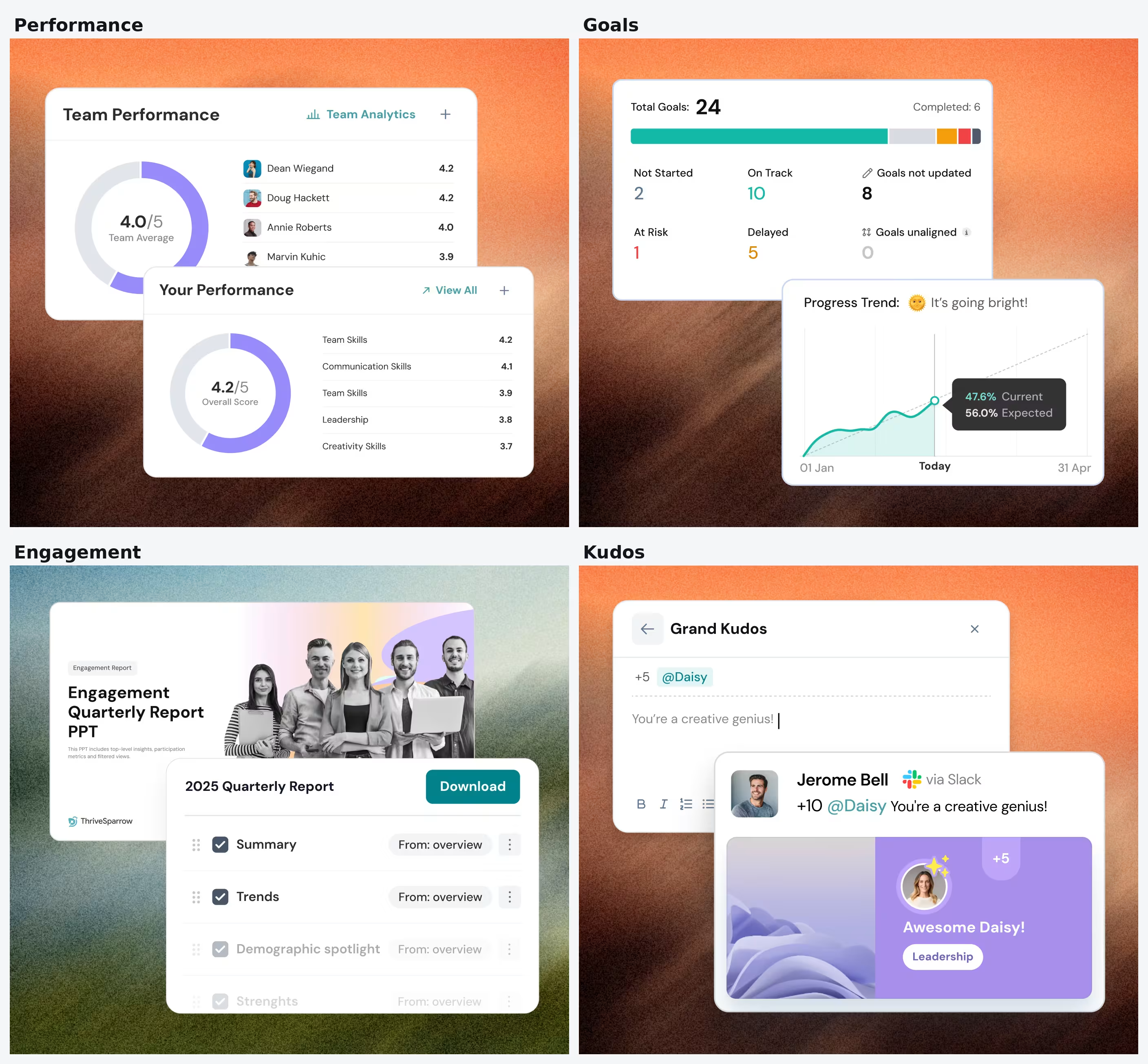
For that third case, ThriveSparrow is built around exactly that gap. It pairs Culture Amp's kind of survey depth and benchmarking with a weekly rhythm closer to what 15Five does for managers, in one platform instead of two. Pricing starts at $2/user/month, with a 14-day free trial, so you're not paying two separate bills to cover both halves of the problem. See the full breakdown: ThriveSparrow vs. Culture Amp.
Start your 14-day ThriveSparrow trial. No credit card needed.
.svg)
Frequently Asked Questions
1. Is Culture Amp or 15Five easier to use?
Depends what "easier" means to you. G2 reviewers rated 15Five easier to use day-to-day and easier to do business with overall. But the same reviewers rated Culture Amp easier to set up initially, the opposite of what most people expect going in, since 15Five has a lighter reputation. Don't assume the general reputation predicts your specific setup experience.
2. Which has better customer support, Culture Amp or 15Five?
G2 reviewer data shows a clear preference for 15Five on ongoing support quality. For product direction and feature roadmap, reviewers preferred Culture Amp instead. Those are two different things: support responsiveness now versus where the product is headed. They point in opposite directions here.
3. Which is cheaper, Culture Amp or 15Five?
15Five is dramatically more transparent: $4 to $16/user/month, published on its own site. Culture Amp publishes nothing and requires a sales call, with a reported minimum around $4,500/year. That said, some G2 reviewers still find 15Five's pricing steep for smaller teams, especially at the Total Platform tier. "More transparent" isn't automatically "cheapest for you."
4. Should I choose Culture Amp or 15Five if engagement surveys are my main need?
Culture Amp. Its benchmarking database, survey science, and dedicated DEI measurement module go deeper than 15Five's Engage tier, which is solid but not the product's main focus.
5. Should I choose Culture Amp or 15Five if manager follow-through is my main problem?
15Five. Weekly check-ins, AI-assisted coaching, and guided 1-on-1s are built specifically to change manager behavior week to week. That's the entire premise of the product, not a secondary feature.
6. Can I run Culture Amp and 15Five together?
You can, but it's less common than pairing Culture Amp with a pure performance tool. 15Five's Engage tier already includes real engagement surveys, so running both usually means paying twice for overlapping survey capability. Most teams pick one rather than layer them.
7. Is there a cheaper alternative that covers both engagement and manager coaching?
Yes. ThriveSparrow starts at $2/user/month with a 14-day free trial and covers engagement, performance, recognition, and goals in one platform. See the full alternatives comparison for other options.
8. Which is more established, Culture Amp or 15Five?
Culture Amp is the older company, founded in 2010. 15Five has more total G2 reviews (roughly 1,900) versus Culture Amp's 1,539+, though it's actually a close gap, and 15Five also has a slightly higher average rating.
9. Does 15Five's AI coaching actually work, or is it just a marketing feature?
It's a real, distinct product built through 15Five's 2025 acquisition of Kona, an AI-powered manager coach, not just a chatbot bolted onto existing check-ins. G2 reviews mention it specifically and favorably, though as with any AI feature, results depend on whether managers actually use it consistently.
10. What's the real difference between reading 15Five's own comparison page vs. independent reviews?
15Five's own blog post comparing itself to Culture Amp argues it's "the stronger fit if you need engagement to connect to everything else," a real point, but one a vendor is naturally going to make about itself. Independent, review-site data (G2, Capterra) is a more reliable signal, with one caveat: even G2's own comparison summaries can produce counterintuitive results. For example, G2 reviewer data rates Culture Amp as easier to set up than 15Five, despite 15Five's lighter reputation.