That was Take-Two CEO Strauss Zelnick’s reply when Rockstar told him Grand Theft Auto VI would slip a second time.
GTA 6 has been in development for more than eight years. But this isn’t a story about a slow team. It’s a story about what happens to goal alignment and team productivity when a project runs for years, the plan keeps changing and the team keeps growing.
The short answer: GTA 6 has been in development for more than eight years, according to Bloomberg. Early research began in 2015. Full production started in 2020. It launches on 19 November 2026, 13 years after GTA 5.
In October 2026, Rockstar’s leaders told Bloomberg why it took so long: the vision took years to settle, the plan had to shrink, and the team nearly doubled mid-build. Swap the game for a product launch or a system migration, and you have the three things that quietly drain productivity on any long project: a goal people describe differently, scope that’s cut too late, and new joiners who never get the full picture.
This article uses GTA 6’s eight years as a case study. You’ll learn:
- Why unclear goals stall productivity even when everyone works hard, and how to define “done” before you ask for speed
- How to make “stop doing” and “not yet” a normal part of a long project
- How to keep a growing team aligned with a monthly clarity check
Why do people give different answers?
You'll see 13, 11, 8 and 6 years quoted online. Each one counts from a different start line.
We use Bloomberg's "more than eight years", because it comes from Rockstar's own interviews.
The GTA 6 development timeline, 2015–2026
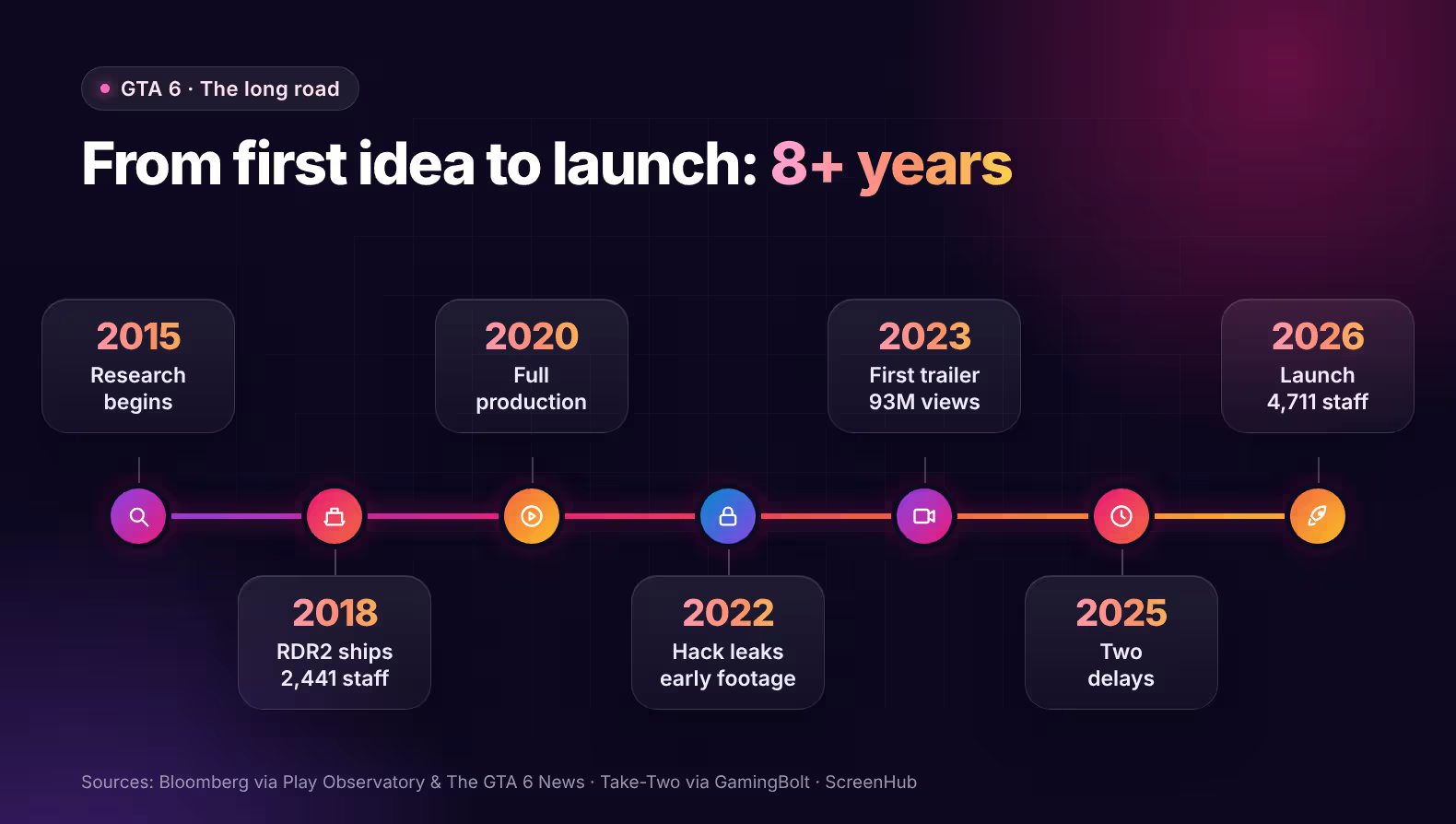
Sources: Bloomberg via Play Observatory and The GTA 6 News; Take-Two via GamingBolt; GamesRadar+; ScreenHub.
Why did GTA 6 take so long?
In October 2026, Rockstar let Bloomberg's Jason Schreier spend a day at Rockstar North in Edinburgh. It was the first time the studio talked openly about the build. Four reasons stand out.
1. The vision took years to settle
Rob Nelson, one of the game's heads of development, described a stretch when the team didn't know what the game was yet. He called it "a dark period."
The arguments were about detail. Should players open the fridge, take out a beer and open it themselves? Or should the game skip that?
2. The plan was too big, so it shrank
Project Americas once covered large parts of North and South America. It was cut back to Leonida, a fictional Florida with Vice City at its centre (Play Observatory).
3. The team nearly doubled mid-build
Rockstar had 2,441 staff when Red Dead Redemption 2 shipped in 2018. By October 2026 it had 4,711, across 12 offices (GTA BOOM). It even opened a Los Angeles studio just for the game's non-player characters. Nelson called the early projections for that work "horrifying."
4. The team wouldn't ship before it was ready
Rockstar delayed the game twice. Its second statement said the extra months would let it "finish the game with the level of polish you have come to expect and deserve" (ScreenHub).
That's when head of publishing Jennifer Kolbe called Zelnick. After the team explained, Kolbe said, "he got it" (GamingBolt).
What can your team learn from GTA 6's eight years?
You don't need 4,711 people for these problems to show up. A six-month project with 40 people across three teams drifts the same way.
Rockstar hasn't said how it manages goals, check-ins or feedback internally. So the lessons below are ours, drawn from what its leaders said on the record. Each one comes with a step you can take this week.
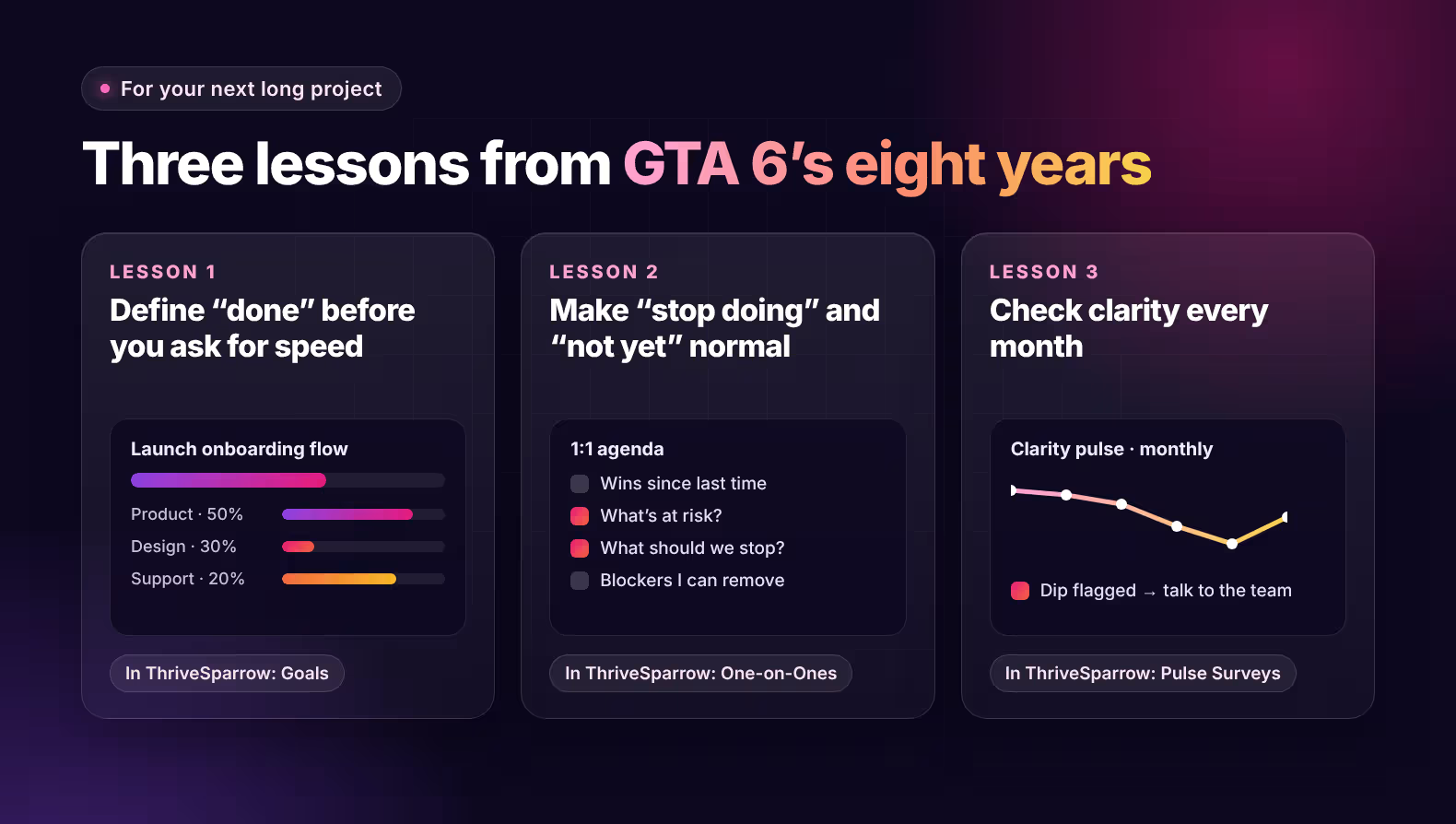
Lesson 1: Define "done" before you ask for speed
The hardest stretch Nelson described wasn't a staffing problem. It was not knowing what the game was. Smart people can work hard for months and still stall if the goal isn't settled.
When the goal is fuzzy, every team fills the gap with its own version. Design builds for one idea of "done", engineering for another. Nobody is slacking. They're just pulling in slightly different directions, and you only find out when the pieces don't fit.
What it looks like in practice. Here's an example of one outcome, broken into weighted team goals:
- Project goal: Launch the new customer onboarding flow by 31 March.
- Product: ship guided setup (50% of progress)
- Design: finish the new screens (30%)
- Support: publish the help articles (20%)
If design stalls at a fifth of its work, the whole project should show it, not just design's own tracker.
Try this week: write your project's outcome as one sentence. Ask three people on different teams to repeat it back. If you get three different answers, fix that before you ask anyone to move faster.
Where spreadsheets fall short. A goals sheet lists goals, but it doesn't show how they connect. It's out of date the moment work moves on. And a stalled team goal stays hidden in its own row while the project total looks fine.
A "dark period" stops being a feeling in the room. It shows up as goals that are unlinked, or flat for weeks.
See every team goal roll up to the project
Link team goals to one project outcome, weight them, and watch progress update as work moves.
See how Goals works →
Lesson 2: Make "stop doing" and "not yet" normal
Project Americas shrank to Leonida over years, not in one panicked week. And the second delay happened because someone was willing to tell the CEO "not yet."
Most teams only cut scope, or admit a date is wrong, when it's too late to do it cheaply. The fix isn't braver people. It's a regular place where bad news is expected.
What it looks like in practice. A 20-minute 1:1 agenda for long projects:
- Wins since last time (2 min)
- What's at risk? (5 min)
- What should we stop doing? (5 min)
- Blockers I can remove (5 min)
- Actions and owners (3 min)
Try this week: add items 2 and 3 to every 1:1 you run. Ask them even when the project looks on track. That's how they become normal.
Where calendar invites and notebooks fall short. The agenda lives in the manager's head. Actions get lost between meetings. And no one can see that the same risk has come up in four different 1:1s.
One-on-Ones and Feedback are free on every ThriveSparrow plan, so cost isn't a reason to skip this step.
Lesson 3: As the team grows, check clarity every month
Rockstar nearly doubled during this project. Every new hire arrived without years of context. And people rarely say "I don't know what we're building" out loud, so confusion hides until a deadline slips.
What it looks like in practice. A three-question monthly pulse:
- "I can explain what we're building and why." (1–5)
- "I know how my work connects to it." (1–5)
- "What's one thing that's unclear right now?" (open text)
Read the trend, not one month's score. If one team's scores drop two months running, that team needs a conversation, not a reminder email.
Try this week: send the three questions to one project team. Share the results with them within a week, along with one thing you'll change.
Where annual surveys fall short. A yearly engagement survey is too slow for a project. By the time results arrive, the decisions they could have changed are already made.
As the team grows, notice who does the quiet work of briefing new joiners. ThriveSparrow Kudos lets anyone thank them with a kudos card. It can be backed by a reward from a marketplace of 800+ gift cards, so the work that keeps a team aligned gets seen.
A monthly 5-question alignment check
Run it with your team on any long project to spot fuzzy goals and late cuts early.
One email with the template. No spam. Unsubscribe anytime.
Is ThriveSparrow a good fit for your team?
ThriveSparrow puts goals, 1:1s, pulse surveys and recognition in one place. That matters on long projects, because the signals that something is drifting are spread across all four.
It's a strong fit if:
- You have roughly 25 or more employees and managers across several teams or locations.
- Your projects run longer than a quarter.
- You want goals, check-ins and feedback in one tool rather than four.
It's not the best fit if:
- You're a team of under 20–25 people; a shared doc and good habits may be enough.
- You need payroll or a full HR system. ThriveSparrow doesn't replace one.
(Fit guidance from People Managing People's 2026 review.)
What it costs. Prices are per employee per month, billed annually, as of November 2026 (pricing page):
For a 40-person team on the Full Platform, that's $360 a month. There's a 14-day free trial.
Setup. Most customers get guided onboarding with a dedicated customer success manager; smaller teams can set it up themselves (People Managing People). G2 reviewers report an implementation time of about a month.
What users say. ThriveSparrow is rated 4.5 out of 5 on G2, from 121 reviews (as of 16 Nov 2026).
A 30-day rollout for your next long project
What we don't know. Rockstar hasn't said how it sets goals, runs check-ins or gives feedback, so we don't describe those practices. Bloomberg's full feature is paywalled. Some details here come from outlets that reported on it. We'll update this post if Rockstar shares more.
Keep your next long project aligned Goals, 1:1s, pulse surveys and recognition in one place, so everyone knows what “done” means.
Start your 14-day free trial →
Conclusion: the lesson isn’t about speed
GTA 6 didn’t take more than eight years because the team was slow. The vision took years to settle, the plan had to shrink, and the studio nearly doubled. Most teams face the same risks on a smaller scale: a fuzzy “done”, cuts that come too late, and confusion nobody says out loud.
Start this week: write “done” in one sentence and ask three people to repeat it back. When you want that habit, and the 1:1s and pulse checks behind it, to run every month, that’s what ThriveSparrow’s Goals, One-on-Ones and Pulse Surveys are built for.
GTA 6 development FAQ
1. Who is leading GTA 6's development?
There's no single game director. Bloomberg names three heads of development: Rob Nelson, Phil Hooker and Aaron Garbut. Jennifer Kolbe leads publishing (Play Observatory).
2. Why did Rockstar bring GTA 6 staff back to the office?
In February 2024, Rockstar asked GTA 6 staff to work in the office five days a week from April. Its email cited productivity, security and the polish the game needed. Bloomberg reported that employees were "not thrilled" (GamesRadar+).
3. Did Rockstar crunch to finish GTA 6?
Rockstar says it tried not to. Kolbe told Bloomberg, "We're not going to finish this game by crunching," and admitted "It's not been perfect." Some employees allege otherwise (GamesRadar+).