


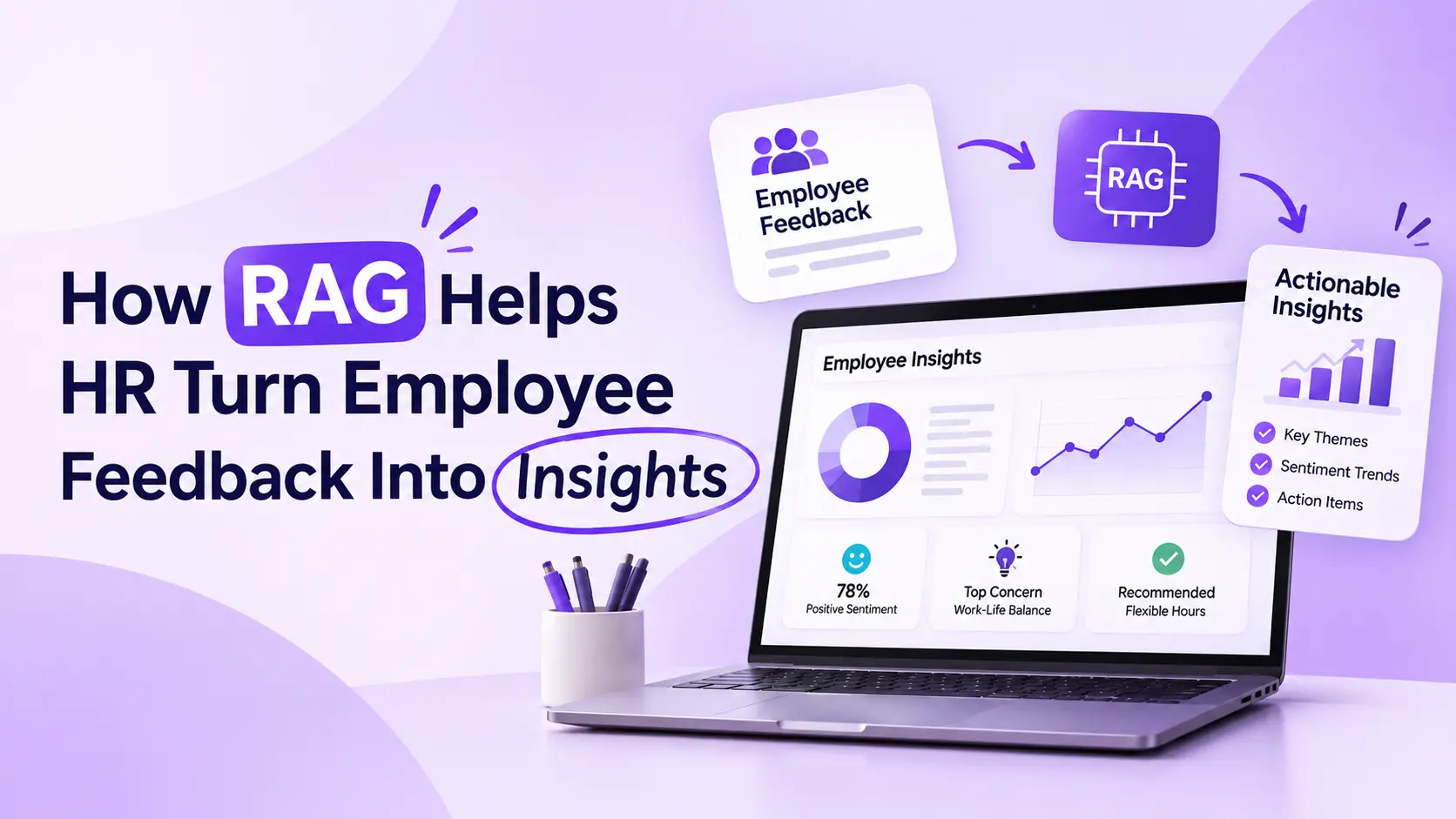


Employee feedback can show where people struggle, what keeps teams motivated, and why engagement changes. The problem is rarely collecting enough information.
HR departments already receive comments through pulse surveys, performance reviews, exit interviews, one-on-one meetings, and engagement questionnaires. The harder task is deciding what deserves attention.
Retrieval-augmented generation, or RAG, can make that process more practical. Instead of treating each comment as an isolated piece of text, RAG lets AI retrieve relevant company information before producing an answer.
For HR teams, that can mean comparing current concerns with earlier surveys, policies, manager notes, or approved workforce data.
Why Employee Feedback Often Produces More Noise Than Clarity
A large engagement survey may generate thousands of written responses. Reading every comment manually takes time, while simple keyword analysis can miss the real meaning.
Imagine that employees never use the phrase “poor workload management.” Instead, they write that deadlines keep moving, evening work has become normal, or one person is covering two roles.
A basic dashboard may treat these as separate topics. An experienced HR professional will recognize that they may point to the same underlying problem.
The challenge becomes even greater when feedback is spread across different systems.
HR teams may need to review:
- engagement survey comments;
- pulse check responses;
- exit interview notes;
- performance review feedback;
- internal support requests;
- manager observations;
- employee questions and suggestions.
Each source shows only part of the picture. Looking at them separately can make an emerging workplace issue appear smaller than it really is.
Where RAG Changes the Feedback Workflow
RAG combines a language model with a retrieval layer. When someone asks a question, the system first searches approved company sources for relevant information.
Only then does the model generate a response based on that material.
That difference becomes useful when HR needs an answer tied to company reality rather than general HR advice.
Example: Complaints About Career Growth
Suppose several employees say that promotion decisions feel unclear.
A standard AI assistant might explain common reasons employees become dissatisfied with career development. That answer may be accurate but still too generic to help.
A RAG system could retrieve the current promotion framework, previous engagement results, career-path documentation, and related employee comments.
HR could then see that the policy itself is clear, but many employees have never received it from their managers.
The problem is no longer simply “career dissatisfaction.” It becomes a communication and management issue that can be addressed more directly.
Organizations building these internal tools may use specialized rag development services to connect AI applications with selected HR systems and company knowledge. The useful part is not text generation alone. It is giving the model access to relevant internal context while controlling what information can be retrieved.
Practical Ways HR Teams Can Use RAG
The strongest use cases appear when HR already has information but lacks an efficient way to connect it.
1. Finding the Real Cause Behind Falling Engagement
An engagement score can tell HR that sentiment has changed. It rarely explains why.
Consider a sales department whose engagement rating falls after two stable quarters. Recent survey comments mention pressure, confusing targets, and frustration with leadership.
A RAG-based tool could retrieve earlier surveys, sales target announcements, management communications, and relevant policy changes.
HR might discover that complaints increased shortly after a new compensation structure was introduced.
That does not prove causation, but it gives the team a much stronger place to investigate.
2. Comparing Feedback Before and After a Workplace Change
Companies frequently run surveys after restructuring, leadership changes, office returns, or new policy rollouts.
The difficulty is comparing new responses with older feedback without manually reviewing hundreds of comments.
RAG can help retrieve material from both periods and surface recurring themes.
For example, employees may have complained about slow decision-making before a reorganization. Six months later, the same issue may appear again under phrases such as “too many approvals” or “unclear ownership.”
Seeing that continuity is more useful than treating the latest comments as a new problem.
3. Preparing Managers for One-on-One Meetings
Managers often enter one-on-one meetings with limited context, especially when they oversee larger teams.
An internal AI assistant could retrieve approved information from previous meeting notes, goals, development plans, and recent feedback.
Before a conversation, the manager might receive a short summary showing that an employee previously asked for more ownership but has since been assigned mainly routine work.
That context can improve the quality of the meeting without requiring the manager to search through several systems.
Sensitive notes would still require strict access rules.
4. Understanding Why Employees Leave
Exit interviews contain useful information, but companies often review them individually rather than as a broader dataset.
Imagine that five employees leave different teams within three months. Their stated reasons include limited development, poor communication, and uncertainty about future roles.
Viewed separately, the exits may seem unrelated.
A RAG system could compare those interviews with engagement surveys, internal mobility records, and career-development documentation.
HR may discover that all five employees worked in departments where promotion paths had not been updated for two years.
That creates a specific question worth investigating instead of a vague conclusion about retention.
RAG Can Make Employee Surveys More Useful
Many organizations run surveys, publish the results, and then struggle with the next step.
A common problem is that managers receive a score and several broad categories but do not know what action to take.
RAG can support a more focused process.
A typical workflow might look like this:
- Identify the question HR needs to answer.
- Retrieve relevant comments and approved company records.
- Compare the current issue with previous periods or related teams.
- Check whether the retrieved evidence supports the suggested pattern.
- Decide what action requires human follow-up.
The last step matters most. AI can organize evidence, but HR still has to decide whether a pattern is meaningful.
Going Beyond Simple Sentiment Scores
Sentiment analysis is useful for identifying broad positive or negative trends. However, workplace feedback rarely fits neatly into three categories.
An employee might write, “My manager is supportive, but priorities change every week.”
The comment contains both positive and negative signals. More importantly, the main problem is not the manager's attitude. It is unstable planning.
A sentiment score can easily miss that distinction.
RAG gives the model another layer of context. If recent team announcements show repeated changes to quarterly priorities, the system can connect the employee's concern with a documented workplace pattern.
That makes the output more useful than simply labeling the comment “mixed.”
Helping Managers Act on Feedback
Feedback becomes valuable only when it changes something.
Managers do not necessarily need access to every employee comment. In many cases, a concise summary of recurring themes is more appropriate.
For example, a manager might learn that team members repeatedly mention:
- unclear weekly priorities;
- limited recognition for completed work;
- few opportunities to discuss career development;
- long approval cycles;
- inconsistent communication between departments.
HR could then work with the manager to choose one or two issues for immediate action.
A team with unclear priorities might introduce weekly planning sessions. Another department may need clearer ownership rules rather than another engagement initiative.
Specific evidence leads to more specific responses.
Where RAG Should Not Replace Human Judgment
HR decisions affect careers, compensation, workplace relationships, and sometimes employment status. That makes blind reliance on AI especially risky.
A RAG system may retrieve relevant information and still produce a misleading interpretation.
An employee could mention burnout after one difficult week. The system might connect that comment with older workload complaints and overstate the seriousness of the pattern.
Context still requires human interpretation.
AI-generated insights should therefore support investigation rather than automatically trigger decisions about performance, promotion, discipline, or retention.
Privacy and Access Need to Be Designed From the Start
Employee data is not ordinary business information.
Performance notes, complaints, survey responses, and exit interviews can contain confidential details. Connecting these sources to an AI tool requires careful permission management.
Not every manager should be able to retrieve the same information as HR leadership.
A practical system should define which sources are available to each user, remove unnecessary personal information, and log access to sensitive records.
Data governance becomes part of the product design rather than an afterthought.
For example, a department manager might receive aggregated feedback themes but never see identifiable exit interview notes.
When RAG Is Most Useful for HR
RAG is not necessary for every employee survey.
A small company with 30 employees may still get better results from reading responses directly.
The technology becomes more valuable when feedback volume grows, information is scattered across multiple platforms, or historical context is difficult to retrieve.
It can also help organizations that run frequent pulse surveys and want to compare results continuously rather than once per year.
In those environments, the main advantage is not replacing HR analysis. It is reducing the time spent searching for the evidence needed to perform that analysis.
Conclusion
Employee feedback is easy to collect but difficult to interpret well.
RAG can help HR teams move beyond isolated survey scores by bringing relevant policies, historical comments, workplace changes, and internal records into the analysis.
Its strongest value appears in practical questions: Why did engagement fall after a reorganization? Are exit interview complaints part of a wider pattern? Did employees raise the same concern six months ago?
Those questions lead to better decisions than another generic summary of positive and negative sentiment.
Used with strong privacy controls and human review, RAG can help HR teams spend less time searching through scattered information and more time addressing the workplace issues employees are actually describing.


