




The short answer: it depends on what you are holding people accountable for
Most teams do not actually need to choose between OKRs and KPIs. They need to decide which framework carries accountability for which kind of work. KPIs hold people accountable for keeping the business healthy. OKRs hold people accountable for changing it. Mix the two up and you end up in one of two bad places: punishing people for ambitious bets that were designed to fall short, or rewarding them for hitting numbers that stopped mattering two quarters ago.
That distinction has become urgent in 2026. Managers are now evaluating work that is partly produced by AI. Org charts are being flattened at a pace not seen in years. And engagement among the very people expected to enforce accountability, the managers, is falling faster than anyone else's. A goal framework that worked fine in 2021 can quietly stop working when the ground underneath it moves this much.
In this guide, we break down what each framework really measures, where each one breaks, which roles need which, and how to run both without burying your managers in admin. Along the way you will hear from five practitioners who have lived with both systems, from crypto tax software and affiliate marketing to dedicated OKR coaching.
Three shifts that reopened the OKR vs. KPI debate in 2026
Three big changes this year turned "OKRs or KPIs?" from a semantic argument into a practical management problem.
1. AI-driven restructuring is flattening the org chart
The wave of AI-attributed job cuts has kept building all year. A running tracker from Programs.com counted more than 180,000 employees affected by AI-related layoff announcements between January and October 2026, spread across roughly 50 companies and already above the full total for 2025. In October, Barclays confirmed around 5,000 role cuts, and its CFO tied them partly to the early effects of AI. A month earlier, Uber cut about 10% of its workforce, with its CEO explaining that the company was removing layers and simplifying team structures.
Fewer layers means wider spans of control. Every remaining manager now owns more people, more dashboards and more goals, which makes it far more expensive to run a fuzzy accountability system.
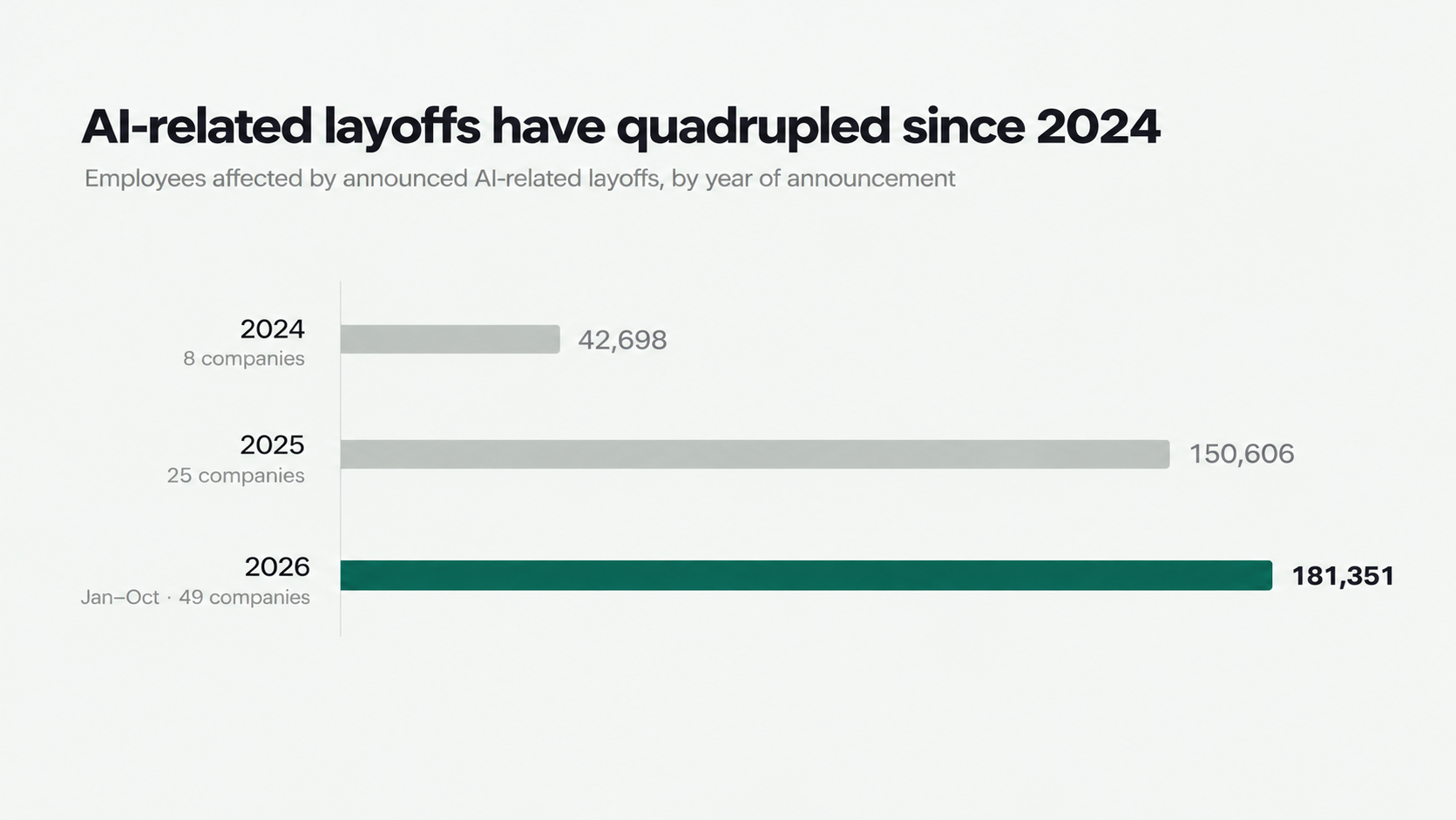
Source: Programs.com AI layoffs tracker
2. Managers are losing their engagement premium
Gallup's State of the Global Workplace 2026 report found that global employee engagement slipped to 20% in 2025, the lowest level since 2020 and the first time Gallup has ever recorded two consecutive annual declines. The bigger story is who is pulling the number down. Manager engagement fell from 31% in 2022 to 22% in 2025, while individual contributors barely moved. Gallup puts the cost of low engagement at around $10 trillion in lost productivity, roughly 9% of global GDP.
This matters for goal frameworks because every accountability system runs through managers. A disengaged manager stops reading the KPI dashboard and turns the weekly OKR check-in into theatre. Yet Gallup also found that in best-practice organizations, 79% of managers are engaged, so the slide is not inevitable.
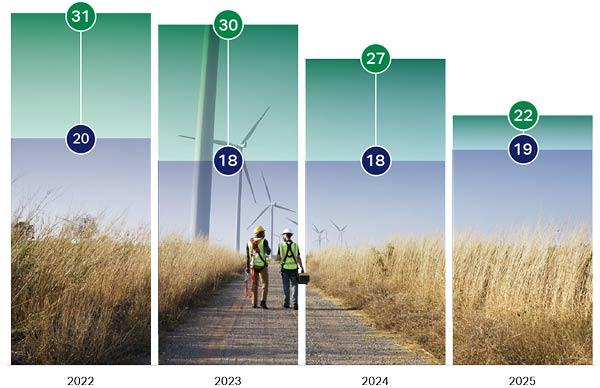
Global engagement by role, managers (top values) vs. non-managers (bottom values), 2022 to 2025. Source: Gallup, State of the Global Workplace 2026
3. AI is making output harder to judge
In late October, TechCrunch reported on a Nielsen survey of 1,700 directors and senior managers across seven countries, commissioned by Monday.com. More than half said it has become harder to evaluate employees' work since adopting AI, because polished output no longer tells you who did the thinking. Some 78% said they have already changed how they evaluate people, and 39% now use AI to help draft performance reviews. Most striking of all, 58% expect to oversee more AI agents than human employees within the next year.
When a beautiful deliverable no longer proves effort, activity metrics lose their meaning. Accountability has to move toward outcomes, and the question becomes which outcomes you measure continuously (KPIs) and which ones you deliberately chase (OKRs).
The 2026 accountability backdrop in numbers
OKRs vs. KPIs: what each one actually measures
A KPI tells you whether something that already works is still working. An OKR tells you what you are trying to change and how you will know you changed it.
Key performance indicators (KPIs) are metrics you monitor continuously against a target or a healthy range. Think churn rate, customer acquisition cost, on-time delivery, first-response time in support, or days to close the books. A KPI has no end date. As long as the process exists, the KPI keeps running, and a miss is a signal that something is broken and needs fixing now.
Objectives and key results (OKRs) pair a qualitative objective (where you want to go) with a handful of measurable key results (how you will know you got there), usually for a single quarter. OKRs are built for change: launching into a new segment, rebuilding onboarding, getting a team to actually use AI. Classic OKR practice sets key results ambitiously enough that landing around 60 to 70% of the target counts as a solid quarter.
The most common mistake is writing key results that are really a to-do list. Ben Lamorte, founder of OKRs.com and a coach who has worked with more than 2,000 leaders, puts it bluntly: "If your key result sounds like a task, you're doing it wrong." His point is that OKRs exist to create impact, not to make people do more things. "Publish five blog posts" is a task. "Lift demo signups from blog traffic from 30% to 40%" is a key result.
If you are also weighing a broader strategy framework, our breakdown of Balanced Scorecard vs OKR shows how the scorecard's four perspectives can sit above both your KPIs and your OKRs.
When KPIs are the better accountability tool
KPIs win wherever a role's results swing with forces outside the person's control, or wherever a miss hurts the business immediately. In those roles, people need a stable, fair floor they can be judged against week after week.
The classic examples are sales and marketing. A quarter can be wrecked by a lost enterprise deal, a seasonal dip, or a search algorithm update, none of which says much about the rep or the marketer. David Kemmerer, Co-Founder at CoinLedger, has watched this play out firsthand. "It really depends on the role and on how predictable the results are," he says. "For teams where effort maps cleanly to outcomes, like engineering, finance or operations, OKRs are fine, because you can plan the path and grade progress fairly. Sales and marketing don't work that way. Their results swing with seasonality, algorithms and buyers you don't control, and OKRs are meant to be so ambitious that hitting 70 percent is a win. If you judge salespeople or marketers only by OKRs, you'll be staring at a wall of missed goals every quarter, and you'd have to fire them all next month. Give them a few hard KPIs they truly own, and put the OKR stretch on top."
The marketing side of that argument has only grown stronger this year. AI answers now sit on top of search results, and publishers have openly blamed falling referral traffic for real damage. Chegg, for example, attributed a steep decline in its traffic and revenue to AI and reduced traffic from Google when it cut nearly half its workforce in late 2025. A content marketer who set an OKR in January to grow organic sessions by 40% may be sitting at 0.2 in October through no fault of their own. Judging that person on efficiency KPIs, such as pipeline generated per dollar or MQL-to-SQL conversion, is both fairer and more useful.
KPIs also shine in performance-driven funnels where small margins decide everything. David Pickard, Global Chief Executive Officer at Phonexa, has compared performance marketing to elite sport. "In our world, a four-point lift in contact rate can decide whether a vertical scales or gets switched off," he says. "Numbers like that have to be KPIs that someone owns every single day, not every quarter. OKRs earn their place when you choose which margins the whole team will fight for next, and they have to span the handoffs. Weak follow-up can undo strong media. If marketing and sales each hit their own number while the lead falls through the gap between them, nobody was really accountable."
The dark side of KPIs
KPIs are not harmless. The moment a number becomes the whole definition of success, people start optimizing the number instead of the result, a pattern economists call Goodhart's law. The Wells Fargo cross-selling scandal, in which aggressive sales targets led employees to open millions of unauthorized customer accounts, remains the textbook warning.
Research backs this up. In their widely cited Academy of Management Perspectives paper "Goals Gone Wild", Lisa Ordóñez, Maurice Schweitzer, Adam Galinsky and Max Bazerman showed that narrow, tightly enforced goals can encourage unethical behavior, excessive risk-taking and tunnel vision. An earlier experiment by Schweitzer, Ordóñez and Douma found that people who fell just short of a specific goal were more likely to overstate their performance than people who were simply asked to do their best. The lesson is not to drop KPIs. It is to choose them carefully, cap their number, and pair them with guardrail metrics like quality, retention or customer satisfaction.
When OKRs are the better accountability tool
OKRs win when the goal is change rather than maintenance, when the path is uncertain, and when several teams have to move together. Product launches, a new market entry, a rebuilt onboarding flow, a culture reset or an AI rollout all fit this profile.
The science behind ambitious, specific goals is some of the most robust in organizational psychology. Edwin Locke and Gary Latham's goal-setting research, built on hundreds of lab and field studies over several decades, found that specific and challenging goals led to higher performance than vague "do your best" instructions in roughly 90% of the studies reviewed. OKRs essentially package that finding into a repeatable quarterly ritual.
There is an engagement dividend too. Gallup's performance management research found that employees who strongly agree they are involved in setting their own goals are 3.6 times more likely to be engaged than other employees. With manager and team engagement sliding globally, a goal process that people help write is not a nice-to-have. It is one of the few levers that pushes engagement up while also driving results.
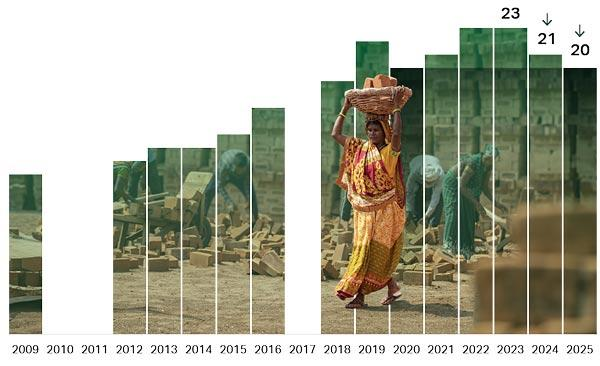
Global employee engagement (% engaged), 2009 to 2025. Source: Gallup, State of the Global Workplace 2026
OKRs fit 2026's biggest change initiative almost perfectly: getting AI to deliver value at the team level. Gallup's 2026 report found that manager-led AI adoption is one of the two strongest drivers of frequent AI use inside organizations. A support team might set an objective like "Make AI assistance part of every customer conversation", with key results such as raising the share of tickets resolved with AI help from 20% to 50% and cutting average handling time by 25%, while the team's existing CSAT KPI acts as the guardrail that must not drop.
Where teams go wrong is pushing OKRs all the way down to every individual. Felipe Castro, OKR coach and founder of Lean Performance, is firm on this point: "Individual OKRs are not for everyone and should never be required." He argues that good OKRs follow good metrics, and for many roles the meaningful indicator belongs to the team rather than the person. That is also why so many OKR practitioners advise keeping OKRs out of bonus calculations. Once pay depends on hitting a key result, people quietly sandbag their targets, and the ambition that makes OKRs useful disappears.
Why the strongest teams run both, on purpose
The real answer to "OKRs or KPIs?" is that each framework is strongest exactly where the other is weakest. KPIs give you stability but no direction. OKRs give you direction but no safety net.
Artem Fedin, the CEO and co-founder of aff.studio, describes the two as a pair that keeps each other honest. "KPIs and OKRs are good precisely because each one covers the other's blind spot," he says. "A KPI will tell you the engine is running, but it will never tell you to build a different engine. An OKR pushes the team toward that change, but on its own it lets people chase the exciting objective while the basics quietly erode. We run them together: the KPIs are the guardrails that cannot break, and the OKRs are the direction we are steering in this quarter. Drop either one and you get a business that is either stable and stuck, or ambitious and fragile."
In practice, the two frameworks feed each other in a simple loop:
- A KPI goes red or plateaus. Customer churn has crept up for three months, for example.
- That KPI becomes the reason for an OKR. The objective might be "Make the first 90 days unforgettable for new customers", with key results on activation, time to first value and 90-day retention.
- Other KPIs act as guardrails. Support CSAT and gross margin must stay inside their healthy range while the team experiments.
- The OKR outcome graduates into a KPI. Once 90-day retention is fixed and stable, it moves onto the dashboard as a permanent health metric, and the team picks its next bet.
This loop also makes performance conversations fairer. KPIs tell you whether someone kept their part of the business healthy. OKRs tell you how boldly and how well they pushed it forward. Keeping those two lenses separate during reviews prevents a missed stretch goal from erasing a year of solid delivery, and it stops a great KPI streak from hiding a lack of growth. If your managers are struggling to rate people consistently across both lenses, a structured session helps. Our guide on how to run a calibration meeting walks through an agenda you can adapt.
Which framework does your team need? A role-by-role guide
The more predictable and controllable a team's results are, the more weight you can put on OKRs. The more a team's results depend on markets, buyers and algorithms, the more its accountability should rest on a small set of KPIs, with OKRs as the stretch layer on top.
How to set up both without drowning in admin
- Sort every metric you track into "health" or "change". Health metrics become KPIs. Anything you are actively trying to move this quarter is a candidate key result.
- Give each KPI one owner and a healthy range. A range (for example, CSAT between 88% and 94%) is easier to manage than a single target and reduces the urge to game the number.
- Cap your OKRs. One to three objectives per team, with three or four key results each, is plenty. If you cannot discuss every key result meaningfully in a single check-in, you have too many.
- Attach guardrails to every objective. Name the one or two KPIs that must not slip while the team pursues the OKR.
- Pay on KPIs and behaviors, not on OKR scores. Keep stretch goals out of bonus formulas so teams stay ambitious and honest.
- Let teams write their own key results. Leadership sets the direction, teams propose how to measure progress, and managers align the two.
- Measure the system, not just the scores. If goal clarity, recognition or manager support are slipping, your framework will fail no matter how well it is designed. Our list of employee engagement metrics covers the leading indicators worth tracking alongside your business KPIs.
The bottom line
Accountability does not come from picking the trendier framework. It comes from matching the measure to the work. Use KPIs to hold people accountable for keeping the business healthy, especially in roles where results swing with forces nobody fully controls. Use OKRs to hold teams accountable for the few changes that matter most this quarter, and keep them ambitious by keeping them away from pay. Then connect the two, so a red KPI triggers the next OKR and every finished OKR leaves behind a new KPI.
In a year of flatter org charts, stretched managers and AI-polished output, that clarity is worth more than any dashboard. Teams that know exactly which numbers they must protect and which ones they are trying to move are the ones that will still be accountable, and still engaged, when the next shift arrives.


