












Ask a generic appraisal question, and you'll get a generic answer. "How did this year go?" or "Any feedback?" tend to produce a few vague lines that don't help anyone — not the employee, and not you when it's time to make decisions about development, growth, or pay. The right questions do more work: they surface real achievements, specific challenges, where someone needs support, and what they want to work toward next.
This guide gives you a library of performance appraisal questions organized by purpose, so you can quickly find the ones that fit what you're trying to learn, and guidance on choosing and combining them into a full appraisal questionnaire.
Best Performance Appraisal Questions to Start With
If you need a starting point rather than the full library, these six give you a solid foundation across the core areas most appraisals need to cover — achievements, goal progress, challenges, strengths, development, and future direction. Use them as-is, or jump to the fuller set below organized by purpose.
- What are you most proud of accomplishing since your last review?
- How would you describe your progress toward the goals set for this review period?
- What challenges made it harder for you to do your best work during this review period?
- Which of your strengths had the biggest impact on your work during this review period?
- What skill would you most like to develop to grow in your role?
- What do you want to focus on or achieve before your next review?
How to Choose the Right Performance Appraisal Questions
Not every appraisal needs every question. Start with what you're trying to understand, then go straight to the relevant category below.
Performance Appraisal Questions by Category
Performance & Achievements
- What are you most proud of accomplishing since your last review?
- Which of your core responsibilities do you feel you perform particularly well?
- Can you share an example of how your work contributed to your team's or organization's results?
- Can you share an example of how you've demonstrated the company's values in your day-to-day work?
Goals & Progress
- How would you describe your progress toward the goals set for this review period?
- Which of your goals contributed most directly to your team's or company's priorities?
- What's the biggest obstacle that affected your progress toward your goals this period?
- What's a goal you achieved that had a real impact on your team or department?
Skills & Competencies
- Which skills have you developed or strengthened most since your last review?
- Where have your technical skills made the biggest difference in your work this period?
- How do you keep your professional knowledge and skills up to date?
- Describe a time you had to learn a new skill or technology to do your job better.
- Can you walk me through a time your problem-solving skills helped you get past a significant challenge?
- How do you make sure your work consistently meets our quality standards?
Behavioral & Situational
- Tell me about a time you navigated a disagreement or challenging situation with a colleague. How did you handle it?
- Can you share a time you took the initiative to solve a problem without being asked?
- Describe a situation where you had to adapt to a significant change at work.
- How do you typically approach and apply constructive feedback from a manager or peer?
- Tell me about a time you led a project. What did you do to make it successful?
Teamwork & Collaboration
- Can you share an example of how you collaborated with others to achieve a shared goal?
- How would you describe the current state of communication within your team?
- What do you do to help keep communication within your team effective?
- What changes would you like to see in how your team operates day to day?
Feedback on Management
- How would you describe the day-to-day support and guidance you get from your manager?
- Do you feel your manager genuinely listens to and values your input?
- How comfortable do you feel giving feedback to your manager?
- What's one thing your manager could do differently to better support you or your team?
- How useful is the feedback you get from your manager throughout the year, not just at review time?
Career Development & Growth
- What skill would you most like to develop to grow in your role?
- Where do you see your career heading over the next few years?
- What career goal would you most like to achieve within this organization?
- Is there a training program or resource that would meaningfully support your growth?
- What could the company do to better support your professional development?
- What's one area you'd like to focus on improving heading into the next review period?
Work Environment & Job Satisfaction
- Are there any specific factors in your work environment that get in the way of your job satisfaction?
- How do you feel about the balance between your work responsibilities and your personal life?
- What's one change that would meaningfully improve your day-to-day job satisfaction?
- What resources or tools would help you do your job better?
- How recognized do you feel for the contributions you make?
Before you wrap up: Is there anything about how we run performance reviews that we could do better?
Performance Appraisal Questions for Evaluating Managers
Use these questions when evaluating employees with people-management responsibilities, with a focus on how they lead, develop, and support their teams. For employee feedback on their manager, see the Feedback on Management questions above.
- Can you share an example of how you've supported a team member in achieving a specific goal?
- Tell me about a conflict that came up within your team. How did you handle it, and what was the outcome?
- How do you prioritize and delegate work across your team when priorities compete?
- How do you make sure your team understands how their work connects to company objectives?
- Describe a time you had to give an employee difficult feedback. How did you approach the conversation?
- How do you approach developing and mentoring the people on your team?
- Tell me about a difficult decision you had to make as a manager. How did you work through it?
- What have you done to build a more collaborative or inclusive environment on your team?
- What signals do you look for to understand whether your team is engaged and supported?
Building a Balanced Appraisal Question Mix
There's no universal formula for how many questions to ask or exactly which mix to use — it depends on the role, the length of the review period, and how much time you've built into the conversation. What matters more than hitting a specific number is making sure you're not just asking several variations of "how did you perform."
A practical starting point:
- One or two on performance and achievements — grounds the conversation in what actually happened.
- One on goal progress — connects the conversation to whatever was agreed on last time.
- One on challenges — helps uncover obstacles or support needs that performance outcomes alone may not reveal.
- One on development or growth — keeps the conversation forward-looking, not just a retrospective.
- One optional addition depending on the role or what you're trying to learn — skills, teamwork, or feedback on management, for example, if that's particularly relevant this cycle.
Adjust from there based on the scope of the appraisal. A shorter check-in might only need two or three questions from the categories most relevant to that period, while a comprehensive annual review — or a role with specific competencies to assess — gives you room to pull from more categories in the library above.
The goal isn't to ask more questions. It's to choose a mix that gives you a genuinely useful picture of the person's work.
Answering These Questions as an Employee
If you're on the receiving end of an appraisal, your answers will be more useful when they include specifics — such as a project, a concrete example, an outcome, or a measurable result where relevant — rather than general claims.
A couple of examples:
Q: What are you most proud of accomplishing since your last review?
Weak: "I've done good work this year and taken on more responsibility."Stronger: "When our CRM migration stalled because the rollout plan didn't account for how reps actually used the old system, I put together a simpler onboarding walkthrough based on their day-to-day workflow, which got the rest of the team migrated over without the delays we'd been seeing."
Q: What skill would you most like to develop to grow in your role?
Weak: "I want to get better at communication."Stronger: "I'd like to get more comfortable presenting technical findings to non-technical stakeholders — I've noticed I over-explain when I'm not sure the audience is following."
A simple way to structure your answers: for performance or achievement questions, walk through the situation, what you actually did, and the result. For development questions, name what you want to improve, why it matters to you or your role, and what support or next step would help.
Building Your Performance Appraisal Questionnaire
Once you've chosen your questions, turning them into something you can actually send out and use takes a bit more than copy-pasting a list. A few things worth getting right before you do:
1. Start with what you're trying to learn. A questionnaire built for a mid-year check-in looks different from one built for a promotion decision. Before you finalize your question mix, be clear on what you actually need to walk away with — that's what should drive which categories you lean on, not the other way around.
2. Consider a mix of question types. Rating-scale questions can make responses easier to compare across employees or review periods, while open-ended questions give people space to explain the context behind their responses. Depending on what you're trying to learn, using both can give you quantitative signals alongside qualitative detail.
3. If you use rating scales, define what each point means. A "4 out of 5" can mean different things to different people unless you spell out what each point on the scale represents. A shared definition helps employees and managers interpret ratings consistently.
4. Match questions to the role. Not every category in the library applies to every position — people-management questions, for instance, aren't relevant to someone without direct reports, and which competency questions matter most can vary by function. Choose questions based on the person's actual responsibilities rather than sending the same fixed questionnaire to everyone.
5. Include space for self-assessment. Consider sharing relevant questions with employees before the appraisal so they have time to reflect and prepare examples. Their responses can then provide a starting point for the discussion.
6. Distinguish core questions from follow-ups. Each core question should be clear and answerable on its own — if it needs a follow-up just to be understood, it's worth rewording. Follow-up questions are still useful, but for exploring an answer in more depth, not for fixing an unclear question.
7. Watch your wording. Avoid double-barreled questions (asking two things at once), leading questions that hint at the "right" answer, and jargon that might not translate across roles or teams.
8. Decide upfront how you'll use the answers. A questionnaire built with the next step in mind — development planning, goal setting, a performance decision, or another relevant outcome — tends to produce more focused questions than one built without that clarity.
Common Mistakes to Avoid
1. Asking overly complex or vague questions. If a question needs jargon or several qualifiers to make sense, it's usually a sign to simplify it. A quick way to check: read the question out loud as if you were asking it in conversation — if it sounds unnatural, it probably needs rewording.
2. Using the exact same questions for every role. A questionnaire that works for an individual contributor won't necessarily fit a manager, and a set built for one department may miss what actually matters in another. Reusing one fixed list across every role tends to produce feedback that's technically complete but not particularly useful for any one person.
3. Collecting feedback without acting on it. An appraisal questionnaire only creates value if something happens after the responses come in — patterns are reviewed, follow-up actions are identified, and relevant next steps are communicated. When employees repeatedly provide feedback without seeing any follow-through, the appraisal process can start to feel like a formality rather than a useful part of their development.
What to Do With Performance Appraisal Responses
Submitting the questionnaire isn't the finish line — the real value of an appraisal shows up in what happens with the answers afterward.
1. Look for patterns, not just individual answers. Once responses are in, review them for recurring themes — a skill gap that keeps coming up across a team, a challenge several people mention independently, or a consistent gap between how someone rates their own performance and how they describe it in their own words. A single response can highlight an individual concern; recurring themes across a team or department can point to areas worth investigating further.
2. Read ratings and comments together. If you're using a mix of rating-scale and open-ended questions, the two are most useful side by side. The comment adds context to the rating, while the rating gives you a consistent signal you can compare across responses or review periods.
3. Flag anything that needs a follow-up conversation. Not every response needs immediate action, but some will raise something worth a direct conversation — a mention of feeling unsupported, an answer that's vague enough to need clarifying, or a development goal that needs more detail before you can act on it. Sorting these out early prevents them from getting lost once the appraisal cycle moves on.
4. Turn relevant findings into concrete next steps. A theme or a specific answer only becomes useful once it's tied to something actionable — a development goal, a change in how work is assigned, a training need, or a conversation with a manager. Vague takeaways ("communication could be better") are harder to act on than specific ones ("this person wants more context before taking on ambiguous projects").
5. Assign ownership. Decide who's responsible for following up on each action — the employee, their manager, or HR — and by when. An action item with no owner tends to quietly disappear.
6. Close the loop. When action is taken based on appraisal feedback, communicate the relevant next steps to the people involved. Even a short update — what was heard, what will change, and what won't change — helps make the follow-through visible rather than leaving employees wondering what happened to their feedback.
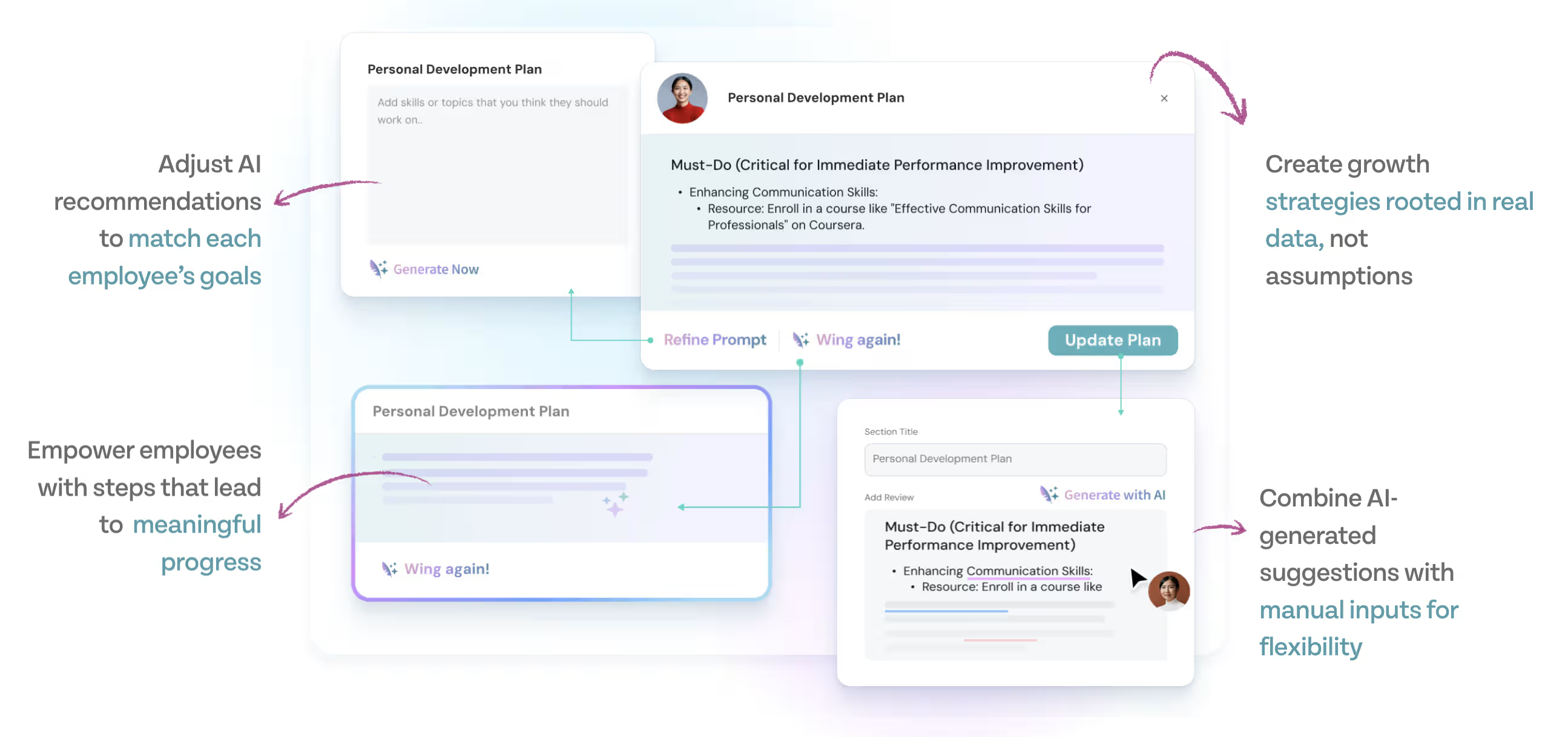
As appraisal cycles grow across teams, keeping responses, development priorities, and follow-up actions organized can become harder to manage manually. ThriveSparrow's Performance module brings that workflow together with Team Analytics, Action Plans, and trend analysis across assessments. For development needs identified during reviews, managers can also use AI-powered Personal Development Plans as a starting point for structured employee growth.
Customer result: greytHR reduced assessment cycles by 80%, from about a month to under a week, using ThriveSparrow.
Final Thoughts
The questions you ask shape the quality of the appraisal, but what happens afterward matters just as much. Choose questions that fit the employee and the purpose of the review, give people room to answer with specifics, and turn what you learn into clear next steps.
As your review process grows across teams, ThriveSparrow Performance can help you keep appraisals, development priorities, and follow-through connected in one place.
Start your 14 day free trial. See how ThriveSparrow Performance works.
.svg)