









Quick answer: Culture Amp and Lattice solve different problems, even though they compete for the same budget. Culture Amp is the stronger pick if your top need is employee engagement, survey data, and benchmarking. Lattice is the stronger pick if your top need is performance management: review cycles, OKRs, and ongoing feedback, with engagement as a secondary feature.
Neither wins on price alone. Culture Amp publishes no pricing at all. Lattice publishes real per-seat numbers for individual products, from $4/seat/month for Engagement, but keeps its bundled "Foundations" package and enterprise deals behind a custom quote. If you need both jobs done equally well, neither tool is a full answer. See the alternatives section below.
Last updated: August 2026. Pricing and review data checked against current G2, Capterra, and each vendor's own pricing page, sources linked throughout.
Prefer to watch? Our 5-minute breakdown of Culture Amp vs. Lattice covers pricing, key features, and exactly where G2 reviews contradict each other.
The Core Difference in One Line
Culture Amp was built for employee listening. That means surveys and engagement data. It also means a People Science team that turns survey answers into useful, benchmarked insight. Lattice was built for something else: performance management. That means review cycles, OKRs, and ongoing feedback. Lattice added engagement surveys later. That part came as a bolt-on.
That history still shapes how each tool feels to use today. Reviewers on G2, Capterra, and independent HR-tech sites all say roughly the same thing.
Culture Amp is the more mature engagement tool. Lattice is the more mature performance tool. That's not just an opinion, either. It's a pattern that shows up in the actual feature-level review scores on both platforms. Both vendors' own comparison pages say their product does everything well. Neither is being fully straight with you. Culture Amp's own "alternatives to Lattice" page says Lattice is "built by engineers. It also says Lattice "lacks the behavioral expertise to drive lasting change. Lattice's own comparison page says Culture Amp's reporting is "disjointed," because it's "built out via acquisition. Both are marketing claims. Each company has an obvious stake in the outcome.
Weight the independent G2 and Capterra data below more heavily than either vendor's self-published page.
Culture Amp vs. Lattice: Quick Comparison
Lattice was also named to G2's 2026 Best Software Awards, as one of the top 50 HR software products. That's a real, dated recognition, announced February 2026, not a marketing claim without a source.
Full breakdowns: Culture Amp review · Lattice review
Where the Reviews Actually Disagree
This is the part most comparison pages skip. It's worth slowing down for. It affects how much you should trust any single source's answer, including this one.
G2's own AI-made comparison summaries contradict each other, depending on which comparison page you land on. That's worth sitting with for a second, because it's not a small discrepancy. One G2 comparison page favors Lattice. It says reviewers found Lattice easier to use, set up, and manage than Culture Amp, and preferred Lattice on support quality.
A different G2 comparison page for the same two products says the opposite. It claims Culture Amp has a "significantly higher G2 Score" and a "robust support system." It also says Lattice's support gets criticized for a "lack of recent feedback and support options." A third G2 comparison view shows Lattice scoring higher than Culture Amp on specific traits: Performance Benchmarking, Employee Development, and Continuous Feedback.
Why the mismatch? G2 builds these summaries per comparison pairing, pulling from different review groups and update windows.
Here's the practical takeaway. Don't trust a single AI-made summary score on its own. Click through to the actual review count. Read a sample of real reviews, especially for the one specific thing (support, setup, a certain feature) that matters most to your decision.
Support quality is genuinely disputed on both sides. Some reviews credit Culture Amp with live chat that's open nearly 24/7 across time zones.
But a Capterra reviewer (a Chief People Officer in financial services, on the platform 2+ years) described a different reality for complex requests. On-demand help is limited to the chat bot. Anything more advanced, like talent grids or calibration, has to go through a CS team whose fixes that reviewer called "super limited."
Lattice reviewers report a similarly mixed picture. Some praise responsive onboarding help. Others note support gets slower once they're live. Neither company has a clean, one-sided reputation on support. Ask both vendors directly for their current SLA and escalation path, instead of trusting review-site averages.
Feature-by-Feature Breakdown
1. Engagement Surveys & Employee Listening
Culture Amp is the stronger tool here, and it's not close. Its People Science team, benchmarking database, and survey customization are the product's core strength. This is what Culture Amp was built around from day one. Lattice Engagement is a real module, pulse surveys, eNPS, action plans, and benchmarking are all there, but it was added to the platform later. Several reviewers say the engagement side feels less polished than Lattice's performance tools. If deep survey science is your top need, Culture Amp is the more direct fit.
2. Performance Reviews & OKRs
Lattice is the stronger tool here. Custom review cycles (quarterly, twice a year, project-based), OKR tracking that flows from company to person, and ongoing feedback are core to the product, not an add-on. Culture Amp Perform covers standard reviews and goal tracking, but several reviewers describe its OKR and goal tools as more basic than a dedicated performance platform, fine for teams with simple review cycles, less so for teams that want detailed control.
3. Recognition
Neither platform treats recognition as a core module. If peer recognition is something you need, both will feel thin. You'd likely want a dedicated tool (Kudos, ThriveSparrow, Vantage Circle) or a platform where recognition is built in from the start.
4. AI Features
Both added AI over the last two years, but Lattice has gone further recently. Culture Amp offers an AI coach aimed at helping HR interpret engagement data, summaries, theme detection, that kind of thing. Lattice now ships an "AI Agent," which it positions as more than a chatbot: it's built to act on workforce data, answer employee questions directly, and coach managers in the moment, not just summarize reports. Lattice has also added MCP (Model Context Protocol) support, letting other AI tools connect to Lattice data directly. Reviewers on both sides say AI saves admin time either way, but Lattice's AI investment is currently broader in scope. Don't let this break a tie on its own, the deeper platform difference (engagement vs. performance focus) still matters more for most buying decisions.
5. Analytics & Benchmarking
Culture Amp's benchmarking database is one of the most praised strengths across independent reviews. It's built from a large dataset that spans many industries. Lattice's analytics are strong for performance and goal data specifically, but it doesn't have the same kind of benchmarking layer for engagement scores. Lattice's own customer stories cite specific results: GoCardless reports lifting review participation from 62% to 100%, and Bark reports 800+ active goals with full employee adoption. These come from Lattice's own marketing pages, not independent review data, so weigh them accordingly.
6. Integrations & HRIS
Culture Amp connects with common HR systems, but doesn't have a built-in HRIS of its own. Lattice used to sell one. It doesn't anymore. Lattice's HRIS access ended July 31, 2026, and payroll access ended earlier, on March 31, 2026. Lattice announced this in November 2025 and has fully exited both products to focus on performance management, engagement, career development, and compensation. If you were evaluating Lattice as an HRIS-plus-performance combo, that option no longer exists. Lattice's own pricing page confirms its current five product areas, none of which include HRIS or payroll.
7. Support & Setup
Both platforms take real setup work. This isn't a quick win with either one. Plan for a multi-week rollout, a dedicated internal owner, and, given the disputed reviews above, a direct conversation with sales about current support terms, rather than trusting either company's review-site reputation alone.
8. Pricing Comparison
Neither vendor makes this simple, but the type of unclear pricing is different.
Culture Amp: No pricing published anywhere, not on the website, not in a brochure. You go through a full sales process (discovery call, demo, quote) before you see a number. The reported minimum yearly spend is roughly $4,500, and per-user pricing has been reported anywhere from $5–$9/user/month at basic tiers to $118–$122/user/month at the top tier, depending on modules and company size.
Lattice: Partly published. Lattice's own pricing page lists real per-seat numbers for each base product. Engagement from $4/seat/month, Goals & OKRs from $8/seat/month, Performance from $10/seat/month, and $13/seat/month for its most popular "Foundations" bundle (Performance + Goals & OKRs + Analytics + AI Agent). Compensation (+$6/seat/month) and Grow (+$4/seat/month) are add-ons. Lattice enforces a $4,000 minimum annual commitment regardless of headcount, and full enterprise deals are custom-quoted.
What this means in practice: if getting a real number without a sales call matters to you, Lattice gets you closer, you can anchor on published per-seat prices starting at $4/seat/month for Engagement alone. Culture Amp needs a conversation before you see any number at all.
One more thing worth flagging, in the same spirit as the review-data conflict: G2's own tracked "Entry-Level Pricing" field for Lattice still lists $11/person/month. Lattice's current pricing page shows $4/seat/month as its cheapest standalone product.
That's not a typo on either side. It likely means G2's figure reflects the price of a typical starting bundle rather than the single cheapest add-on. Don't treat either number as the Lattice price. Check the specific product mix you'd actually buy on Lattice's own pricing page before budgeting.
Can You Use Both at Once?
Some companies do this, usually while switching from one to the other. But most find it wasteful past the short term.
Why? The two tools don't share a data model.
Engagement data collected in Culture Amp doesn't feed into Lattice's performance view, or the other way around. You end up connecting insights by hand that one platform would show automatically.
If you're seriously thinking about running both long-term, not just during a switch, that's usually a sign. Look at a platform built to do both from the start.
Which Should You Choose?
Here's the short version, based on everything above.
- Choose Culture Amp if employee engagement, survey science, and benchmarking are your top need, and performance management is a secondary concern or already handled elsewhere.
- Choose Lattice if structured reviews, OKR-to-performance links, and ongoing feedback are your top need, and you're fine with engagement as a secondary layer, not the main event.
- Choose neither, and look at a unified alternative, if you need engagement and performance to genuinely work together, same data, same dashboard, no manual matching between two tools. That's the gap both companies' histories create: Culture Amp added performance later, Lattice added engagement later, and reviewers on both sides say the "added later" module is less polished than the original core product.
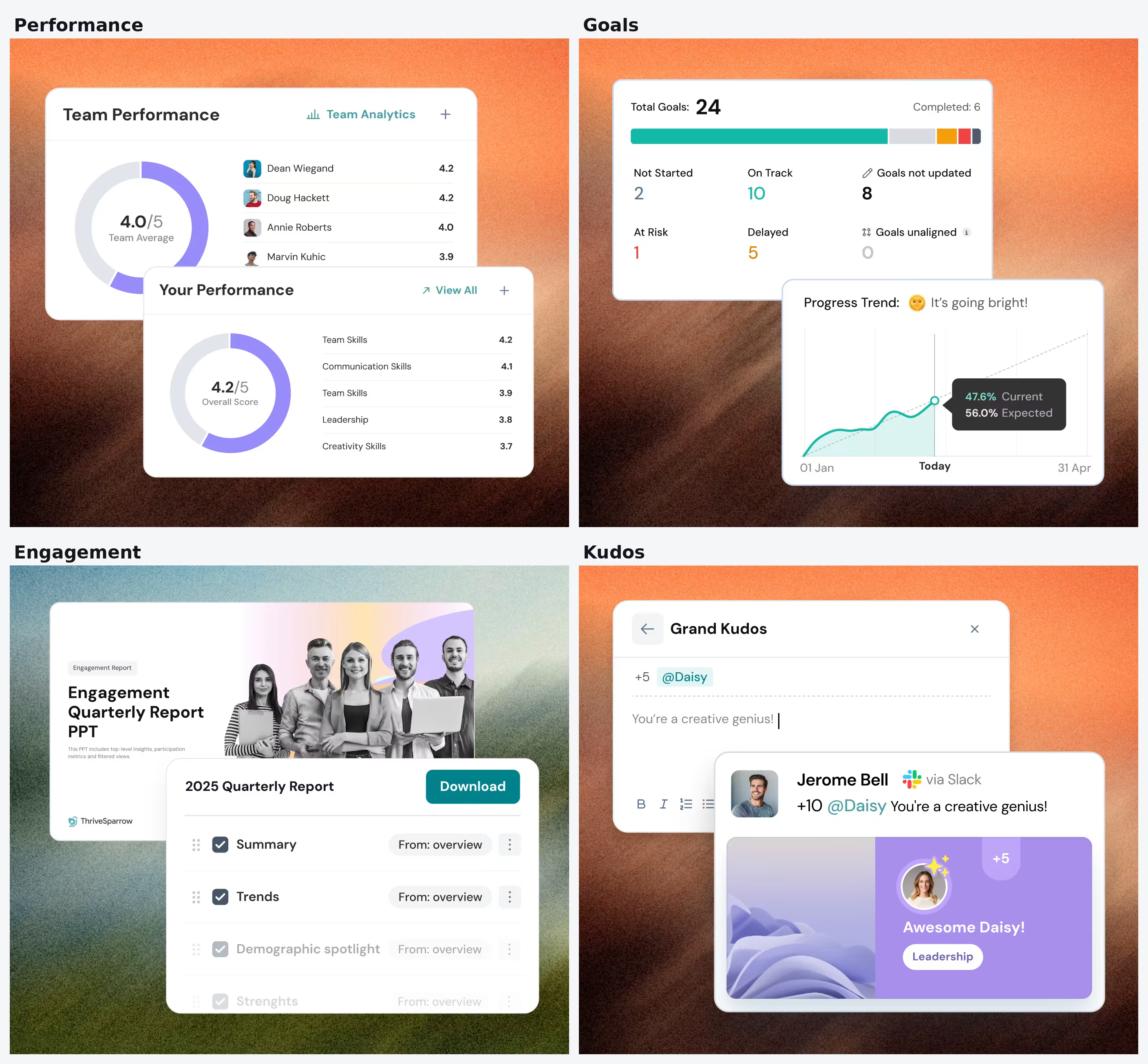
For that third case, ThriveSparrow is worth a look. It covers engagement, performance, recognition, and goals in one place. Pricing is clear. It starts at $2/user/month. There's a 14-day free trial too, and it doesn't have either company's "bolted-on" problem.
See the details here: ThriveSparrow vs. Culture Amp and ThriveSparrow vs. Lattice. Want the full field? See our Culture Amp alternatives guide for all 17 tools, across every budget and priority.
Start your 14-day ThriveSparrow trial, no credit card needed. Prefer to talk it through first? Request a demo instead.
.svg)
Frequently Asked Questions
1. Is Lattice actually easier to use than Culture Amp, or is it the other way around?
It depends which source you check, and that's worth knowing before you trust any single rating. G2's own comparison pages give conflicting answers to this exact question, depending on which comparison page is pulled, one favors Lattice on ease of use and setup, another favors Culture Amp. Read a sample of recent, specific reviews for the exact thing you care about, rather than trusting one aggregate score.
2. Which has better customer support, Culture Amp or Lattice?
Neither has a clean, one-sided reputation. Culture Amp offers live chat that's open nearly 24/7 for first-line support, but reviewers report that complex requests (calibration, talent grids) get sent to a CS team some call slow to fix things. Lattice reviewers report a similarly mixed picture, strong onboarding support for some, slower response after launch for others. Ask both vendors directly for their current SLA, rather than trusting review-site averages.
3. Which is cheaper, Culture Amp or Lattice?
Lattice is more upfront about pricing. That's not quite the same as cheaper. It publishes real per-seat prices for individual products, from $4/seat/month for Engagement up to $13/seat/month for its most popular bundle, though the full enterprise platform is custom-quoted. Culture Amp publishes no pricing anywhere and needs a full sales process to get a number, with a reported minimum spend around $4,500/year. If you need a real number before you'll even take a call, Lattice gets you closer to one.
4. Should I choose Culture Amp or Lattice if I only care about employee engagement?
Culture Amp. Its survey science, benchmarking database, and People Science team are built for engagement measurement specifically. Lattice's engagement module is real, but it was added after the platform's core performance-management build, and several reviewers say it's less mature than Culture Amp's.
5. Should I choose Culture Amp or Lattice if I only care about performance reviews and OKRs?
Lattice. Custom review cycles, OKR tracking, and ongoing feedback are core to the platform. Culture Amp's Perform module covers standard reviews, but reviewers generally describe its OKR and goal tools as more basic than a dedicated performance platform.
6. Can I run Culture Amp and Lattice together?
Some companies do, usually while switching from one to the other. Most find it wasteful past the short term, because the two platforms don't share a data model, engagement data from Culture Amp doesn't automatically feed into Lattice's performance view. If you're planning to run both long-term instead of just during a switch, look at a unified platform instead.
7. Is there a cheaper alternative that does what both Culture Amp and Lattice do?
Yes, platforms built to cover engagement and performance in one connected system, instead of bolting one discipline onto the other, exist at a lower and clearer price. ThriveSparrow is one, starting at $2/user/month with a 14-day free trial. See the full alternatives comparison for others.
8. Which is more established Culture Amp or Lattice?
Culture Amp is the older company, founded in 2010; Lattice came later. But Lattice has built up roughly three times as many G2 reviews (4,000+ vs. Culture Amp's 1,539+) despite the shorter history, which reflects both companies' growth in the performance-management category specifically, not overall company age.
9. Does Lattice still offer a built-in HRIS?
No. Lattice fully exited the HRIS and payroll market in 2026. Payroll access ended March 31, 2026, and HRIS access ended July 31, 2026, following a November 2025 announcement. Lattice now focuses on five product areas: Performance and Goals/OKRs, Engagement, Grow (career development), Compensation, and AI features. Check Lattice's own pricing page for its current lineup.
10. What's the real difference between reading each vendor's own comparison page vs. independent reviews?
Both vendors' self-published "vs." pages are marketing content written to win the comparison, not neutral analysis. Culture Amp's page criticizes Lattice's "engineering-first" build; Lattice's page criticizes Culture Amp's "disjointed" reporting. Independent review-site data (G2, Capterra) is a more reliable signal, with the one caveat that even G2's own AI-made summaries can conflict, depending on the specific comparison page you land on.