










Two managers each have a strong senior analyst. One calls her analyst "ready now" for a team lead role. The other says his analyst needs another year or two. Nobody knows whether the two analysts are different or whether the two managers are using different yardsticks.
Talent calibration exists to answer that question. This guide covers what it is, how it differs from performance calibration, who should be in the room, and a five-stage process you can run in your next cycle. It ends with a template and a way to check whether the process is working.
What Is Talent Calibration?
Talent calibration is a structured session where managers and HR review employees' potential, readiness, and current capabilities against shared criteria. The goal is consistent decisions about succession, development, and retention across teams. It looks forward to what someone could do next. Performance calibration looks back at how well someone did their job.
In practice, talent calibration usually happens during or right after a talent review. Leaders bring evidence about each person and discuss it against agreed definitions of potential and readiness. They leave with decisions they can defend: who is ready for a bigger role, who needs development, and where the team has gaps.
What does calibration mean in HR?
In HR, calibration means checking that different managers apply the same standard when they evaluate people. The word comes from measurement, where you calibrate an instrument so it gives the same reading as every other instrument. In a calibration session, the instruments are managers. The goal is that equivalent employees get equivalent assessments, regardless of who manages them.
Is talent calibration the same as a talent review?
Not quite, although many organizations use the terms interchangeably. A talent review is the broader process of assessing your workforce for performance, potential, and future needs. Talent calibration is the step inside that process where leaders compare and align their individual assessments. You can hold a talent review without calibration, but the results will reflect each manager's personal yardstick.
Talent Calibration vs Performance Calibration
Performance calibration aligns ratings of what employees have already delivered. Talent calibration aligns judgments about what employees could do next. Both rely on evidence and shared standards. They answer different questions, feed different decisions, and usually happen at different points in the year.
The order matters. If performance ratings aren't consistent, any judgment about potential built on top of them inherits the same inconsistency. Settle the ratings first. Our guide to performance review calibration covers that process in detail.
Why Talent Calibration Matters
Talent calibration matters because potential is a subjective judgment, and subjective judgments drift between managers. Performance can be checked against goals and results. Potential is a forecast, so it leaves more room for personal impressions, and those impressions shape who gets promoted, developed, and paid more.
Research shows the cost of leaving potential ratings unchecked. The study below was published in the American Economic Review in February 2026 (Benson, Li and Shue, "Potential" and the Gender Promotion Gap):
- It covered 29,809 management-track employees at a large retail chain.
- Women received substantially lower potential ratings than men, despite higher performance ratings.
- Differences in potential ratings accounted for about half of the gender promotion gap.
- The women went on to outperform their male colleagues.
That finding doesn't mean you should stop assessing potential. It means potential ratings need the structure that calibration provides:
- Consistent succession decisions. Leaders compare candidates against the same readiness definition, not whoever argues hardest.
- Earlier visibility into gaps. Calibrating across teams shows which critical roles have no ready successor.
- Better-targeted development. Development budgets go to the people and skills the business needs next, rather than to whoever asked first.
- Decisions you can explain. When an employee asks why they weren't put forward, the manager can point to agreed criteria and documented evidence.
Who Should Be in a Talent Calibration Session?
A talent calibration session needs the managers who know the employees, a facilitator who owns the process, and a senior leader who can make final calls. Keep the group small enough that every manager can speak about their people. For most organizations, that means six to eight people per session. Split larger populations into several sessions by function or level.
Small companies with one layer of management can still calibrate. Have two or three managers review each other's assessments of people they've worked with, and have the founder or HR lead facilitate.
How to Run Talent Calibration: A Five-Stage Process
Run talent calibration in five stages: define the criteria, gather evidence, discuss by segment, decide and document, then act. Each stage has a clear output, so you can check the process is on track before the next stage starts.
Stage 1: Define the criteria
Agree in writing what potential and readiness mean before anyone assesses anyone. Vague labels such as "high potential" drift quickly between managers. Useful definitions describe observable behavior. For example, "ready now" could mean the person already handles most of the next role's responsibilities without close support.
Tie the criteria to your competency or leadership framework. Share them with managers at least two weeks before the session.
Stage 2: Gather evidence
Ask each manager to prepare a short evidence summary for every direct report. Use an identical format for everyone, so the discussion compares like with like:
- Performance ratings from the last two or three cycles
- Two or three specific examples of the person working above their current level
- 360-degree feedback themes, where collected
- The employee's stated career interests
- The manager's proposed placement and a one-line reason
HR should review the summaries a few days before the session. Send back any summary that relies on adjectives instead of examples.
Stage 3: Discuss by segment
Discuss people in groups rather than alphabetically. A practical sequence is:
- Top talent: people who may be ready for bigger roles soon
- Emerging talent: people who could be ready with the right development
- Steady performers: people you need to keep and grow in their current roles
- People who are struggling or haven't been assessed
Starting with the clearest cases sets reference points for the group. You can check later placements against those anchors.
Stage 4: Decide and document
For each person, the group confirms or adjusts the proposed placement and records the reason. When the group changes a placement, note what evidence changed the decision. That record makes the decision defensible later and stops the same debate from repeating next cycle.
Documentation is where manual calibration usually breaks down, because notes end up split across a spreadsheet, a slide deck, and someone's notebook. In a performance tool with a calibration workflow, such as ThriveSparrow, each score change is saved with the calibrator's reason, so the audit trail builds itself during the session.
Stage 5: Act and follow up
Turn every placement into an action with an owner and a date:
- Add successor candidates to succession planning slates for named roles.
- Give emerging talent an individual development plan tied to the gap the group identified.
- Schedule a retention conversation within 30 days for critical people at risk of leaving.
A talent calibration that ends with a grid but no actions has only produced a snapshot.
Running this process in spreadsheets?
ThriveSparrow builds calibration into your performance review. Set up calibration groups, choose which questions to calibrate, record every change with a reason, and lock final scores when the panel agrees. See how calibration works in ThriveSparrow →
.svg)
A Sample Talent Calibration Meeting Agenda
A 90-minute talent calibration meeting can cover 15 to 25 employees if managers send their evidence in advance. Adjust the individual review block to fit your numbers.

How the 9-Box Grid Fits Into Talent Calibration
The 9-box grid is a common way to display the results of talent calibration. It plots each employee on two axes, performance and potential, which creates nine boxes ranging from low on both to high on both. Calibration is the discussion that decides where each person sits. The grid is the picture of the outcome.
The grid is only as reliable as the potential ratings behind it. The American Economic Review study above examined potential ratings of this kind, which is a good reason to treat placements as hypotheses to test rather than permanent labels. For a full walkthrough of the model, see our guide to the 9-box grid.
Talent Calibration Examples
The scenarios below are illustrative. They show the kinds of decisions a well-run talent calibration session produces.
Example 1: Two "ready now" candidates for one role
Two managers each nominate a senior analyst as ready now for an open team lead role. Against the shared definition, only one analyst has already led a project with other people reporting to them. The group places that analyst as ready now. The other analyst is placed as ready in 12 months, with a development plan built around leading a cross-team project.
Example 2: A strong performer with no interest in managing
A top-rated engineer has been placed in the high-potential box every year. Her evidence summary shows she wants to stay on a technical path. The group removes her from the management succession slate and adds her to a senior technical track. Without calibration, she might have been pushed toward a role she didn't want.
Example 3: A critical role with no successor
Calibration shows that no one in the finance team is within two years of being ready to replace the controller. The group records the gap. HR takes ownership of planning either an external hire or an accelerated development path before the next cycle.
How to Reduce Bias in Talent Calibration
Calibration can reduce bias, but a poorly run session can also add new bias. Calibration meetings are meant to hold managers to consistent standards. Research covered in Harvard Business Review in January 2024 found they can introduce bias in several ways, and that small changes, such as teaching participants what bias looks like, can help. (HBR: How Calibration Meetings Introduce Bias into Performance Reviews)
Four biases come up often in talent calibration:
Build two further checks into the agenda:
- Run an anonymized final review. Before closing the session, look at the full set of placements with names removed. Scan them by gender, tenure, location, and team for patterns the evidence doesn't explain.
- Check the pay and promotion impact. Before acting on the placements, check whether the resulting promotions and development spending would widen any existing pay gap.
For more on specific biases, see our guides to performance review bias and the halo and horn effect.
How to Communicate Talent Calibration Outcomes to Employees
Tell employees what the calibration outcome means for their development, not which box they're in. A label such as "medium potential" rarely helps anyone and can hurt motivation. The next step, and the reason for it, is what employees can use.
Brief managers before they speak to their teams:
- Share the direction, not the grid. For example: "We see you moving toward a team lead role, and here's what we'd like you to build first."
- Explain changes with evidence. If a manager's proposal changed in the session, the manager should explain the criteria rather than blame the committee.
- Offer a route to respond. Give employees a way to add information before the next cycle, such as career interests their manager didn't know about.
This is easier when the tool keeps calibration behind the scenes. In ThriveSparrow, employees only see their final score, never whether it changed during calibration, so the manager can own the conversation.
Linking the conversation to a real plan makes it more credible. Career pathing shows employees what "ready" looks like for the next role.
Talent Calibration Template
If you'd rather not maintain a spreadsheet, ThriveSparrow Performance keeps the same information inside the review: the baseline score, the calibrated score, the reason for each change, and the final locked result.
How to Tell Whether Talent Calibration Is Working
Judge talent calibration by what happens after the session, not by whether the session ran on time. Track these measures across cycles:
- Succession coverage: the share of critical roles with at least one successor who is ready now or ready soon
- Internal fill rate: how often open senior roles go to people identified in calibration
- Placement accuracy: whether people rated high-potential go on to succeed in bigger roles
- Regretted attrition: how many people identified as top talent leave within a year
- Pattern checks: whether placements differ by gender, tenure, or location in ways the evidence doesn't explain
Placements that rarely change during sessions suggest calibration has become a rubber stamp. Placements that change constantly suggest your Stage 1 criteria need tightening.
How to Run Talent Calibration in ThriveSparrow
ThriveSparrow builds calibration into the performance review itself, so you don't need a separate tool or spreadsheet. You can switch calibration on at any point during a live review. Managers and HR then work from the same ratings, evidence, and decision history.
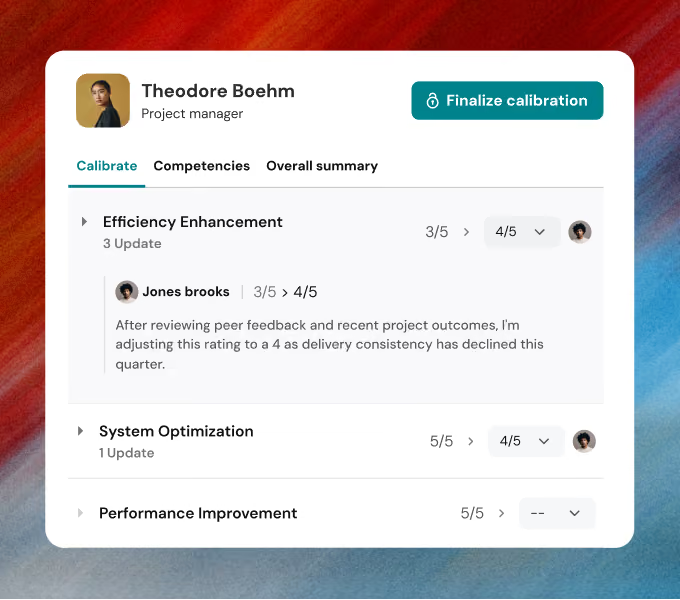
Here is how the five stages map to the product:
What to Do Before Your Next Talent Calibration
Start with Stage 1. If your managers can't describe "ready now" the same way, no amount of meeting structure will fix the outcome. Write the definitions, share them early, and ask for evidence in one format.
Then decide where the process will live. Spreadsheets work for one team. Once you're calibrating across several teams, you need one place for baseline scores, change reasons, and final locked results.
Book a ThriveSparrow demo to see calibration groups, scoped questions, and finalization running inside a real performance review.
- You choose the baseline. Calibration can start from the manager's score, which is the default, or from the department head's score, depending on who owns assessments in your organization.
- You calibrate what drives decisions. Limiting calibration to your potential or competency questions keeps sessions focused on succession and development instead of revisiting every rating.
- Employees never see whether their rating was calibrated. Final scores reach employees through their manager as the standard result of the review.
If your next review cycle is coming up, book a demo to walk through setting up calibration groups for your own teams.
Talent Calibration FAQ
1. How often should talent calibration happen?
Most organizations run talent calibration once or twice a year, usually after the performance review cycle closes. Critical roles or fast-changing teams may need a shorter quarterly check-in so succession slates stay current.
2. How long should a talent calibration session take?
A well-prepared talent calibration session covering 15 to 25 employees usually takes about 90 minutes. If sessions regularly run past two hours, split them by team or level so the final cases get the same attention as the first.
3. Should employees know they were discussed in talent calibration?
Employees should know that calibration is part of your review process and what criteria it uses. They don't need to know whether their individual score changed. Sharing the final outcome and the development plan behind it is more useful than showing the before-and-after. Some performance tools, including ThriveSparrow, keep calibration changes hidden from employees for this reason.
4. Is forced distribution part of talent calibration?
Forced distribution isn't a required part of talent calibration. Forced distribution makes managers fit people into fixed percentages, which pushes the group to compare people with each other rather than with the criteria. Use distribution patterns as a sanity check after the session, not as a quota.
5. Who should facilitate a talent calibration session?
An HR business partner or another trained facilitator should run the session, ideally someone who doesn't manage any of the employees being discussed. The facilitator's job is to hold the group to the criteria and the evidence, not to decide placements.