

15Five was built on a small, likeable promise: 15 minutes for an employee to write a weekly update, and 5 minutes for their manager to read it. That habit is where the name comes from (VentureBeat).
If you're reading this, chances are you like that promise too. What you really want to know is whether it holds up for your team, at your headcount, once the demo is over.
Short answer: 15Five is worth it if you want weekly check-ins and manager coaching at the center of your team's routine. You'll also need to be comfortable with an annual contract. Its core manager tools sit in the $11 Perform plan, not the $4 Engage plan. If you mainly need reviews and OKRs, compare a few options first.
In this review, we'll walk you through verified 2026 prices, what each plan really includes, and what users love and struggle with. A quick note before we start: ThriveSparrow makes performance software too. That's why every price and quote here links to a source you can check, and why we've included a section on when 15Five is the better pick.
What is 15Five?
15Five is a performance management platform built around one habit: a short weekly check-in between each employee and their manager. Its 1-on-1s, reviews, goals and recognition all build on that rhythm, with engagement surveys alongside.
It sells three plans (15Five pricing, checked Nov 18, 2026):
- Engage: engagement surveys and analytics
- Perform: check-ins, 1-on-1s, reviews, OKRs and High Fives recognition
- Total Platform: Engage and Perform together
More recently, 15Five has added a layer of AI. 15Five acquired the AI coach Kona in January 2025. In February 2026 it launched Amaya, an AI assistant that answers questions about your people data, alongside a new Insights Dashboard. It also offers a 15Five MCP connection, so the AI tools your team already uses can work with 15Five data, limited to what each person can already see.
The idea is easy to like. The real test is how it holds up once your managers use it every week, so let's start with what users say.
15Five ratings at a glance
The good news first: users rate 15Five highly on G2, Capterra and Gartner, and there are plenty of reviews behind those scores.
Ratings checked November 19, 2026.
High scores tell you people are broadly happy. What they don't tell you is which plan those people pay for, or what starts to wear thin after a year. That's what the next few sections cover.
What does 15Five do well? Key features
Here's a quick tour of each feature: the problem it solves and the plan you'll need for it.
1. Weekly check-ins
Without a regular touchpoint, managers can hear about problems weeks too late. A weekly check-in helps close that gap with a short form. It opens with a Pulse question about how the employee felt at work since the last check-in, then covers priorities, goal progress and any questions the manager or admin adds. Check-ins are due on Fridays by default, and admins can change how often they run. This is 15Five's signature feature, and it's in Perform and Total Platform only. Source (15Five Help Center).
2. 1-on-1s
Both people add talking points to a shared agenda before the meeting, and items from check-ins can land there too. Anything left unchecked carries over to the next 1-on-1, comments included. A talking point bank helps managers prepare, much like a ready list of one-on-one meeting questions, and 1-on-1s connect to Google Calendar and Slack. Source (15Five Help Center).
If 1:1s are the main thing your managers use, note that on 15Five they sit in the $11 Perform plan. ThriveSparrow takes a different approach: one-on-ones are free on every plan, with agendas, shared notes and carried-over action items. [CTA #2]
3. Performance reviews (Best-Self Review®)
15Five calls its review feature the Best-Self Review®. A cycle can mix self, manager, peer and upward reviews for full 360-degree feedback, and admins can run optional calibration sessions using a Talent Matrix.
Check-in history is available as context, so managers don't have to write from memory or fall into recency bias. 15Five recommends quarterly or twice-yearly cycles rather than one annual review.
4. OKRs and goals
Teams set objectives and key results, then update progress inside their weekly check-ins. OKRs are part of Perform, not Engage.
5. Engagement surveys
Engage runs engagement surveys and turns the results into team-level analytics. This is the only part of 15Five available on the $4 plan.
6. High Fives recognition
High Fives let anyone thank a colleague publicly, a simple form of peer-to-peer recognition, and admins can tag them with company values. They come with Perform, so there's no separate recognition tool to buy.
7. AI: Kona, Amaya and AI-assisted reviews
Kona's Meeting Assistant preps managers before a 1-on-1 and writes the recap afterward. AI-Assisted Reviews draft reviews from the goals, feedback and 1:1 notes already in 15Five.
Amaya is available to HR admins only and requires the Perform or Total Platform plan. Kona's notetaker and coach are priced as add-ons, covered in the pricing section.
8. Integrations
An HRIS connector syncs employee data from systems including Workday, ADP, BambooHR, UKG, HiBob, Paylocity and Paycor. 15Five also connects with Slack, Microsoft Teams, Google Meet and Jira.
Notice a pattern? Almost everything managers use day to day lives in Perform, which makes pricing the most important part of your evaluation.
How much does 15Five cost in 2026?
15Five costs $4, $11 or $16 per user per month, billed annually, depending on the plan (15Five pricing, checked Nov 18, 2026). The plan you need depends on one question: do you want weekly check-ins?
Which 15Five plan includes check-ins?
Engage is surveys only. If you're looking at 15Five to build manager habits, you're really choosing between Perform and Total Platform.
What do 15Five add-ons cost?
The AI and coaching features are priced on top of your plan:
- Kona Notetaker: $2 per employee per month
- Kona Coach: $19 per manager per month
- Manager content: $49 per manager per month
- Live coaching: $399 per credit
- Compensation: $9 or $11 per user per month
How do you buy it?
You can request a 14-day free trial through a form on 15Five's site, or book a demo. The plan buttons on the pricing page lead to the demo, and contracts are billed annually.
For scale: 200 employees on Total Platform is $38,400 a year at list price, before any add-ons. Try your own numbers below.
Weighing 15Five’s $16 plan?
ThriveSparrow’s Full Platform: reviews, OKRs, surveys and recognition for $9 per employee per month.

Of course, price is only half the story. The other half is whether your people keep using it.
What do users like about 15Five?
Most of the praise comes back to one thing: the weekly conversation between employees and their managers.
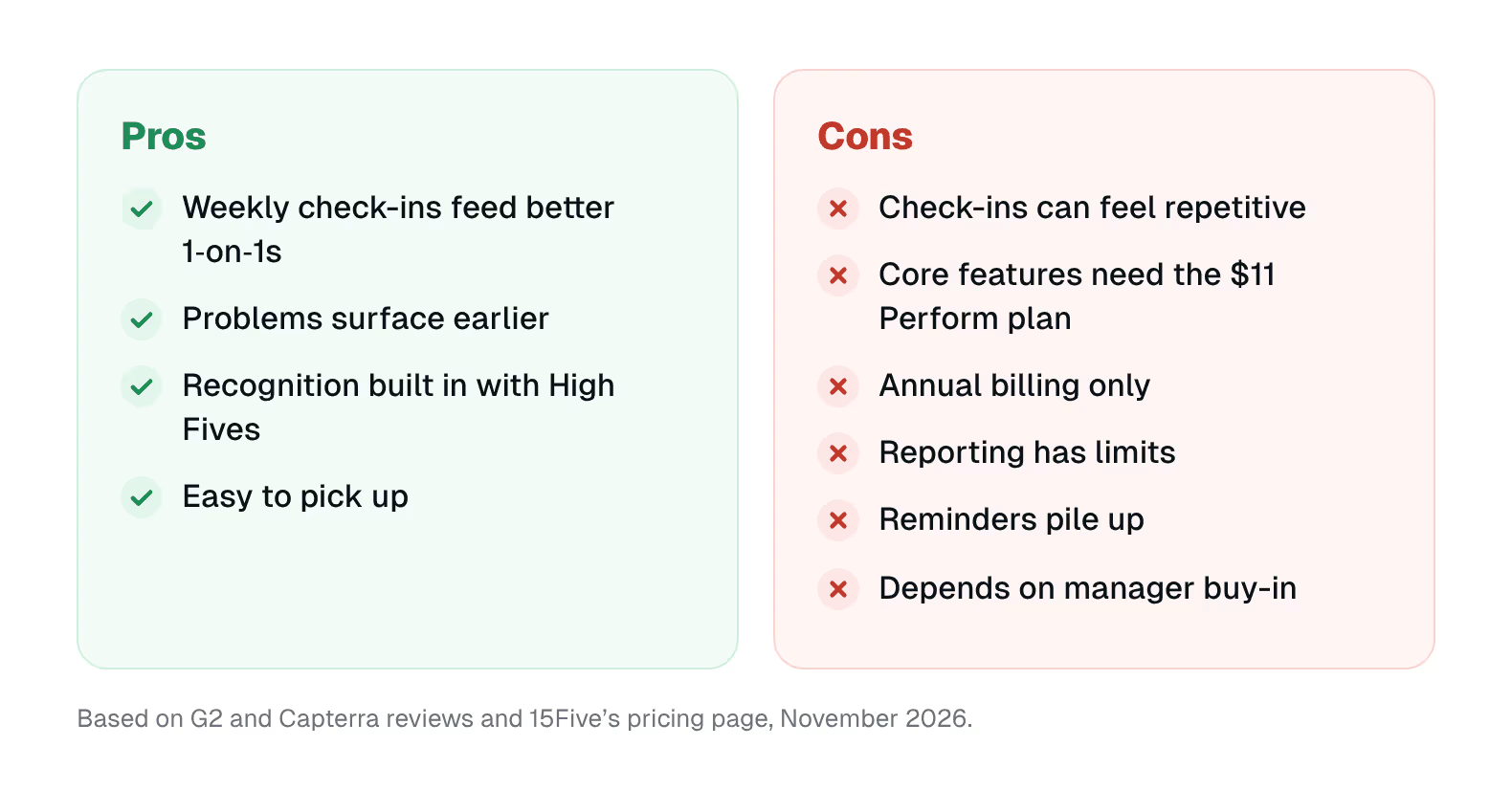
1. Check-ins feed better 1-on-1s: A G2 reviewer in November 2026 said check-ins take 10 to 15 minutes and "feed directly into our shared 1-on-1 agenda" (G2). Blockers come up in the next meeting, not at review time.
2. Problems surface earlier: A Capterra reviewer in November 2026 said the weekly team pulse helps them spot issues earlier than an annual review would (Capterra).
3. Recognition is built in: Another Capterra reviewer said High Fives make it quick and visible to celebrate a colleague's win, and that check-ins make formal review cycles faster (Capterra).
4. It's easy to pick up: Ease of use is the most-mentioned strength in G2's review summary, ahead of goal setting and communication (G2).
That same weekly rhythm is also where the frustration starts.
What do users complain about?
The complaints are consistent, and most trace back to two things: the weekly cadence and the way plans are packaged.
1. Check-ins can turn into a chore: A weekly habit only helps if it stays fresh. Otherwise, it runs into the same survey fatigue that sinks long questionnaires. Several G2 reviewers say check-ins start to feel repetitive or like admin during busy weeks, and limited customization is the most common con in G2's review summary (G2). A Capterra reviewer made the same point about busy schedules (Capterra).
15Five lets admins add questions from a built-in question bank and change how often check-ins run. Rotating the questions keeps check-ins honest, whichever platform you use.
2. Core features need the $11 plan: Teams that start on Engage find that check-ins, 1-on-1s and recognition aren't included. Moving to Perform nearly triples the per-user price, from $4 to $11.
3. Annual billing only: Contracts are billed annually, so you commit for a year before you know whether managers will keep the habit going. One Capterra reviewer in February 2026 wished for shorter terms, such as six months (Capterra).
4. Reporting has limits: Reporting issues appear among the cons in G2's review summary, and users ask for more flexible dashboards and easier exports (G2). A Capterra reviewer in November 2026 called reporting frustrating (Capterra).
5. Reminders pile up: G2's review summary notes that the volume of reminders can feel overwhelming. Reviewers suggest adjusting notification settings early (G2).
6. It depends on manager buy-in: A Capterra reviewer in November 2026 named heavy reliance on manager buy-in as the main drawback (Capterra). In our view, a check-in tool is only as good as the manager who replies. If managers skim and move on, employees stop writing. Gallup's research backs this up: managers account for at least 70% of the variance in employee engagement.
Put the praise and the complaints side by side, and it becomes much clearer who 15Five is right for.
Who is 15Five best for?
15Five fits teams that want a weekly habit, not just a yearly review. If you're making that shift, our guide to moving from annual reviews to continuous performance management is a useful companion.
15Five is a strong fit if:
- You want every manager running weekly check-ins and 1-on-1s
- Your managers will reply to check-ins, not just read them
- You want AI coaching for managers and can budget for add-ons
- You're comfortable committing to an annual contract
15Five is a weaker fit if:
- You only need annual or twice-yearly reviews and OKRs
- Your budget is built around the $4 Engage price
- You want month-to-month or shorter contract terms
- Weekly check-ins would feel like extra admin for your team
Set up your first review cycle today
Start a 14-day free ThriveSparrow trial yourself, before you ever talk to sales.
If you found yourself nodding along to the second list, it's worth seeing what else is out there.
15Five alternatives to consider
If 15Five doesn't feel like quite the right fit, you have good options, and our roundup of the best performance management software covers even more. Here are the three tools buyers most often weigh it against, and where each one shines.
1. ThriveSparrow
ThriveSparrow is built for teams that want the full performance toolkit without paying for features they won't use. You can start with a single module from $2 per employee per month, or get everything in the Full Platform for $9 (ThriveSparrow pricing). One-on-ones and continuous feedback are free on every plan.
- Price: $2–$5 per module; Full Platform $9 per employee/month, billed annually
- How to try it: 14-day free trial, self-serve signup
- Best for: growing teams that want reviews, goals, surveys and recognition in one place. See how it stacks up in ThriveSparrow vs Lattice and ThriveSparrow vs Culture Amp

2. Lattice
Lattice is a solid choice for teams focused on structured reviews, goals and career growth. It charges $4 to $13 per seat per month, with a $4,000 minimum annual agreement.
- How to try it: demo or free interactive tour
- Best for: larger teams that want a broad talent suite. Our Lattice pricing guide breaks down the costs
3. Culture Amp
Culture Amp is best known for engagement surveys and people analytics. It doesn't publish prices, so you'll need to request a quote.
- How to try it: demo
- Best for: teams where engagement surveys are the top priority. Read our full Culture Amp review
15Five vs the alternatives at a glance
Prices per person per month, billed annually, checked November 19, 2026. Lattice adds a $4,000 minimum annual agreement.
Why ThriveSparrow is a stronger fit for many teams
Yes, we're biased. So here's the case, built on facts you can check.
1. You only pay for what you use. On 15Five, the everyday manager tools sit inside an $11 plan. With ThriveSparrow, you can start with Performance at $5 or Goals at $3 and add more as you grow.
2. 1-on-1s and feedback cost nothing. Shared agendas, notes and carried-over action items are free on every ThriveSparrow plan (One-on-Ones). On 15Five, the same routine needs Perform.
3. The full suite costs less. ThriveSparrow's Full Platform covers reviews, OKRs, engagement surveys and recognition for $9 per employee per month, versus $16 for 15Five's Total Platform. For 200 employees, that's $21,600 a year instead of $38,400 at list price.

4. AI is included, not an add-on. AI Coach, AI Sentiment Analysis, AI development plans and AI Highlights all come with the Full Platform. On 15Five, Kona's coach and notetaker are priced separately.
5. The results are real. EnAble India cut its review cycle from about 14 weeks to 5–6, APL Logistics saw 75% more employees complete their self-evaluations, and Uniting cut admin time by 75% (ThriveSparrow pricing).
You can start today. Sign up for the 14-day free trial yourself and set up your first review cycle before you ever talk to sales. Start your free ThriveSparrow trial.

To be fair to 15Five: if a structured weekly check-in ritual and Kona's AI coaching are the heart of what you need, 15Five is built around exactly that.
For deeper head-to-heads, see our four-way comparison of Lattice, 15Five, Culture Amp and Leapsome, plus Lattice vs 15Five, Culture Amp vs 15Five and 15Five vs Leapsome.
What should you ask in a 15Five demo?
Ask about plan limits, add-ons, renewal terms and data export. These are the details a feature tour skips, and the ones that shape your bill in year two.
Here are ten questions worth taking into the call:
- Which plan do we need for weekly check-ins, 1-on-1s and High Fives? On the public pricing page, these sit in Perform and Total Platform, not Engage.
- What will our total be with the add-ons we'd actually use, such as Kona Notetaker, Kona Coach, manager content or Compensation?
- Do any of those add-ons carry a minimum spend?
- Which plan's features does the 14-day free trial include?
- Is annual billing the only option, and what's the renewal notice period?
- Is there a cap on price increases at renewal?
- Should we buy Engage and Perform separately, or Total Platform? At list price, Engage plus Perform is $15 per user versus $16 for Total Platform.
- What happens to permissions and history when we reassign a manager?
- Can we see engagement scores and review status by manager in one report, without exporting?
- Can we export all review, goal and check-in history as a CSV, including after we cancel?
Final verdict: is 15Five worth it?
Yes, if the weekly check-in is the habit you're buying. 15Five does that rhythm better than most, and reviewers say it turns routine updates into real conversations. Budget for Perform at $11, not Engage at $4, and add Kona if you want AI coaching.
Look elsewhere if you mainly need reviews and goals, need shorter contract terms, or want 1:1s without paying for a performance plan. If that sounds like your team, compare 13 15Five alternatives by price and fit.
Either way, take the demo checklist above into the call. The best decision is the one where nothing in the contract surprises you.
Rather test it yourself than book a demo?
Set up a review cycle in ThriveSparrow on your own. EnAble India cut its review period from about 14 weeks to 5–6.
FAQ
1. Does 15Five have a free trial?
Yes. 15Five offers a 14-day free trial, which you request through a form on its trial page. The plan buttons on its pricing page lead to a demo instead, so use the trial page if you want hands-on time before talking to sales.
2. What companies use 15Five?
15Five says it serves more than 3,000 companies and 250,000 employees. Customers shown on its site include HubSpot, Udemy, BetterUp, Credit Karma and the American Red Cross. On G2, mid-market companies of 51 to 1,000 employees write most of its reviews (G2).
3. Is 15Five good for small businesses?
It can be. Pricing is per user, so a 30-person team on Perform pays $3,960 a year at list price. The bigger question for a small team is whether weekly check-ins fit how you already work, or add a routine you don't need.
4. What is a 15Five Best-Self Review?
Best-Self Review® is 15Five's name for its performance review feature. A cycle can include self, manager, peer and upward reviews, with optional calibration. 15Five designed it as a strengths-based alternative to annual reviews and recommends running it quarterly or twice a year (15Five Help Center).
5. What is AMAYA in 15Five?
Amaya (styled AMAYA on 15Five's site) is 15Five's AI assistant, launched in February 2026 with a new Insights Dashboard. HR admins ask questions in plain language and get answers drawn from their 15Five data, within their existing permissions. It requires the Perform or Total Platform plan (15Five Help Center).